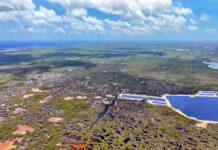
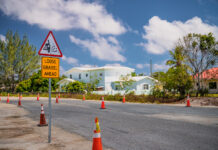
There are seven engineering solutions to the Savannah flooding problem, but not one of them will work on its own, area residents heard at a public meeting on Wednesday night.
Consultant engineer Steve Bolt listed the possible solutions in three combinations, citing the advantages and limitations of each. He then took questions and comments from some of the more than 70 people crowded into the Savannah Primary School hall.
One man drew applause when he suggested that the National Roads Authority and consultants take their proposal to insurance companies. The companies could contribute to the cost because flood mitigation would lessen their pay-outs on claims.
No specific costs were mentioned. Mr. Bolt did say, ‘We’re talking about seven-figure projects.’
The first combination of engineering solutions includes coastal armouring, raised road elevations and vertical drainage wells as needed.
The second alternative combines a flood wall, culverts, creating a catchment basin in the Savannah Gully, a swale or channel along Hirst road to North Sound and vertical drainage wells.
The third combination includes coastal armouring, flood wall, a culvert, a basin in the Savannah Gully with drainage wells, and other wells as needed.
Each of the three possibilities was designed with two purposes in mind: to minimise the volume of water that would come ashore from a Category 2 storm surge and then to drain that water as efficiently as possible.
Mr. Bolt acknowledged limitations of each engineering tool on its own.
Raised road elevations, for example, will help traffic but may complicate access to properties.
A flood wall will limit storm surge, but it requires easements.
Drainage wells are site-specific and care would have to be taken that they did not interfere with a freshwater lens.
Culverts under a road allow traffic to pass, but do not limit inland flooding.
Swales or roadside channels could drain the water into the North Sound, but would require pumps and lift stations because development has interrupted the natural slope of the land.
A floodwater basin may require additional land and there is a lack of feasible locations.
Coastal armouring limits pounding wave action and can be constructed quickly. It has been used elsewhere to protect docks and jetties, but not in situations like Cayman’s ironshore bluff. Mr. Bolt said engineers were enthusiastic about investigating this method.
In describing coastal armouring, he asked the audience to imagine giant jacks like the jumping jacks they might have played with as a child. These forms interlock.
One man asked about using the old quarry near Pedro Castle as a catch basin. Mr. Bolt said the problem would be piping the water to that area.
Many of the questions were about a flood wall. People wanted to know where it would be how long and how tall it would be, what it would cost.
Mr. Bolt said height might be four to seven feet depending on location. Location would be determined after further investigation, including a field survey, subsurface exploration and drainage analysis.
Everyone in attendance was asked to fill out a questionnaire, choose an alternative and/or suggest other alternatives.
The project team wants to be able to make its recommendation to the NRA and government by the beginning of the new year so that funding can be put in place, Mr. Bolt told residents.
Speaking with the Caymanian Compass afterwards, Mr. Bolt said no further public meeting had been announced but he would be in favour of it if the NRA thought it appropriate.
He emphasised that the directive from Minister for Works Arden McLean had been for the entire programme to be transparent to the public. The NRA is working on a website to keep the public informed, he said. He was receiving personal e-mail from residents all the time, he added.
Related Videos