The Cayman Islands Government introduced a moratorium on the establishment of any new dolphinariums effective immediately on Friday.

Dolphins jump over tourists at the Xcaret eco-park near Cancun, Mexico. On Friday, the Cayman Islands Government announced a moratorium on any new dolphinariums. |
However two companies already in advanced stages of establishing such facilities in Cayman will be allowed to do so.
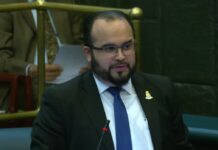
Minister of Tourism, Environment, Investment and Commerce Charles Clifford said the Cabinet had recently approved the 2006 Revised Dolphin Policy after a one-year review in consultation with local authorities, including the Departments of Agriculture, Environment, Environmental Health, Planning and the Water Authority.
Mr. Clifford said few topics can provoke such heated debate as the dolphin issue.
‘While the government does not aim to sway personal preferences in relation to dolphin facilities, the Government takes very seriously its responsibility to protect human and animal welfare while also safeguarding the environment, economy and reputation of the Cayman Islands,’ he said.
The two dolphinariums grandfathered into the new policy – Dolphin Cove and Dolphin Discovery – will still be required to ‘continuously satisfy the ongoing regulatory requirements, including those governing water discharge, land use, public health, animal welfare and environmental impacts,’ Mr. Clifford said.
Another dolphinarium that was proposed – The Living Seas – has not actively pursued the venture.
‘The Living Seas is not in a position to apply at this point because of the moratorium,’ Mr. Clifford said.
The dolphin policy mandates new legislation to consolidate the various separate laws that regulate dolphinariums.
Should the moratorium ever be lifted, the policy also stipulates that new dolphinariums must operate under a closed-loop system that does not empty any water from the dolphin holding area into the sea, and that only dolphins bred in captivity can be kept at the facility.
In addition, it is possible the terms of operation could change for Dolphin Cove and Dolphin Discover, if and when they open.
‘The dolphin policy contains a very broad provision which allows the Government to review and amend its regulatory policies in light of future environmental awareness, or as a result of ongoing monitoring, even where a permit has already been obtained,’ Mr. Clifford said. ‘For example, if ongoing monitoring suggests that additional mitigation is necessary, this could result in the requirement of a closed-loop system, even for an operator which is grandfathered under the 2006 revision policy framework.’
Such a change would be made with reasonable notice and in consultation with existing dolphin operators, Mr. Clifford said.
The Department of Agriculture, through Chief Agricultural and Veterinary Officer Dr. Alfred Benjamin, has issued two import permits for dolphins, Mr. Clifford said. Those permits are subject to receiving the required health certification for the animals within 10 days of their expected arrival, as well as the presentation of valid CITES certificates from the management authority of the exporting country.
‘At present, no dolphins have been imported into the Cayman Islands,’ he said.
The Water Authority issues discharge permits for the discharge of effluent from land-based facilities into the ground or territorial waters.
‘To date, the Authority has dealt with two applications for a discharge permit from dolphin facilities; both facilities proposed to discharge their effluent into the marine environment,’ Mr. Clifford said.
The Water Authority issued a discharge permit to Dolphin Cove in August 2005 after it had completed an anti-degradation study that focused on the effects of nutrients in the marine environment.
‘The objective was to keep the turtle grass in the area healthy and avoid nuisance algae blooms,’ he said.
The study concluded the uptake rates by the existing turtle grass beds near the dolphin lagoon would prevent the nuisance algae.
Dolphin Discovery, on the other hand, has not carried out its anti-degradation study, and the Water Authority has not yet issued it a discharge permit.
Billy Adam of Keep Dolphins Free Cayman Islands said it was disappointing that the new policy contained many gaps. He said the policy contained empty and unproven statements.
‘Anything they say, if it is not verifiable, is not trusted,’ he said, noting that successive government had not been honest about the dolphin issue.
‘Where are the laws? Where are the regulations? Where are the studies?’ Mr. Adam asked.
Mr. Clifford said a White Paper outlining the provisions of the policy would be table in the Legislative Assembly shortly.
Related Videos