Plans to help tourist properties go green, to update the National Environment Policy, and to establish a National Conservation Council were environmental projects announced for the Cayman Islands this week.

Mr. Clifford |
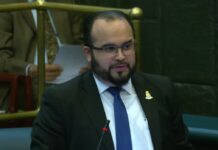
Speaking at the Chamber of Commerce luncheon Wednesday, Minister for Environment Charles Clifford said the 2002 National Environment Policy is currently being updated.
He also announced that the National Conservation Bill is to be introduced, in the form of a White Paper, in the March meeting of the Legislative Assembly.
This existing legislation has been sitting dormant for the past decade. In her speech during the luncheon, Chamber President Angelyn Hernandez noted the need for the government to pass this legislation.
Mr. Clifford outlined that key elements of the legislation include the establishment of a National Conservation Council, which shall be responsible for the proper administration of the law. ‘The Council will consist of representatives of various government agencies, private sector organisations and members of the public.
‘DoE Enforcement Officers will be referred to as Conservation Officers and their powers and authorities are prescribed in the law. The new law also provides mechanisms for the nomination, designation and management of protected areas and species.’
This new legislation also provides the framework for environmental impact assessments, he said, in order to ensure that environmental consequences are examined as part of the decision making process.
Mr. Clifford noted that the amendments to the Marine Conservation Law were a precursor to the National Conservation Bill, providing a framework for the regulation of watersports activities. The law was passed in December and the regulations will be considered by Cabinet in March, with the aim of them coming into effect in June of this year.
Mr. Clifford also noted that Cayman has been a party to the Convention in International Trade in Endangered Species of Flora and Fauna since 1976 and in 2004 the Endangered Species Trade and Transport Law was passed by the Legislative Assembly. ‘This new law is not yet in effect as new mechanisms and systems are needed to regulated trade in CITES listed species such as black coral, conch and hard corals,’ he said.
But last month, UK CITES experts assisted the government in designing suitable local mechanisms that will enable Cayman to comply with its international commitments, and workshops will be held later in the year to train local Customs officers and border control agencies in the requirements of this legislation.
Mr. Clifford then turned to sustainable development. In 2006, Mr. Clifford’s Ministry supported the creation of a Sustainable Development Unit within the Department of Environment, whose primary focus will be to guide the creation and implementation of a National Sustainable Development Strategy, a framework for which is currently being developed.
It is envisaged that the NSDS will contain four priority policy areas, he said: sustainable consumption and production; climate change and energy, natural resource protection; and sustainable communities.
The DoE has enlisted the expertise of Professor Tim O’Riordan, one of the UK’s Sustainable Development Commissioners, to help guide the process.
Addressing the issue of climate change, the Minister said, ‘Climate change is widely recognised as the most serious environmental issue facing the world.’
The most effective response, he said, is to substantially reduce emissions of greenhouse gas. ‘Locally there are many challenges and opportunities ahead for government, private enterprise and civic society in meeting these obligations.’
The Minister also noted that in September 2005 he confirmed with the UK Government the intention to join their instrument of ratification of the United National Framework Convention on Climate Change and its Kyoto protocol.
Turning to sustainable tourism, Mr. Clifford said, ‘This government understands that a healthy and natural environment is the bedrock and cornerstone of our tourism industry.’
He announced a planned joint initiative between the Departments of Environment and Tourism for improved environmental performance in the tourism sector.
Environmental audits are to be done for the tourist accommodation sector in which they will review occupancy, water consumption, wastewater generation, electricity consumption and compare the property’s environmental performance with industry benchmarks. Recommendations will then be made, with the ultimate goal for the properties to achieve Green Globe 21 Certification.
Mr. Clifford noted the DoE’s progress with the Darwin Initiative and conservation plans for species and native flora.
He also noted the consolidation of the Brac Parrot Reserve as a significant achievement.
Mr. Clifford publicly thanked Director of DoE, Ms Gina Ebanks-Petrie, along with her team.
Related Videos