Hurricane researchers, who forecast seven more storms this season, have flubbed the past two annual estimates because of unusual El Nino and La Nina weather phenomena in the Atlantic and Pacific Oceans.

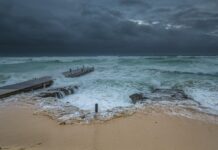
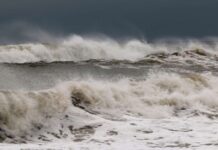
Hurricane Felix brought out surfers last week as the extremely dangerous Category 5 hurricane passed nearly 400 miles south of Grand Cayman. Photo: James Dimond |
The predictions reflect variables that make this kind of weather forecasting ‘more art than science,” said Eric Blake, a hurricane specialist at the National Hurricane Center in Miami. Two of the nine Atlantic hurricanes predicted already have occurred for the season that ends Nov 30. Last year, five storms emerged after nine were anticipated.
Both of those storms brought wind, rain and surf to the Cayman Islands.
Hurricane Dean, which passed a little more than 100 miles south of Grand Cayman 19 August brought tropical storm force winds and maximum gusts of 64mph. Rainfall was minimal but several areas of the island – South Sound and Savannah in particular – received some flooding and storm damage.
Hurricane Felix brought out surfers last week as the extremely dangerous Category 5 hurricane passed nearly 400 miles south of Grand Cayman.
Insurers and energy companies, the industries with the most at stake from damaging storms, say the forecasts don’t affect their business plans. Until a tropical storm takes shape in the mid-Atlantic, there is no way to determine a hurricane’s potential intensity or predict whether it may target populated areas and threaten to cause millions of dollars in losses, analysts say.
‘The number of hurricanes are forecast for the entire Atlantic Basin,” said Roger Read, an energy analyst at the investment firm of Natixis Bleichroeder Inc. in Houston. ‘Even if you’re accurate about predicting the numbers, saying specifically whether one will hit Texas or Florida has too many variables in the weather systems.”
The season last year may have seemed uneventful because the five storms that arose stayed in the Atlantic, Read said.
‘As soon as a tropical depression forms in the middle of the Atlantic, gasoil traders are watching it,” Read said. ‘You don’t start worrying until it’s in the Caribbean.”
Only when hurricane watchers signal danger do companies like Exxon Mobil Corp. and Chevron Corp. protect drilling rigs and platforms in the Gulf of Mexico, where 30 per cent of US oil is produced.
While Hurricane Felix reached landfall along the Nicaraguan coast last week, it missed oil production and refining areas in the southern Gulf of Mexico and refineries along the U.S. Gulf Coast.
Forecasters overestimated last year’s season, when 10 lower-intensity tropical storms and five hurricanes formed. The researchers underestimated 2005’s record-breaking season, when Hurricane Katrina caused more than $41.1 billion in insured losses in New Orleans and along the US Gulf Coast. There were so many tropical storms that year forecasters had to name some using the Greek alphabet for the first time.
This season, which formally began 1 June, may yield 13 to 16 named storms and as many as nine of them may reach hurricane strength, said the National Oceanic and Atmospheric Administration’s National Hurricane Center. So far seven storms have occurred and two, Dean and Felix, became hurricanes, striking Central America with winds above 160 miles (257 kilometers) an hour.
‘We haven’t even hit the peak of the hurricane season yet and we’ve already seen two top-level storms,” said the Hurricane Center’s Blake. `It’s premature to say we’ve over-forecast this year.” The peak usually comes around 15 September, he said.
Late-forming El Nino conditions are blamed for the fact that last year’s hurricane season was more benign than forecast, said Philip Klotzbach, a forecaster at the hurricane centre of Colorado State University in Fort Collins. The centre advises meteorologists, businesses and government officials in hurricane-prone areas.
An El Nino is when Pacific Ocean temperatures turn abnormally warm, igniting storms around the Asia-Pacific rim and curbing stormy weather in the Atlantic. El Nino usually forms in April or May.
‘We base our forecasts on history,” said Klotzbach. ‘We make the assumption that the future is going to behave similarly to the past, and that didn’t happen last year. An El Nino formed rapidly in September and crushed all Atlantic activity.”
Forecasters base predictions on measurements of upper atmosphere wind, water temperature, surface pressure, and the chance of either an El Nino or a La Nina, a different type of climate phenomenon. In a La Nina, cool water generates easterly winds and alters upper atmospheric conditions, aiding formation of tropical storms and Atlantic hurricanes.
On 6 September, the US Climate Center, which operates under the National Weather Service, said the two weather phenomena would occur about when they are supposed to this year.
‘This is a typical year and we’re seeing La Nina conditions forming,” Klotzbach said. ‘That historically leads to a more active hurricane season.”
Hurricane Katrina hit in 2005, during a ‘freak season,” Blake said, the most active since 1933. Hurricanes Katrina, Rita and Wilma all reached top level intensity and killed more than 1,500 people.
‘It was an anomaly year and probably won’t happen again for many years to come,” he said.
After shouldering $5.67 billion of 2005 storm costs, Allstate Corp., the second-largest home insurer, retreated from coastal areas, raised rates and tripled its budget for reinsurance.
Allstate, based in Northbrook, Illinois, said its losses would be less than $2.17 billion if the ferocity of the 2005 season, with three major hurricanes, is repeated.
`The industry would probably like to see a midsized storm this year that would help them take up rates,” said Joshua Shanker, an insurance stock analyst at Citigroup Inc. in New York.
Investor confidence is boosted as the season goes on, said energy analyst Adam Stevens, of Velite Capital Management in Houston. Energy and insurance stocks will begin increasing after today, he said.
‘Insurance and energy investors are saying, `The peak’s on me, and every day makes it less likely”’ that a major storm will make landfall, Stevens said.
Related Videos