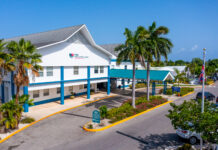
The Public Accounts Committee heard widely conflicting testimony last week concerning the matter of the Royal Watler Cruise Terminal construction project.
Some of the testimony – which went unchallenged by Port Authority management – contradicted statements made in the auditor general’s report on the matter released in January 2006.
That report suggested the project was ‘poorly planned and managed’ and that the procurement activities did not secure the best value for money. The report also said it found strong evidence of overcharges.
However, witness testimony in the first PAC proceeding open to the public in years refuted some of the claims made in the auditor general’s report.
Change in scope
Perhaps the biggest discrepancy between the auditor general’s report and the testimony of witnesses concerned a large change in scope of the project between when it was bid and when it was built.
The auditor general said he did not see evidence of significant revision to the projects that would have led to the cost increases over the amounts bid.
Burns Conolly of the Burns Conolly Group, which served as project manager for the Royal Watler Cruise Terminal, disagreed.
‘One of the major problems with the auditor general’s report is that it does not recognise the change of scope,’ Mr. Conolly told the PAC. ‘The project added one acre of reclaimed land… and the upland buildings went from 9,000 square feet to 18,000 square feet. I think the auditor general has to revisit his report solely on this basis.’
Mr. Conolly said other changes in scope that occurred after bidding included paving the site with concrete instead of asphalt; adding 240 of steel piling to accommodate a change in dock design; the addition of another ramp; and the addition of an elevator.
‘The variations on the contract were completely due to change in scope,’ Mr. Conolly said. ‘The contractor was asked to do more, or in some cases less.’
Misener Marine Construction Inc, which undertook the marine works on the project, also testified before the PAC. Its general counsel Cabell Acree also told the PAC about the change in scope.
‘The scope increased substantially and so did the price in relation to the original contract,’ Mr. Acree said.
In particular, Misener was told to alter the dock design to allow for the reclamation from the sea of an additional acre of land. This required additional sheet piling and increases in the amount of backfill needed to reclaim the land.
The Burns Conolly Group submitted a 75-page report to the PAC in response to the auditor general’s report and Misener submitted a 14-page report of its own.
Speaking on Saturday, Auditor General Dan Duguay said Mr. Conolly should have made his contentions about change in scope known before.
‘If [Mr. Conolly] had come to us with a 75-page document, we would have taken it into consideration,’ he said. ‘We believed we knew all the salient information about the project.’
Mr. Duguay said his office had made some 60 to 70 changes in his report because of information provided by Mr. Conolly during the original investigation.
Change order documentation
One of the issues raised during the proceedings concerned the method change orders were made.
Port Authority Deputy Director Clement Reid said it was a standard construction business practice to have change orders done on forms and then signed. He said it did not happen with the Royal Watler project,
‘No one could show you one signature requesting a change,’ he said.
Mr. Conolly said there had been email communications back and forth concerning the changes.
‘Are you now saying you didn’t want the changes?’ he asked Mr. Reid.
‘No, what I am saying is there was no change order procedure employed,’ he responded. ‘There were no specific instructions to proceed with the change; we were asking about the change.’
Mr. Duguay said he hoped lessons are learned about the usage of change orders on government projects.
‘There are two things for certain on a project of this size,’ Mr. Duguay said. ‘One is that there will be changes. The other is that if those changes aren’t clearly documented, there will be disputes.’
Mr. Duguay said he has seen problems with change orders on construction projects many times in his career.
‘It’s not just a paperwork thing,’ he said. ‘As long as there are random papers floating around out there, there’s always the possibility of disputes.’
Tendering process
The auditor general called the tendering process ‘flawed’ in his report because the award of the contract to Misener for the marine works and Hurlstone Limited for the upland works did not go through the Central Tenders Committee.
Instead, a Technical Assessment Committee was formed from the Port Authority Board along with Burns Conolly.
The Port Authority management was asked by the PAC why the CTC was not used. Mr. Reid said the initial tenders did in fact go before the CTC.
‘However, the CTC had difficulty deciding because they were comparing different things.’
Port Director Paul Hurlston said the bids were not ‘apples to apples’.
‘Some were bidding on the CGMJ [Ltd.] drawings that were 75 per cent complete and some where bidding on their own changes.’
Mr. Conolly said the CGMJ drawings were only supposed to be used for guidance for bidders, but since the project was being tendered on a design-build basis, contractors were free to offer their own design solutions.
‘Design-build submissions are all unique,’ said Mr. Conolly. ‘That is the fundamental thing missed in the auditor general’s report.’
When the original tender was issued, it included remedial works to the adjoining cargo pier, which was to be lengthened, strengthened and repaired from storm damage. Because there was some urgency to get those works under way, Mr. Hurlston said the CTC approved the award of the cargo dock work to Misener. They then asked that the Royal Watler part of the project be re-tendered.
Instead, what Mr. Conolly called a Technical Assessment Committee and the auditor general called a Tenders Assessment Committee was formed to deal with the Royal Watler bids already received.
PAC Chairman Osbourne Bodden said it was permissible not to use the CTC if a Tenders Assessment Committee was used instead and there was justification for doing so.
At one point, the TAC recommended to the Port Authority Board of Directors that the joint venture of McAlpine (Cayman) Ltd. and Arch & Godfrey be awarded the contract.
Mr. Hurlston said that recommendation was not acted on because it was decided another assessment should take place.
Mr. Conolly then sent a questionnaire to three of the four remaining bidders. As a result of the answers to the lengthy questionnaire, Mr. Conolly produced an Analysis of Tenders Report that recommended the Misener/Hurlston Ltd. joint venture.
The Port Authority Board ultimately accepted that recommendation and awarded the contract to Misener and Hurlston Ltd.
One of the criticisms in the auditor general’s report was that the process was not formally documented prior to the bidding exercise.
Related Videos