The risk of a woman developing breast cancer by the age of 70 is one in eight, but that risk is considerably higher if a woman has a mutated gene inherited from her mother or father.
Those genes are known as BRCA1 and BRCA2, usually pronounced by medical professionals as “braca”.
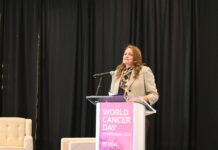
According to a presentation by oncologist Dr. Troy Gatcliffe at a cancer health fair hosted by the Cayman Islands Cancer Society on Saturday, of patients with breast cancer who have the genetic mutation making them more susceptible to cancer, 52 per cent have BRCA1, 32 per cent have BRCA2 and 16 per cent have other mutations as yet unidentified.
Explaining to a room of about 45 people who attended his talk, Dr. Gatcliffe showed how every person has two chromosomes – if one becomes damaged, then the person has a backup gene to protect them. If both are damaged, a tumour will ensue. However, people with the inherited BRCA genetic mutations are born with one chromosome already damaged.
Those genes can be inherited from both the mother’s and father’s side of the family, said Dr. Gatcliffe, so it is important that people know the family medical history on both sides.
If there is breast cancer on both sides of the family, the chances of a person developing breast cancer is “very high”, the doctor said.
He outlined a number of “red flags” that both men and women should look out for – as men can get breast cancer too – that would prompt them to get tested for the BRCA genetic mutations.
These include:
Two first-degree relatives (parent, sister, daughter) with breast cancer, one of whom was diagnosed before age 50
Three or more first- or second-degree relatives with breast cancer, diagnosed at any age
Both breast and ovarian cancer in the family
A first-degree relative with cancer in both breasts
Two or more relatives with ovarian cancer
One relative with both breast and ovarian cancer
A male relative with breast cancer
The Caymanian Compass reported earlier this week that a study of breast cancer in the Cayman Islands and three other countries will be undertaken to determine the genetic characteristics of Caribbean women with breast cancer.
Currently, testing for BRCA1 and BRCA2 are not done in Cayman and women travel off island to have them done. Women who undergo these tests or others that reveal they are likely to develop a disease due to an inherited predisposition are advised to get genetic counselling, said Dr. Sook Yin, medical director of the Cayman Islands Cancer Society.
Research in the Bahamas carried out by University of Miami researchers showed that 23 per cent of women with breast cancer there had the BRCA1 gene, compared to between 3 and 5 per cent of American women with breast cancer. Similar studies will be carried out in Cayman, Dominica, Barbados and Trinidad and Tobago to determine the prevalence of the genes in the local population of women who have had breast cancer.
Another group of women who are predisposed to the disease are Ashkenazi Jews. Research has shown that one out of 40 Ashkenazi Jewish women have a BRCA1 or BRCA2 gene mutation, giving them a 33 to 50 per cent risk of developing breast cancer by age 50 and 56 to 87 per cent by age 70.
Dr. Gatcliffe explained at Saturday’s conference: “It is assured that if you have a family history of breast cancer and you get tested and you have the mutation in your family, by the age of 70, you are going to get breast cancer.”
He said there was 87 per cent of women in this situation will develop breast cancer and 44 per cent will develop ovarian cancer before they are 70.
For women who have the gene, he advises closer surveillance, for example, beginning self examinations from the age of 18, being checked by a doctor twice a year by 25, getting both mammograms and MRI scans from the age of 25.
The other preventative measure is the removal of the breasts and ovaries, a step which Dr. Gatcliffe acknowledges is a hard decision to take. “It’s a very personal and difficult decision for women to make, but a lot of women do make that decision,” he said.
The national prevalence of breast and ovarian cancer is unknown in Cayman, although efforts to gather and collate that information is underway by the Cancer Registry, set up last year.
However, according to statistics compiled by the Health Services Authority, the number of patients who were diagnosed with breast cancer between September 2010 and August 2011 within the public health system was 93, or 0.28 per cent of all 33,307 patients who passed through the Health Services Authority system in that period. According to those statistics, breast cancer was the most commonly diagnosed cancer among all patients seen during that one year period. There were 25 cases of gynaecologic cancers, which include ovarian cancers, during that same period.
Anyone who has had a diagnosis of cancer of any kind, or had a member of their family diagnosed with cancer is urged to register with the Cancer Registry by contacting the cancer registrar Milena Conolly on 244-2560 or by emailing [email protected].
Related Videos