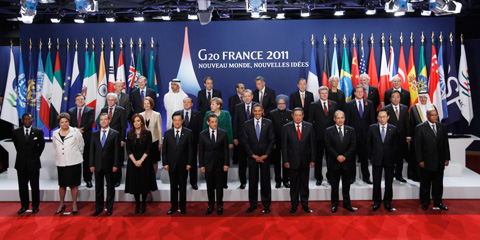
The summit of G20 leaders and heads of state in Cannes last week, as expected, could not agree on the introduction of a financial transaction tax advocated by summit host France. The proposal failed due to the objection of the United Kingdom and the United States and the final summit declaration contained only a vague reference to the G20 acknowledging “initiatives in some of our countries to tax the financial sector for various purposes, including a financial transaction tax, inter alia to support development”.
French President Nicolas Sarkozy said the European Commission will submit a draft plan and aim to get it in place by the end of 2012.
Although much of the debate was focused on Greece and the euro crisis, all G20 governments did sign a multilateral convention to tackle tax evasion more effectively.
Under the Convention on Mutual Administrative Assistance in Tax Matters, governments agreed to share information and cooperate in audits to prevent businesses and individuals from evading tax. The agreement also provides for the automatic exchange of information on a voluntary basis.
The agreement was drafted by the Organisation for Economic Cooperation and Development, which told the G20 the revenues generated from fighting tax evasion would help plug the holes in public finances and lead to greater social cohesion through the elimination of tax loopholes.
A survey of 20 countries conducted by the OECD showed in the past two years, measures tackling tax evasion had resulted in 100,000 individuals paying a total of US$14 billion in unpaid tax on assets worth between US$120 to US$150 billion.
Jeffrey Owens, director of the OECD’s centre for tax policy and administration, said, “Now that the G20 countries have led by example, we expect other countries to sign the convention.
“As the membership expands, so the effectiveness of the convention will increase. Over the coming months we will be working with developing countries, so that they will rapidly be in a position to sign the convention.”
The agreement also imposes safeguards to protect confidentiality of information exchanged.
Tax havens will be shunned
After the closure of the summit, French President Nicolas Sarkozy warned the message of the G20 is clear in that tax havens would be shunned by the international community. He named 11 countries that failed to meet transparency standards in the phase 1 peer review of the Global Forum on tax transparency, which assessed whether individual countries had the legal and regulatory requirements for effective tax information exchange in place. The 11 countries – Antigua, Barbados, Botswana, Brunei, Panama, Seychelles, Trinidad and Tobago, Uruguay, Vanatu, Switzerland and Liechtenstein – were not allowed to proceed to the second stage of the peer review process, which will determine how tax information exchange has worked in practice.
“We do not want any more tax havens,” Mr. Sarkozy said. “The message is very clear, countries which persist in being tax havens will be ostracised by the international community.”
However, the communiqué summarising the results of the conference G20 leaders was less strongly worded, noting the G20 “urge all the jurisdictions to take the necessary action to tackle the deficiencies identified in the course of their reviews, in particular the 11 jurisdictions whose framework does not allow them at this stage to qualify to phase 2.”
The Cayman Islands has addressed most of the deficiencies named in its phase 1 peer review and obtained a supplementary report documenting the progress. The phase 2 peer review of the Cayman Islands is scheduled for the second half of 2012.
Related Videos