The fall in cruise numbers shows no slowing
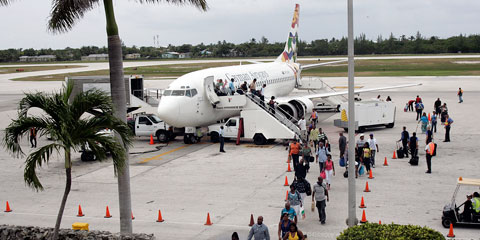
The number of tourists arriving by airplane to the Cayman Islands has increased a 15th consecutive month, led by a sizeable boost in traffic from Europe and continued steady growth originating from the territory’s largest market, the United States.
The most recent figures released by the Cayman Islands Department of Tourism are for arrivals through November 2011 and show Cayman likely on track to eclipse the annual 300,000 visitor air arrival mark for the first time since 2008.
The largest percentage increases for the month, compared with November 2010, were an 18 per cent jump in public tourism traffic from Europe and an 8.4 per cent increase from the US, accounting for an additional 1,800 visitors combined.
Overall in November, Cayman welcomed just shy of 25,000 air arrival visitors, a jump of 7.7 per cent over the same time the previous year.
Canada, which has overtaken Europe as the No. 2 market feeding Cayman, saw virtually no growth in November over the same month the previous year. But Canada remains a bastion of growth for the Cayman tourism industry as the Great White North has witnessed a 32 per cent increase in the year-to-date number of people flying into Cayman, accounting for more than 21,000 visitors through November 2011.
Much of the jump may be attributable to the introduction of nonstop service between Toronto and Cayman in November 2010 by Canadian low-cost carrier WestJet. The Calgary-based airline flies roundtrip three times a week between Toronto’s Pearson International Airport and Owen Roberts International Airport in Grand Cayman.
Meanwhile, Europe and the US have both seen increases of 6.5 per cent in the year-to-date numbers of visitors, with the latter accounting for nearly 80 per cent of the 275,000 air arrivals.
For the year through November, Cayman has seen a 7.3 per cent increase to 275,738 visitors, including nearly 219,000 from the US and 18,600 from Europe. Another 17,000 have arrived from other leading destinations such as Jamaica, Honduras and Cuba, all of which have nonstop service through national flag carrier Cayman Airways.
Air arrivals totalled more than 302,000 in 2008, but have dropped below the 300,000 threshold each of the past two years.
“One of the new things on the horizon that may have bumped some figures is the new Caymankind promotion that the Department of Tourism has taken out,” said Jane van der Bol, executive director of the Cayman Islands Tourism Association. “Also a great deal of travel has come to Cayman because of the Kittiwake. (The former US military ship sunk to create an artificial reef) has increased our dive traffic quite considerably.
“Of course, WestJet coming from Canada has improved our market greatly,” she said. “That’s also where some of the increases in numbers have come from.”
But as positive as the numbers may have been through air arrivals, the number of passengers arriving in Cayman on cruise ships continues to decrease and cause concern. The number of passengers arriving in Cayman on cruise ships has decreased for eight consecutive months when compared with the same time the previous year, and the total appears likely to fall below 1.5 million for the first time since 2001 when December’s figures are released next month.
For the year through November 2011, the number of cruise ship passengers arriving in Cayman have dropped 12.7 per cent to 1.24 million, or 180,000 fewer than in 2010. For the month of November alone, there were nearly 24,000 fewer cruise ship passengers visiting Cayman, or a drop of roughly 15 per cent from the 2010 level of 154,000.
To reach 1.5 million cruise ship visitors for 2011, Cayman would have had to have welcomed nearly 258,000 in December. That figure exceeds the roughly 210,000 entertained in December 2006 when the territory capped a record year of more than 1.9 million.
“The cruise industry in general is down in the Caribbean, it’s not just Cayman,” Ms van der Bol said. “That’s important to remember. While our numbers have dropped in the cruise industry, it has done so across the board in all of the Caribbean. The cruise industry has actively sought out new routes to keep their business fresh. I think that has taken a bit of the business away from the Caribbean.”
The second most visited destination in the Caribbean by cruise ship passengers as recently as 2006, the Cayman Islands long have seen seasonal fluctuations in the number of visitors. But recent years have seen the number of ships steadily decrease as cruise lines have deployed ships overseas in fledgling international markets, including Europe and Asia-Pacific.
Grand Cayman must contend with its status as the only major cruise port in the Caribbean with no pier infrastructure. George Town is a tendering port and its facilities and services are inadequate to cater to cruise ships accommodating several thousand passengers, especially on peak days.
Plans to build new berthing facilities in Grand Cayman have been discussed for years, but nothing has materialised. A major point of contention has been the location of a new pier facility, with some advocating the waters off the downtown capital where ships now tender and others a potential site in South Sound.
“(CITA members) would like to make sure that downtown is considered for revitalisation,” Ms van der Bol said. “I know that our downtown merchants are very excited about having it there in George Town. Because the Cayman Islands government and (potential berthing facility building contractor China Harbour Engineering Company) aren’t willing to comment before March about progress of the pier … we don’t know anything.”


Related Videos