The negative impact of a United Kingdom-imposed air passenger duty on commercial passenger tickets to Caribbean destinations became a hot topic at a recent meeting of the Seventh Ministerial UK-Caribbean Forum.
London late last year announced the APD rates to Caribbean destinations will continue to be considerably higher than those to some competitor destinations, such as Florida. The detailed tax tables show that the tax on economy long-haul flights of more than 6,000 miles will increase from US$132 to US$143 per person. The new measure goes into effect in April.
Caribbean governments, the Caribbean Tourism Organization and the Caribbean Hotel and Tourism Association have during the past two years attempted to expose the negative impact the four band APD system has placed on what was already a fragile regional economy.
CARICOM Secretary-General Irwin LaRocque said the UK Treasury’s present four band system was discriminatory against the Caribbean and its Diaspora in the UK.
“Anything that negatively affects the tourism sector will have repercussions for the entire regional economy,” he said. “In this regard, I refer to the UK Air Passenger Duty, which has placed the Caribbean at a distinct disadvantage in relation to other tourism destinations. This continues to be of grave concern to the Caribbean. We continue to urge that the discriminatory element of the APD be addressed.”
Britain’s Foreign Secretary William Hague agreed “to continue dialogue … in the spirit of cooperation and in the context of the importance of tourism to the economic development of the Caribbean.”
Cayman there
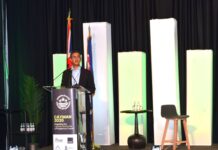
Juliana O’Connor-Connolly, deputy premier of the Cayman Islands and also the Cabinet Minister for District Administration, Works, Lands and Agriculture, attended the meeting in St George’s, Grenada.
“It was good to convene with my political colleagues from the Caribbean and the UK who shared the same goals for enhancement of partnership through the region,” she said. “We talked about economic issues, food and border security, climate change and foreign policy matters. These are big issues that affect us all and more importantly, all countries shared the solutions.”
She said one of the most important aspects of the forum was Mr. Hague’s affirmation of the strong ties between the UK and the Caribbean and his willingness to “renewal the relationship” between them, which was evidenced by the high level delegation that attended to the two-day forum.
“The fact that he reiterated an open-door policy for Caribbean nations was especially comforting,” she said.
Ms O’Connor-Connolly said she was particularly interested in the difference stages of nation building some countries were in. She cited St. Kitts and its efforts to implement a water unit that was almost solar powered.
“This would be great for the Cayman Islands and I am hoping to take a technical team there later this year to examine the feasibility of this water project. If we can apply it to the Cayman Islands, it would save money and greatly assist the farming community,” the deputy premier said.
Also at the 20-22 January gathering were Antigua & Barbuda, the Bahamas, Barbados, Dominica, Grenada, Guyana, Haiti, St Kitts & Nevis, St Lucia, St Vincent & the Grenadines, Suriname, Trinidad & Tobago, Cuba, Dominican Republic. Countries that were there as observers were: Anguilla, Bermuda, British Virgin Islands and the Cayman Islands.
Related Videos