

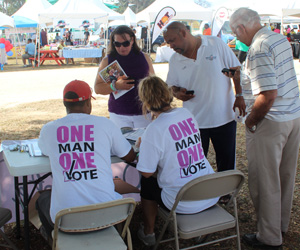

Cayman Islands Premier McKeeva Bush has announced his government’s intention to hold a referendum on the ‘one man, one vote’ issue to coincide with the May 2013 general elections.
The announcement came as the Cayman Islands Civil Service Association received guidelines setting out how government workers could participate in petition-signing activities. Supporters of the ‘one man, one vote’ initiative have begun circulating a petition seeking support to hold a referendum, or public vote, on the issue by this November.
Previous government code of conduct rules prevented civil servants from signing petitions as it would have been considered participating in a political activity, a practice generally forbidden to government workers in the Cayman Islands.
However, guidelines issued last week by the deputy governor’s office mean the large majority of Cayman Islands government workers would not be prevented from signing political petitions addressed to the governor, Cabinet members or other public officials.
“The ability to sign a petition is crucial in the overall democratic process of these Islands,” said Civil Service Association President James Watler. “As responsible members of society, we have valid opinions on issues faced by both individual and country and our voices should not be silenced.”
There are just more than 3,500 workers currently employed within the Cayman Islands Civil Service and more than 2,000 that work within statutory authorities and government-owned companies. The vast majority – somewhere between 70 and 75 per cent – of those workers are Caymanian and their numbers represent close to one-third of all eligible voters in the country.
The voter petition seeks to change Cayman’s current multi-member voting districts to single-member constituencies. It would need close to 4,000 signatures to trigger a public vote on the issue. If the government chooses to hold a referendum on its own, no petition would be needed to force it.
“The fact that they are now cleared to sign this petition, I hope they would take advantage of that privilege,” said East End MLA Arden McLean, one of the petition’s leading supporters. “[Civil servants] must have a say, and not just every four years.”
Mr. McLean and North Side MLA Ezzard Miller said Saturday in a joint statement they would continue petition efforts for ‘one man, one vote’, despite the premier’s announcement.
“[Messrs. Miller and McLean] view this announcement [by the premier] as nothing but a naked attempt to stymie the current petition process, which is getting the support of the electorate,” the statement read. “Do not trust any of the politicians to implement this system after you vote them into office.”
Petitioners are seeking to obtain the necessary votes by April and to have government hold a referendum no later than 30 November. That would allow enough time, they say, to implement the new voting districts for the May 2013 general elections.
Opposition Leader Alden McLaughlin and Premier Bush have both said the November time line would be a bit too ambitious. If the ‘one man, one vote’ referendum is not held until May 2013, the next general election would be held according to current multi-member constituent voting rules.
According to a statement released by the premier’s office Friday evening, the referendum announcement was “a previously stated position of the United Democratic Party government”.
Premier Bush said holding the referendum as part of the general election would help avoid additional costs and would allow for the orderly implementation of single-member voting districts.
Petition rules
The deputy governor’s policy breaks petitions into two “classes”; a petition sent to Cabinet for a public referendum would fall into “Class 2”.
Class 2 petitions are efforts by the public to generate a voter-initiated referendum, which must be addressed to Cabinet members. Class 2 petitions are also any petitions sent to the governor concerning matters directly within his constitutional responsibility.
Class 1 petitions are those addressed to any public official seeking to change or amend any action or proposed action by a government ministry or portfolio. These can include any matters for which a minister or senior civil servant within a portfolio has direct responsibility.
The new policy only applies to petitions presented to the governor, Cabinet or other public official. Petitions involving social, civic, community or professional matters are not covered.
Public servants are generally allowed to sign both class 1 and class 2 petitions, with certain caveats.
For instance, a public servant who holds what is considered a “key position” or a sensitive position to the public official being petitioned is not allowed to sign a class 1 petition. Key positions include chief officers, deputy chief officers, policy advisers, agency heads or deputy heads, clerk of the Legislative Assembly or clerk of the Cabinet.
Sensitive positions are defined as those who provide legal or financial advice, public communications, or physical development services to a ministry or portfolio. Class 2 petitions can be signed as long as senior civil servants doing the signing meet “notification” requirements addressed in the policy. “Notification” requirements are also included in guidelines for signing class 1 petitions.
“Relevant to the signing of a class 1 petition, any public servant who holds a key position, but does not have direct responsibility for the subject matter of the petition must, at least 48 hours prior to doing so, inform the public officials whom his or her position supports, through his chief officer, of his intention to sign a class 1 petition,” the policy states. “Relevant to the signing of a class 2 petition, any public servant who holds a key position must, at least 48 hours prior to doing so, inform the public official whom his or her position supports, through his chief officer, of his or her intention to sign a class 2 petition.”
Changes likely
Deputy Governor Franz Manderson noted that the policy as it was released is probably not the last word on civil servants signing petitions.
“I expect that shortcomings within the policy will inevitably manifest themselves,” Mr. Manderson said in a letter sent to government workers last Tuesday. “Nevertheless, it is imperative that we make a start.”
Mr. Watler also noted that the Civil Service Association would “monitor” certain areas of the policy going forward.
“Despite this, we do have a much clearer understanding of where we stand in relation to this issue,” he said.

Related Videos













I find it amazing that a referendum is required on this issue. The backbone of democracy is the ability for someone to speak their mind on any issue at any time except to use that right to promote Communism.
Cant sign a petition or speak against the governmnet is nothing short of Communism in its highest form.
Get with the times and undertand that we are a free country. Many died for us to have that right and this is nothing short of Cayman showing disrespect for those who died for that right.
Breaking News: Alden McLaughlin, PPM leader has declared WHY THE RUSH. He has promised to implement the One man, one vote if he gets re-elected. He has declared on Rooster 101.9 this morning that Ezzard and Arden need to educate the people first before the go ahead with the referendum on this issue. Alden has even sided with the Premier on the date for the referendum, which General Elections.
My question is – What the hell is going on with these leaders of this two-party system of ours?
THE PEOPLE SHOULD BE FIRST. DON’T CALL US FOOLS AS IF WE CAN’T UNDERSTAND OR ARE NOT EDUCATED ENOUGH! ALDEN OF ALL PERSONS, IF YOU ARE A TRUE OPPOSITION LEADER, YOU SHOULD HAVE BEEN SPEARHEADING THIS DEMOCRATIC EFFORT – NOT PUTTING PARTY INTEREST BEFORE THE PEOPLE LIKE UDP!!!
Interesting comments on your post b.c., but not sure Mr. McLaughlin’s statements on the radio Monday qualify as ‘breaking news’. Check this from 17 February:
http://www.compasscayman.com/caycompass/2012/02/17/Rush-for-'one-man'-questioned/