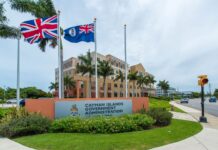
The United Kingdom’s tax authority has issued letters to taxpayers, who it believes have bank accounts in the Cayman Islands, requesting the disclosure of any undeclared income and capital gains tax.
The letters follow the conclusion of automatic tax information exchange agreements between the U.K. and its overseas territories. The Cayman Islands was first to sign the “U.K. FATCA” agreement in November 2013. As a result, financial information on U.K. taxpayers with accounts in the Cayman Islands will be reported to HM Revenue & Customs automatically every year.
Additional information relating to companies and trusts will be shared after 2016.
Accountancy Age reported that U.K. residents with undisclosed assets in Cayman will have until September 2016 to reveal details to the taxman and pay any tax owed, in addition to a fine of between 10 percent and 20 percent of the outstanding tax. While in most cases evaders will escape prosecution, such immunity is not guaranteed by the tax authority.
A spokesman for HMRC said, “Those who have declared any offshore income and gains on their U.K. tax return have nothing to worry about, but anyone with undeclared offshore income and gains needs to come forward now to avoid punitive penalties and in the most serious of cases criminal investigation.”
Sean Wakeman, tax investigations partner with Crowe Clark Whitehill, told Accountancy Age that account holders are invited to make a disclosure for 20 years, which presupposes deliberate behavior in evading tax.
“Anyone who may have underpaid taxes should strongly consider making a tax disclosure, with professional assistance, under the government approved Liechtenstein Disclosure Facility, which would immediately limit any liabilities to 13 years, or even to six years in cases involving just carelessness,” he advised.
The new initiative shows that HMRC is “going global” and “extending its reach beyond the low-hanging fruit of Liechtenstein and Switzerland,” Mr. Wakeman added.
An agreement over taxation of undeclared Swiss bank accounts came into force on Jan. 1, 2013. New information-sharing arrangements made it easier for HMRC to detect undisclosed offshore accounts held by U.K. taxpayers in Switzerland. Under the U.K.-Swiss Rubik agreement, individual accounts that were open on Dec. 31, 2010, and still open May 31, 2013, would be subject to a levy of between 21 percent and 41 percent, depending on various factors, including how long the assets have been in Switzerland.
A lifetime withholding tax on income and gains derived from Swiss bank accounts was introduced in 2013. It applied varying withholding tax rates to investment income, capital gains and dividend income. To avoid the withholding, account holders had the option to consent to the disclosure of their data to HMRC.
The tax authority estimated it would raise about £3.2 billion (US$5.25 billion) from the agreement but took in only about £800 million in 2013, making it unlikely that the initially predicted amount will be reached.
Mark Field, conservative MP for the Cities of London and Westminster, wrote in a blog commentary last week that “far less money held in Swiss bank accounts was found to be non-compliant than had been anticipated when the U.K. and Swiss authorities signed up for this deal twelve months ago.”
Mr. Field believes the proportion of non-domiciled individuals banking in Switzerland is likely to be much higher than previously thought, and that Swiss bank account holders preferred to disclose their assets rather than be subject to the withholding tax. However, he still hailed the agreement a success.
“The deal is set to raise much more than was envisaged by its detractors,” Mr. Field wrote.
Related Videos