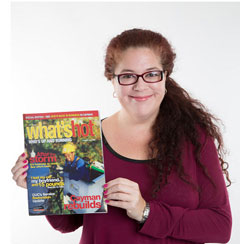
This story originally appeared in What’s Hot magazine, November 2004 issue.
It was when we saw the wind speeds jump from 145 to 165 mph that Lynne (best friend/roommate) and I began to see our roof not so much as a protector from the elements, but more as a wafer-thin cardboard lid.
The walls were solid concrete, so we weren’t worried about being washed away, but after deciding not two hours before that we were going to stay put, we suddenly started having second thoughts. Later afternoon on Saturday, Sept. 11, we grabbed vital belongings, enough canned food to sink a cruise ship, and drove to an office building to stay with my parents and sister.
We had brought a laptop with us, and had Internet access until about 4 a.m., just long enough to see a satellite map on weatherunderground.com that featured the largest swirling cotton wool ball in the world heading straight for us.
By this time the wind had picked up immeasurably and visibility became poorer and poorer as the rain pelted down outside. Cars in the parking lot began to disappear under floodwaters, with some more sophisticated models helpfully opening their sunroofs, trunks and flashing their headlights.
We tried to get some sleep on the floor, but it was difficult when we felt the building physically shaking. It’s quite something to be in the top floor of a four-story structure and feel it move from the force of the wind. As the storm got closer and closer, small parts of the roof began to give way. People had already moved from the first floor, which was up to waist-height in the water, and we were now dealing with a leaking ceiling.
To think at the beginning, we had worried about having water to flush the toilets. We now had more than we could handle. By the Sunday night the carpet was soaking wet, and the corridors were dark and dripping like a cave. Meanwhile, friends of ours were fearing for their lives in one-story houses, as they cowered on countertops, or sheltered in closets with the water rising.
Emerging after the storm
On Monday morning, Lynne and I finally ventured out of the building. You had a sense of emerging like cavemen to see the world for the very first time.
Light poles were snapped like toothpicks and lying all over the road. We made our way along Eastern Avenue, wading through water and being careful not to step on anything sharp. As we came to West Bay Road, we watched people trying to maneuver around the roof of Merren’s Plaza, now mangled and blocking our path.
Everywhere we looked there were damaged or destroyed buildings, and as we began to bump into people we knew, we heard their horror stories of how they had survived the storm. By the time we got close to our apartment – and the roofs hadn’t been so bad leading up to it – we thought maybe we had gotten away with murder. It was not to be.
My bedroom now had a full skylight, and we could see from the road that Ivan had rearranged some of my belongings. Part of the roof had gone in Lynne’s bedroom and the living room had not escaped entirely unscathed either.
Neither of our cars would be saved. Both had been completely flooded with seawater, and although the ignitions had reluctantly turned in the first couple of days, they now wouldn’t budge. I had spent $3,000 on my car earlier that year to fix the air bag suspension, and so can proudly say that it sailed as though on angel’s wings as it was towed to the dump.
I had dutifully filled the tank with gas before the hurricane and couldn’t even retrieve that $45-worth with an anti-siphon feature in my tank. Got a nice mouthful of fumes, though, and paid $80 for the privilege of having it taken way by a dump truck so Lynne and I could gain access to our apartment without having to climb over two cars and a desk rammed again the stairs.
We started to throw away some of our possessions, going back each night to stay at my brother Dominic’s apartment that was suffering a leaky ceiling on the second floor, but was much more habitable than our place.
Radio Cayman a lifeline
The stalwarts at Radio Cayman were broadcasting around the clock, passing on vital information to listeners, and we all expanded our glossaries of alternative terms for “feces” when warned about what could and could not be handled by the toilets. I think “ca-ca” was my favorite, with “do-do” a close second.
With the rush of adrenaline we all experienced in the first week, not to mention a limited choice of food and drink, many lost weight despite, or as a result of, the double-bag-in-a-bin unpleasantness. I actually got a tan on my face and arms for the first time in years, and my teeth had never looked whiter, thanks to the unavailability of sodas.
A rainstorm was a mixed blessing, bringing on further leaking through compromised roofs, but also providing water for showers and washing clothes. Everyone could have used some serious deodorant, and nobody really cared.
Staying at Hope Springs in my brother’s apartment, it was wonderful to have such helpful neighbors around. We shared food and drinks, candles, batteries and social time. We were all in the same boat, every day having to deal with things that we had lost and being grateful for what we had.
Social time
When the first bar opened, word spread like wildfire. I grabbed the cleanest clothes I could find and headed down there with the rest of the populous. Who would have thought that grown men and women would have got teary-eyed over a cube of ice and cold beer?
The day water started running through the taps, we all thought we’d died and gone to heaven. A real shower! We could now doll ourselves up for all those lovely CUC linesmen working to restore power. Men from Canada joined the local contingent to get the power on as quickly as possible, with an extremely impressive showing from our electrical company.
The phone companies came into their own so we could call loved ones overseas and, slowly but surely, the rubble was moved away from roads and properties, which made everyone feel more normal.
Although I have had tough moments through this, I can honestly say that I got off very lightly. I know many others who lost absolutely everything, and had harrowing experiences in the very worst of the storm.
I also know that the island is recovering pretty rapidly from one of the worst hurricanes of the century, and people are much more neighborly than they used to be. It hasn’t been fun, but it’s been a learning experience, and certainly one we’ll never forget.
As for the boyfriend, all I can say is never get involved with a nomad Australian. If you think men get scared off by having you call them more than once a day, imagine wailing down the phone about the misery of a hurricane, and when are they getting here to save you? Nuggets of wisdom folks; I end this article with nuggets of wisdom.


Related Videos