In a vocal push for pension reform, Premier Alden McLaughlin has called for a “radical rethink” when it comes to how Cayman’s current private pensions system operates.
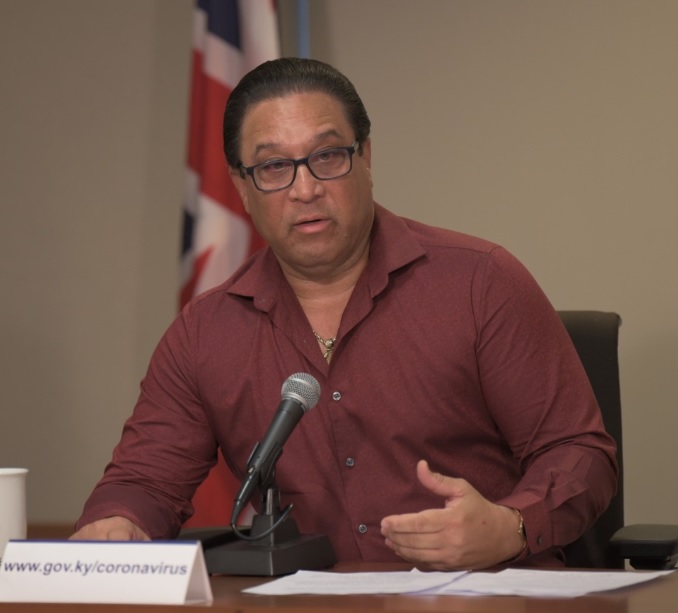
“That system has got to be changed; I mean, radically so,” the premier said Tuesday as he tackled the issue at the daily COVID-19 briefing.
He said as the population continues to grow and Cayman recovers from the COVID-19 pandemic, the strain on government to look after people who do not have the means to look after themselves in their retirement years is going to continue to worsen.
“We just simply cannot, we will not be able to afford it. It will break government. That, coupled by healthcare provisions or the lack of adequate funding for that bill, will render this country bankrupt in 15 or 20 years if it is not dealt with,” McLaughlin said.
The premier said government is also working to try to address the healthcare liability situation during this term.
“I don’t know how much of that will get progressed with the current crisis, but whether I’m around or not in one capacity or another, those are two critical areas that absolutely have to have radical redress. Otherwise, the future of the country, truly, despite all the other great things, will not be very bright,” said the premier.
McLaughlin addressed the issue as he responded to media queries about North Side MLA Ezzard Miller’s proposal in the Legislative Assembly last week during a debate on changes to the National Pensions Law.
Those changes were gazetted Tuesday afternoon and now allow private sector pension holders to withdraw $10,000 from their accounts, plus 25% of the remaining balance. It also paves the way for a six-month pension holiday.
Miller, in his contribution, advocated that instead of a “raid” on pensions to implement a plan that would allow employees to benefit from the utilisation of their funds.
He outlined two conditions for distributing a set amount out of the total pool of pension funds to local commercial banks as a fixed-term deposit.
Under the first condition set out by Miller, the pension funds would be used as collateral on which the banks would offer half a percent interest.
The second requirement would be that the lump sum transferred to the banks would fund loans to business owners to pay the salaries of employees as well as owners/managers. These would be five-year loans at 1% interest, Miller explained, with a moratorium on principle and interest for the first year.
“This would allow pensioners, including employers/owners, to retain their pension money while benefiting from investing in themselves,” Miller said.
While not specifically addressing Miller’s proposal, the premier said the system as it stands is not working and was not “fit for purpose”.
McLaughlin said he agreed with Bodden Town West MLA Chris Saunders’ point, which was made during the debate last week, that it cannot be expected that workers put in only 10% of earnings during their working life and then live another 25 or 30 years after that, and in retirement are expected to survive on $1,000 a month because of the amount contributed.
“It’s just not enough,” he said. “We’re going to have to find some other way of increasing what the yield is, how much is put in, and what the yield in is on the contributions to make it work.
“Now, the government pension scheme has found a way to make it work. So, we actually have a model that we can look at, and I’ve said this for years, that is the model that we ought to have adopted for the private sector pension schemes, as well.”
McLaughlin said to make that model workable for private plans, “it’s going to take a radical rethink of the whole system that is currently in place”.
“I know this will upset a whole lot of private sector people, but it ought to be a national pension scheme that is run by the government, not nine different pension providers. It’s too expensive,” he said.
McLaughlin said too much of the money has to be used to pay for the administrative costs of running all of these funds.
“That’s part of the problem,” he added.
In the public sector, there is a defined contribution plan and, under that plan, both the employee and the government contribute 6% of the worker’s earnings.
With the private service plan, the employee and employer each pays 5%.
When a private sector employee retires, he or she will receive $12,000 a year or between $1,000 to $1,200 per month until the funds are exhausted.
In the public sector, upon retirement, a person can elect to take up to 25% of the total pension fund that has been accrued, with the remainder being used to purchase an annuity which pays the retiree a monthly sum for life.
The annuity is also inflation protected.
The public service pension plan also included a defined benefit plan, but that was closed in 2000 and is no longer open for future enrolment.
Related Videos