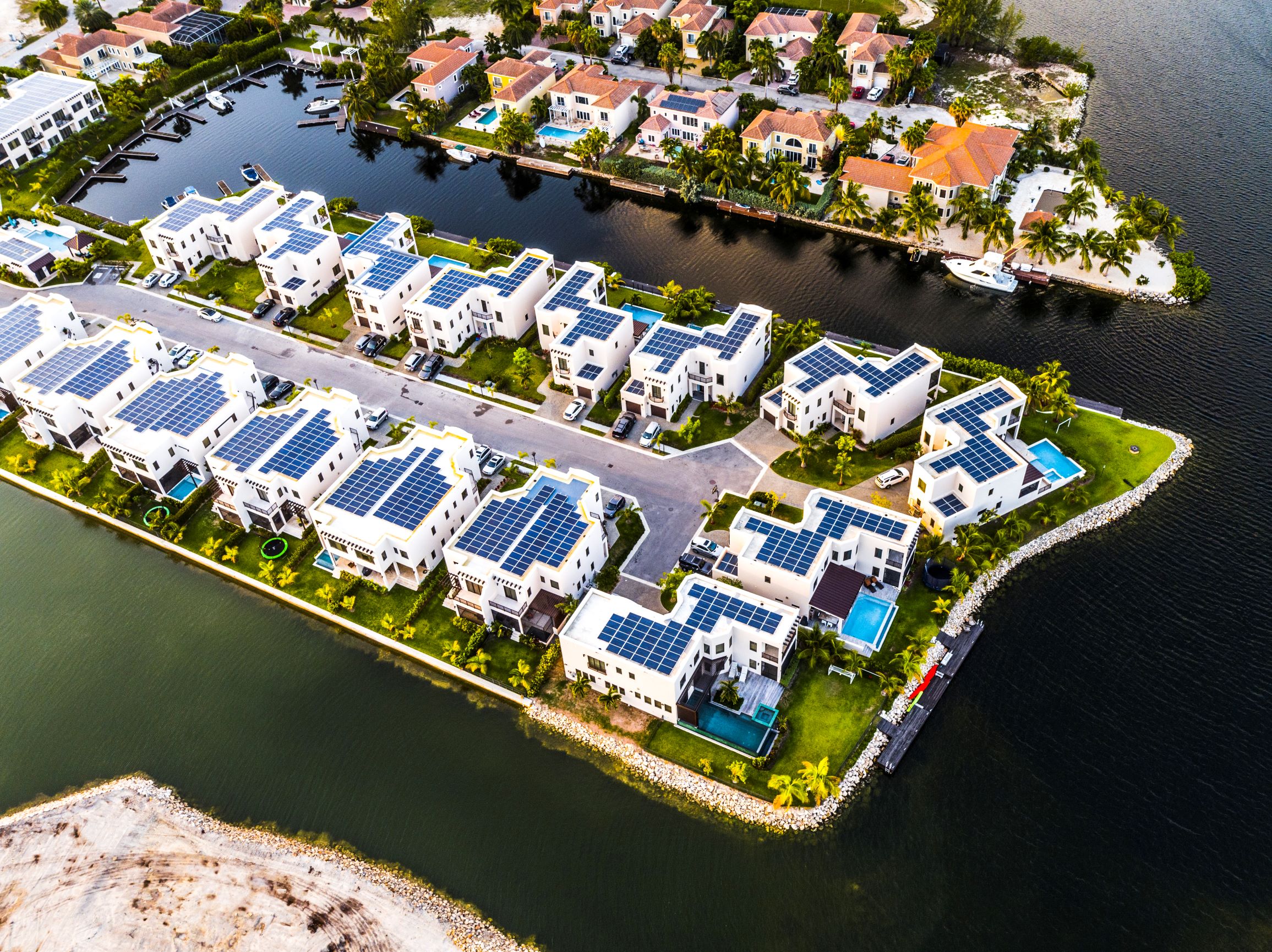
Homeowners in the Cayman Islands can install solar panels again after regulators approved new grid capacity for a popular renewable energy scheme.
The Consumer Owned Renewable Energy programme – which has allowed customers to generate solar energy and sell it back to the Caribbean Utilities Company at a subsidised rate – was halted in December 2019.
At that time, OfReg said there was no space left on Cayman’s power grid for renewable energy of any kind.
The capacity to absorb renewable energy sources – still considered less consistent and reliable than fossil fuels – remains a concern.
That will improve once plans for a large battery system, capable of storing 20 megawatts of electricity, are implemented by CUC but this is not expected to happen until 2022.
In the interim, OfReg has re-allocated renewable energy capacity from the Distributed Energy Resource programme – which has had less uptake – to allow CORE to continue. That follows representations from the Cayman Renewable Energy Association.
The new rate of 17.5 cents per KWH for small solar installations of up to 5KW and 15 cents per KWH for larger installations of 5-10KW is significantly lower than the previous rate of 28 cents and 24 cents.
Renewable energy industry leaders have warned that the lower rate and the time it took to make the decision have led to job losses in the industry, which has effectively been on pause for the best part of the last year.
CREA says pent-up demand will see the new allocation snapped up quickly and it remains concerned that the timely decision-making of OfReg over future allocation could impact the industry further.
OfReg said in a press release Wednesday that it had approved the new tranche of CORE to support demand for the local solar industry.
Gregg Anderson, executive director of energy and utilities, said the programme had been very successful in launching renewable energy at the consumer level.
The release gives no indication about the long-term future of CORE, though Malike Cummings, CEO of OfReg, indicates that distributed generation – the industry term for small scale decentralised renewable systems – would have a big part to play in Cayman’s energy future.
“Not only does the Integrated Resource Plan project 70MW of generation to come from roof top solar systems by the year 2045, but the added benefit of improving system resiliency is characteristic of distributed generation deployment, especially considering the Cayman Islands’ vulnerability to storms.
“After these types of natural disasters, solar and storage offer one of the best means of ensuring that consumers have power,” he said.
James Whittaker, president of the Cayman Renewable Energy Association, welcomed the decision to allocate new capacity to CORE but said it should have taken a few weeks rather than 13 months to achieve.
He said, “This lack of prudent and timely decision-making continues to be OfReg’s primary downfall and injects massive uncertainty and volatility in the local renewables market; this time it has even lead to local job losses as well.
“We hope that after this current allocation of CORE runs out, that OfReg acts in a more timely and prudent manner when it comes to regulatory decision making for consumer owned renewable energy.”
- James Whittaker, the writer of this article, and James Whittaker, the president of CREA, are not related.
Related Videos