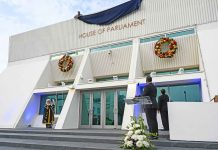
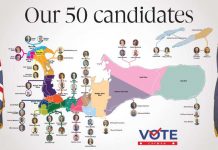
Cayman is set to embark on a historically significant general election in 2021. It marks the first time in the jurisdiction’s history that an early election has been called. It also will mark the first time Cayman votes for Members of Parliament. But before we look too far ahead to 14 April, let’s take a look back at Cayman’s democratic history with this piece researched at the National Archives and published by the Elections Office.
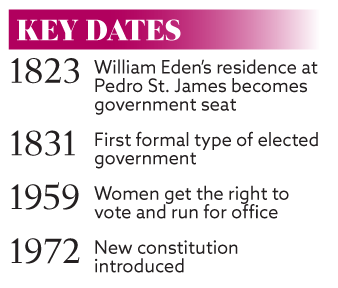
According to our records, the first formal type of elected Government was first introduced in December 1831. However, prior to this the Islands were administered by a number of Magistrates and Senior Magistrates, and some times even by a Custos, appointed by the Governor of Jamaica.
This system of Government worked well while the population remained relatively small but as the population increased a number of problems were experienced because of weaknesses in the system.
The first Magistrates ruled with some references to Jamaican Law. In 1802, as Edward Corbet had noted in his Report,”The Magistrates are understood to have the same power as those in this island [Jamaica], but when any new measure is to be adopted it is generally submitted by them to the consideration of the population at large.”
This seemed to have been a very democratic manner of dealing with affairs of state, but not everyone was pleased as this led to some confusion and conflict.
By at least 1823, the Chief Magistrate, James Coe Sr., and the other “Magistrates and principal inhabitants” of Grand Cayman apparently felt they needed a more formal system of lawmaking and set of laws. Accordingly, they asked for and got commissions for several more Magistrates from Governor Lord Manchester.
Then on 13 December 1823, the Magistrates and “principal inhabitants” held a meeting at William Eden’s residence at Pedro St. James. Their first decision was to lease the Pedro property from William Eden for £5. 6s. 8d a year. It would be used as an animal pound, court-house, and jail, with a daily payment of 2s.11d authorized whenever there was a prisoner.
Other laws were passed at this time, which dealt with roaming livestock, duties on dry goods, provisions, liquor, or any kind of merchandise sold by any non-inhabitant. Another law, which prohibited the sale of liquors, wines, by any slave, was also passed at this time.
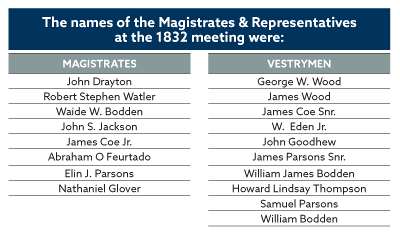
Pedro St. James continued to be the seat of Government, with regular meeting held at this location. On 5th December 1831 a meeting was held at Pedro St. James to form a proper legislative assembly with representatives and Magistrates from each district appointed, forming as it were two houses in imitation of the Council and Assembly of Jamaica.
On 10th December 1831, two representatives of each were “elected” for the districts of West Bay, George Town, South West Sound, Prospect, and Bodden Town. The method of election is not known.
These 10 representatives, later referred to as the Vestry, assembled for the first time on 31December 1831 in George Town, and met again on 2 January 1832. The eight Magistrates met at the same time but in a different room, carefully preserving the classic British form of a bicameral legislature. No law was “deemed valid” until it had received the assent of both houses.
1948
An Election was held in August 1948 wich was noteworthy. Polling was held in the different districts. The first Poll was held in George Town on the 10th August which ended in a tie between two candidates, H. M. Coe and another candidate, which made it impossible to declare five candidates for George Town. This resulted in a By-Election for George Town, ordered for 14 Aug. The By-Election, however, ended in a tie again between H. M. Coe and A. Berkley Bush resulting in another By-Election being ordered for the 19th August.
At this point Mr. H. M. Coe wrote a strong letter to the Commissioner expressing his feelings that it seemed impossible to have three elections with two candidates tied three times. He suggested the possibility of tampering, and called for an investigation.
The new By-Election was held on the 19th August, this time with definitive results.
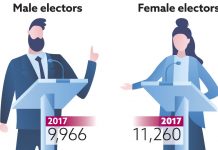
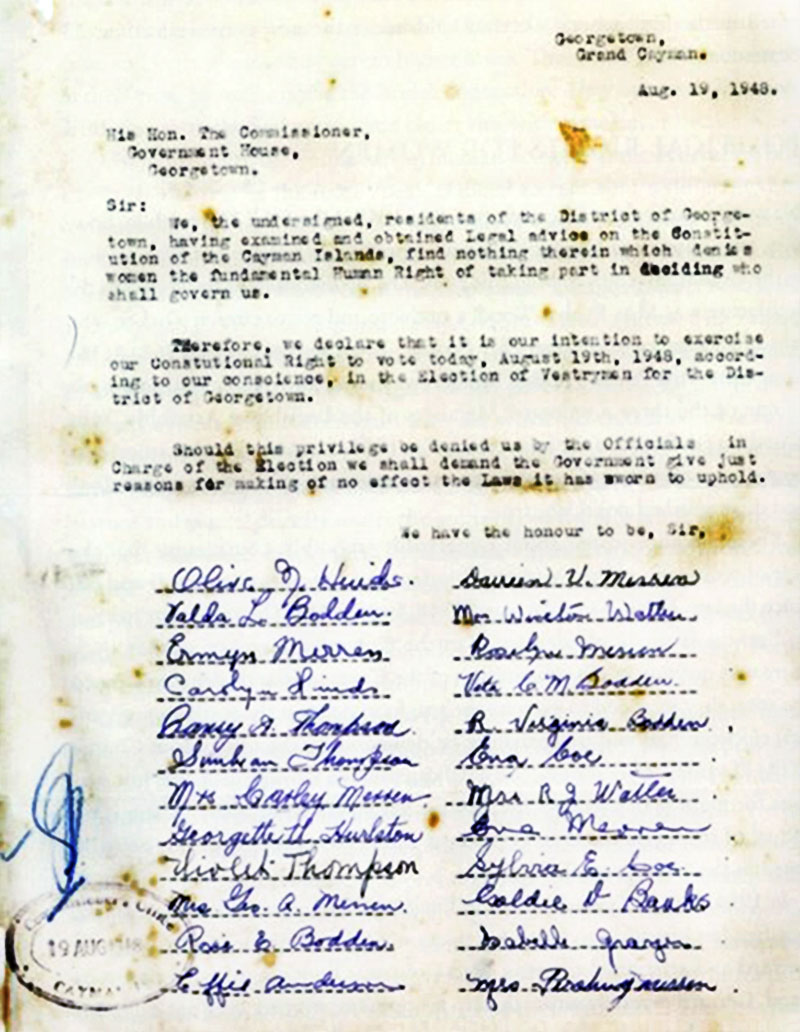
Also during the 1948 Elections, a letter was received by the Commissioner from a group of women in George Town, expressing their right to vote and run for Election. Up until this time, women did not vote though there seemed to have been no law prohibiting women from voting. The matter was raised again in 1956 and finally was settled in 1959 when women got the right to vote and run for office.
1959
In 1959 the Cayman Islands were granted their first Constitution and Universal Sufferage, the Assembly changed from the Assembly of Vestry to the Legislative Assembly and 12 members were elected, there were also three Official Members, and three Nominated Members.
An excerpt from a speech made by His Excellency the Governor on 2 Oct. 1959 from the Secretary of State for the Colonies on behalf of Her Majesty’s Government in the United Kingdom:
“ … The first meeting of the Legislative Assembly for the Cayman Islands under the new Constitution provided for by Order made by Her Majesty the Queen in Council on the 13th of May, 1959 … You have today a Legislative Assembly to which twelve members have been elected for the first time on the basis of universal adult sufferage.”
The 1959 Elections was a turning point for the democratic process in the Cayman Islands as the women finally had a voice and were able to run for Elections, and hold Office. This move came at a pivotal time in the Islands development, as a large percentage of the men were away at sea and were not available to fill many key posts.
 During the early 1960s a move to establish a West Indies Federation of the British Colonies in the Caribbean, the Cayman Islands took a stand against joining the Federation which would have led to political changes for the Cayman Islands. This controversy lasted almost two years and ended with the Federation being scrapped, Jamaica moving into independence, and the Cayman Islands reverting to full colony status.
1972
The next change to the Constitution came in 1972 as a result of select committees appointed by the Legislative assembly in 1966, 67, and 69 but nothing was achieved until 1972.
In June 1970, the Earl of Oxford and Asquith was appointed by the Commonwealth Office to examine the situation and make recommendations. He arrived in Jan. the next year and met with the people in the Cayman Islands. It was soon realized that the people wanted very little changes and certainly no significant constitutional advancements. In the end, the new constitution came into force on 22nd August, 1972. It made some significant changes but stopped short of full self government. One of the changes introduced a “Member” and “Portfolio” system of governing for the first time instead of a full Ministerial Government.
The 1972 Constitution established the qualifications for being a “Caymanian” and the criteria for voting and running for Political Office.
Related Videos