


Steve Broadbelt is taking his kids out on the water this week.
That’s not unusual for the owner of a dive operation, but this trip is a poignant one. He wants his children to get what he thinks could be a final look at rare pillar coral that he fears will be locally extinct by the end of the summer.
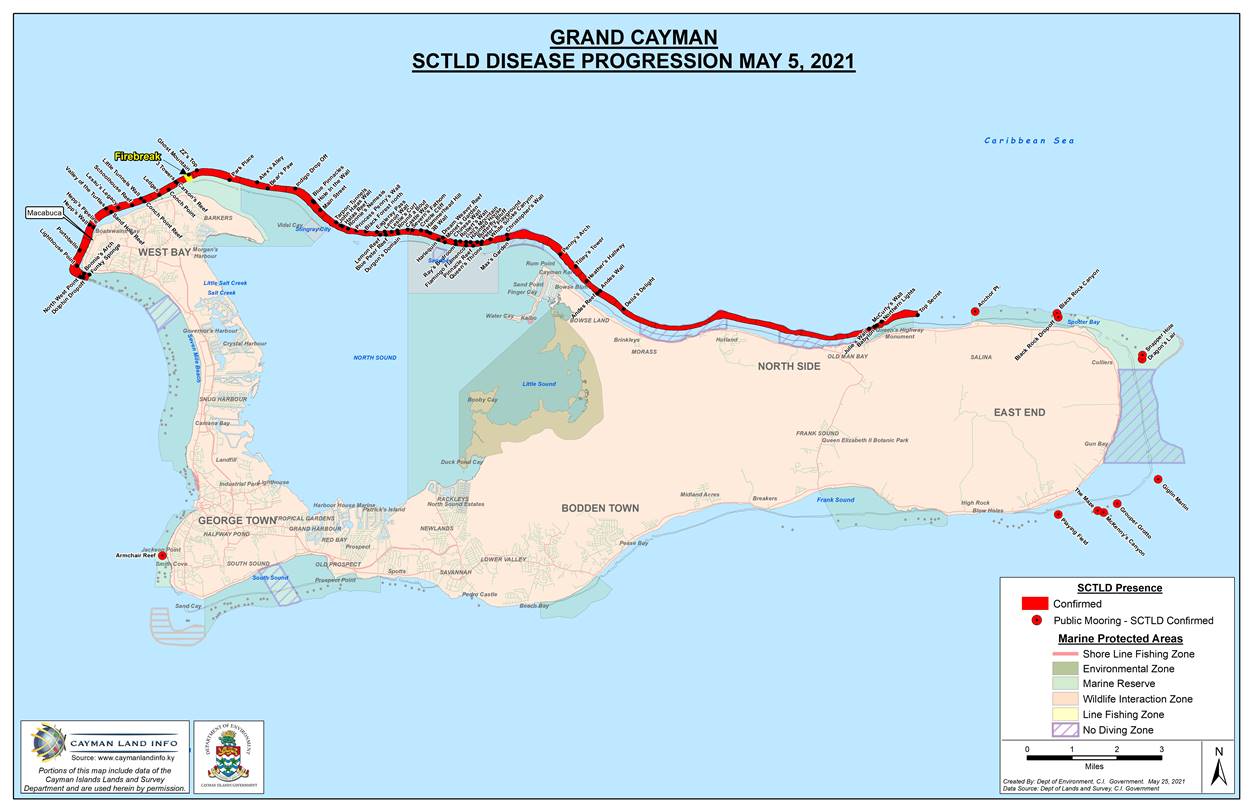
Pillar coral is one of about 24 species of coral threatened by stony coral tissue loss disease, which is spreading quickly around the coast of Grand Cayman.
Broadbelt, who owns East End’s Ocean Frontiers, said pillar coral is one of the rarest species of coral in the Cayman Islands, where there are fewer than 20 colonies of it.
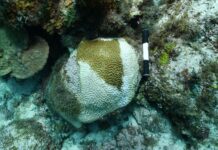
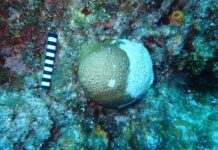
He said Ocean Frontiers is monitoring seven sites containing this coral species and has identified a number of locations where the disease is present. Just last week, he said, at the East End dive site called Top Secret, pillar coral was found with several of the white lesions that are the hallmark of stony coral tissue loss disease.
“I plan to take my kids out to the site after school this week to see the pillar coral,” he said, “as they will be traveling this summer and, then with quarantine, I expect these pillar coral colonies will be dead by the time they are able to get back in the water later this summer.
“Ocean Frontiers is a family business to me, but it is hard to leave a legacy for my children when the greatest part of it is dying off around you.”
Broadbelt said pillar coral is an ‘EDGE species’, which stands for Evolutionarily Distinct and Globally Endangered.
“If you were down to the last 20 blue iguanas or last 20 booby birds, or if silver thatch trees within a four-week period started turning black, and there were just ashes left and black stumps, the response would be massive,” he said.
He hopes the public in Cayman will grasp the seriousness of the stony coral disease, which has been found now on dozens of sites along Grand Cayman’s reef.
While it is likely carried on currents and fish may spread it, but as it has been appearing at random, unconnected sites, the Department of Environment believes this indicates that boats or divers are spreading the disease when they move from one contaminated site to an unaffected area.
The DoE has been appealing to divers to decontaminate their dive gear between dives and for boat operators to disinfect their boats’ bilges in a bid to stop the disease from spreading further.

The disease was first discovered off Miami-Dade, Florida, in 2014, and has since spread along the Florida coast and to several locations across the Caribbean. It was spotted for the first time in Cayman last summer, at the Penny’s Arch site, off Rum Point.
According to the US National Centers for Coastal Ocean Science, Florida’s wild pillar coral population is now less than 6% of its known population in 2014.
Currently, the only weapon in the arsenal against the stony coral tissue loss disease is an antibiotic paste that is placed around the lesions on an infected coral to stop it from spreading to the healthy part of the coral.
Pillar coral is listed as ‘vulnerable’ on the IUCN’s Red List, but is recognised as being rare in many places, such as the Cayman Islands, where the few known colonies are widely dispersed around all three islands.
Related Videos









In my opinion this disease represents a greater threat to the Cayman Islands than Covid-19 and the opening the borders issue.
Thank you for your continuing coverage Norma. It is sad and difficult to hear Steve Broadbelt talk about the “last chance for his kids to see the pillar coral”, and we can only hope he is right when he says he hopes the public in Cayman will grasp the seriousness of the stony coral disease, which has been found now on dozens of sites along Grand Cayman’s reef. Let’s hope the UK funds can actually help “manage” this scourge.