

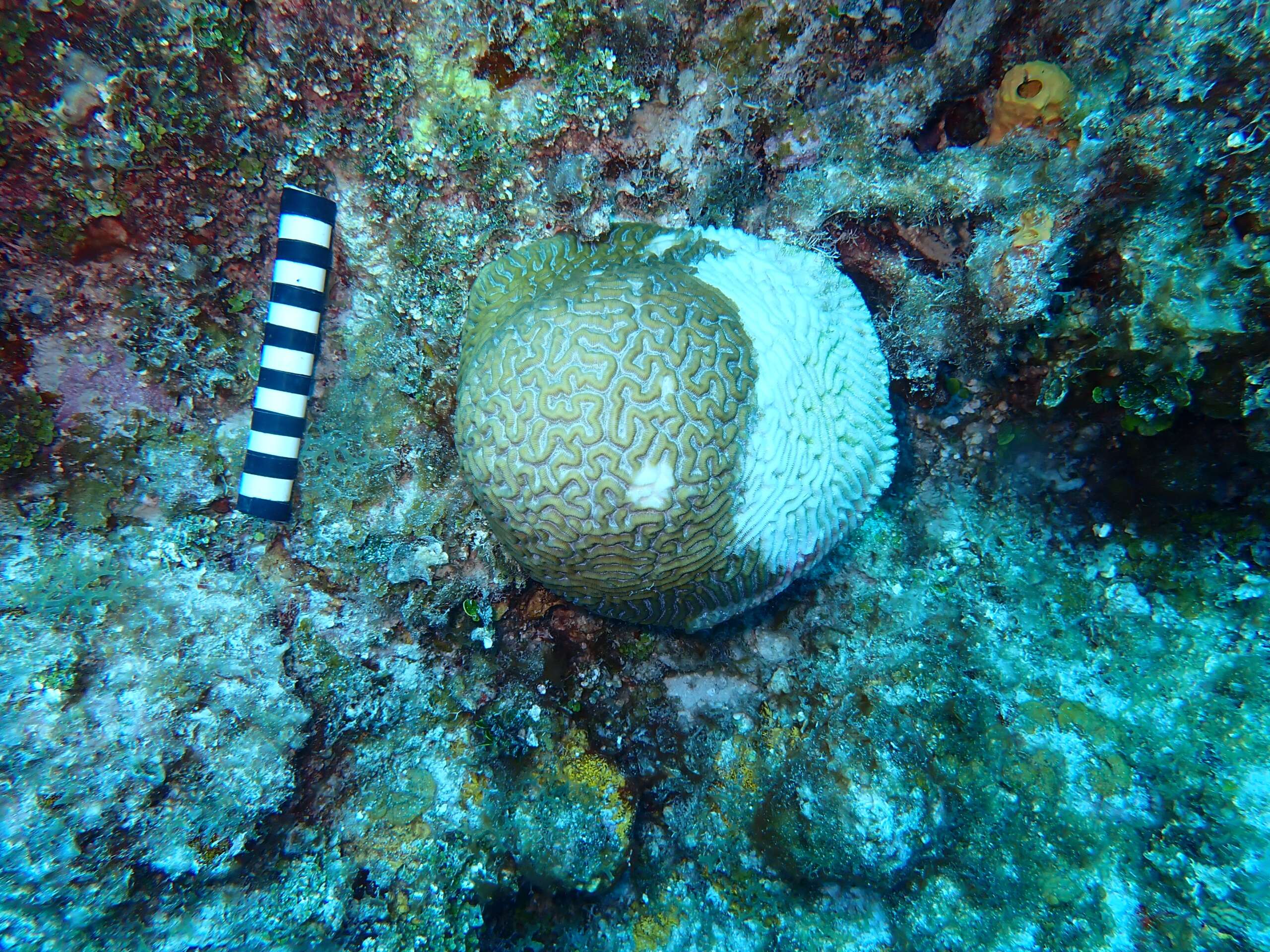
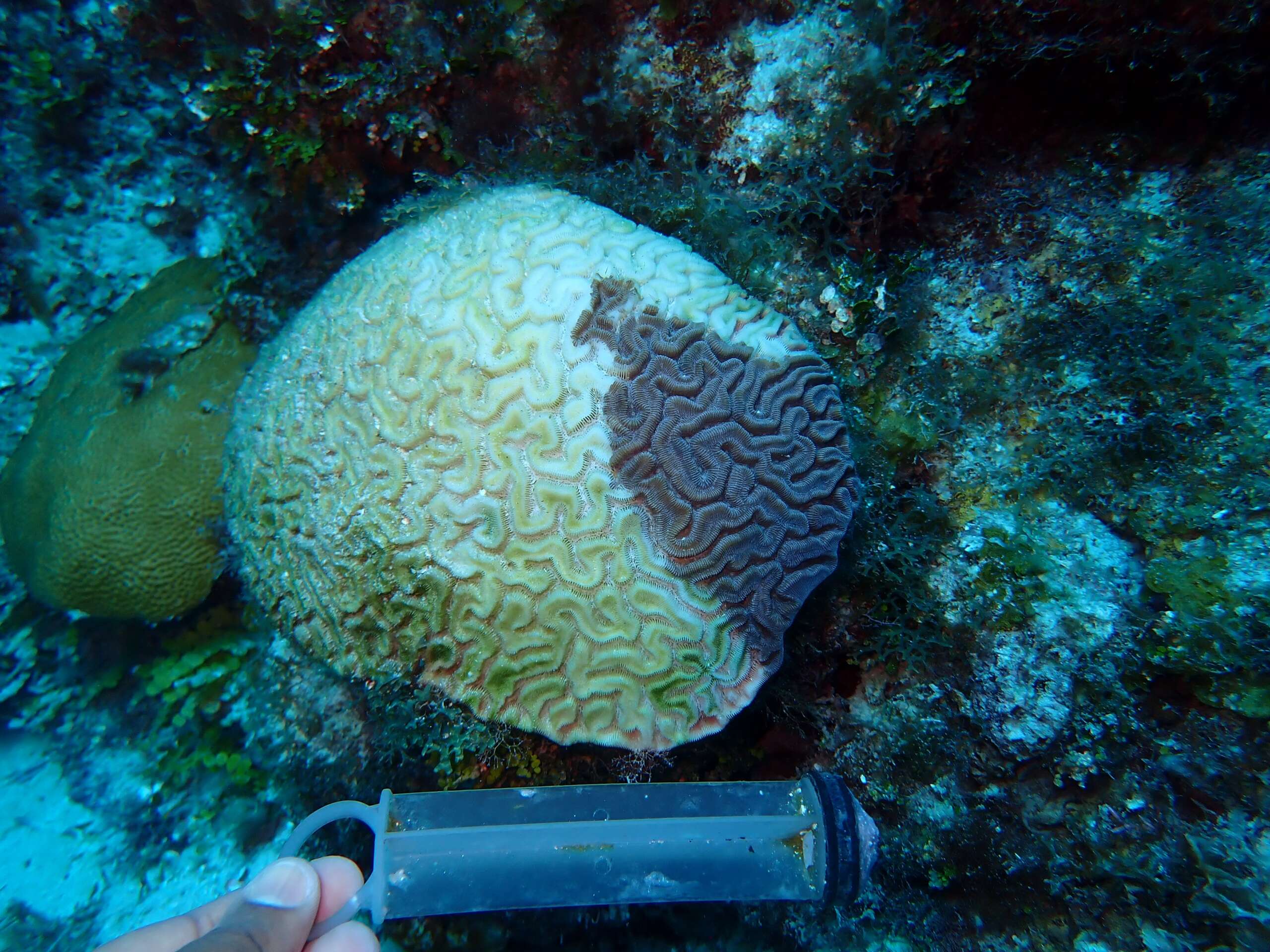
Marine researchers have confirmed the first cases of stony coral tissue loss disease on Little Cayman, after finding lesions on corals over a mile-long stretch of reef near the island.
The disease, known as SCTLD, decimated populations of stony coral species on Grand Cayman’s reefs after it was first found there in 2020, but the Sister Islands had escaped the onslaught until now.
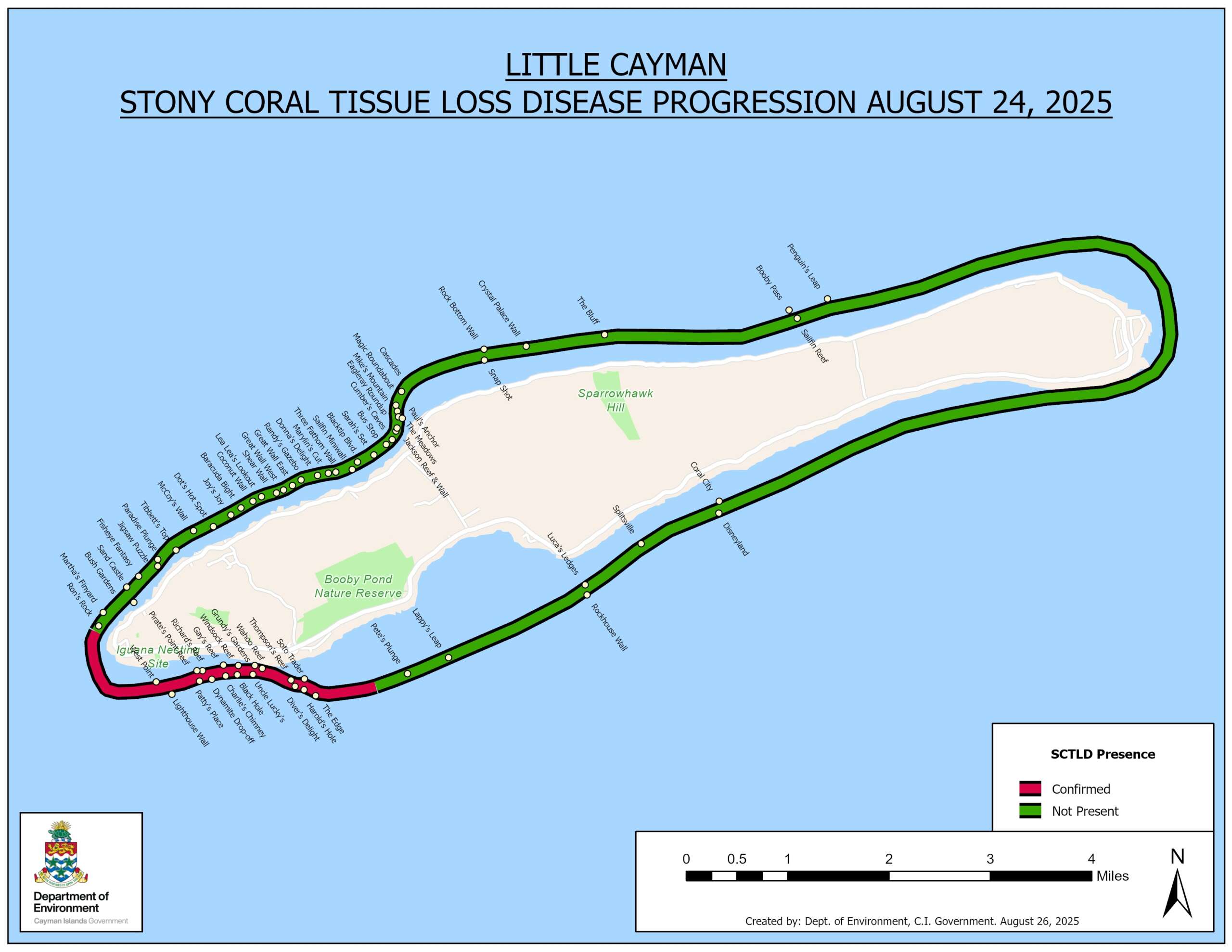
The Department of Environment, on 4 Sept., reported it had confirmed that lesions, which had been spotted on corals at Black Hole and Windsock Reef dive sites on the southwest coastline of Little Cayman, were caused by stony coral tissue loss disease.
Based on data on the progress of the disease on Grand Cayman, researchers have determined it spreads at about one mile a month, meaning the infection likely became established in Little Cayman in July this year, the DoE reported.
So far, there have been no reports of the disease being found on Cayman Brac.
In Grand Cayman, the Department of Environment’s staff and volunteers had battled to stop or slow down the unrelenting march of the disease by using antibiotic paste on infected corals, but it spread around the entire island within 18 months, after being first found at the Penny’s Arch site off Rum Point in June 2020.
The disease was first identified off the coast of Miami-Dade County in Florida in 2014, and since then, it has spread throughout the Caribbean.
Efforts to try to stop the disease from reaching Little Cayman, an internationally renowned dive destination, had included instructing divers to disinfect their dive equipment and boaters to add bleach to their bilge water prior to arriving on the island.
“These measures successfully delayed the transmission of [the disease] from Grand to Little Cayman for the last several years and are still recommended for travel to Little Cayman so as not to add any additional infection sites to the reefs there,” the Department of Environment said.
It added, “Unfortunately, data collected in Grand Cayman has proven that once established, the spread of SCTLD is essentially unstoppable. However, with continued vigilance in keeping dive gear and bilge water island specific, perhaps we can delay the spread of SCTLD to Cayman Brac for a few more years.”
The department said its scientists and senior management would continue to monitor the spread of the infection in Little Cayman and “are evaluating various new and old methods to mitigate and manage the disease”.
Disease adding pressure to already-stressed reef
The discovery of SCTLD on Little Cayman will put additional stress on a reef already reeling from the impacts of bleaching.
In 2023, before a major worldwide bleaching event, surveys by the Little Cayman-based Central Caribbean Marine Institute recorded that the average coral cover in Little Cayman had been at its highest since monitoring began in 1999, at 27.3%. Following the severe bleaching, the institute found that coral cover in 2024 plummeted to the lowest ever recorded – just 10%.
A Health Reef Report Card produced by the institute noted that between June 2023 and August 2024, the coral health state on the island had changed substantially, pointing out that in 2023, over 90% of reefs were recorded to be in good to very good condition, but by the following year, 0% of the reef was recorded as being in a better-than-good condition.
Related Videos








A lot of sad stuff in the news lately. This is the end of diving as we knew it. Not great for tourism either.
In some cases, climate change (warming waters) has been suspected as the cause of coral diseases.
I’m no scientist, I’m not even a diver but has the human impact on our reefs been assessed by anyone?
For over 50 years, our reefs have been assaulted by large-scale commercial scuba diving. Who can say what that impact is? Clearly, human factors have led to the decline of, or damage to, natural resources in every other area of our environment.
Our DoE and volunteer divers have tried some measures to address reef damage. However, has Government ever considered closing dive sites on a temporary and rotating basis? The pandemic lock down allegedly helped restore populations of small reef fish, perhaps closure of some dive sites may help restore the health of those corals.
It might be a tough call by Govt, and of course, the dive companies will go ballistic, but the focus should be on the possible longer-term benefits.
Reducing human activities on our dive sites for a while may help towards improving coral health.