Related: Opposition criticises government’s borrowing plans
Government is planning a return to operating surpluses, without any new fees or taxes in its 2022/2023 budget, based on better than expected revenues.
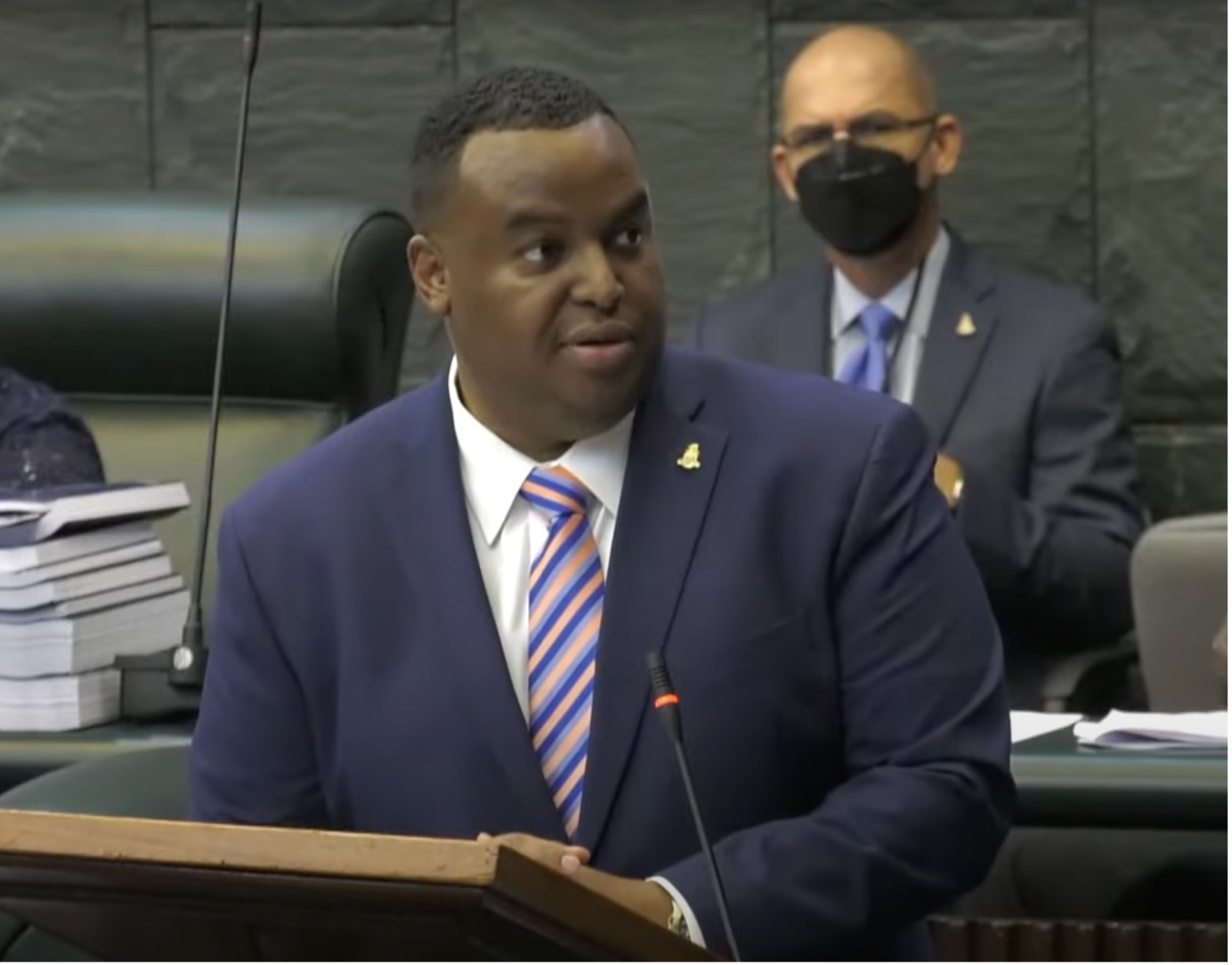
According to Finance Minister Chris Saunders, the 2022/2023 budget will see a return to full compliance with the Public Management Finance Act (PMFA) after a COVID-related budget deficit that is projected for this year.
Government’s day-to-day operating expenses will not be funded by borrowing, but entirely by government’s operating revenue, Saunders said during the presentation of the 2022/2023 Appropriations Bill on Friday.
At the same time, government would not raise any fees or new taxes.
Borrowing is, however, set to increase to up to $349.1 million over the budget period to finance government’s planned capital investments of $170.1 million in 2022 and $133.4 million in 2023.
Government also plans to make equity investments in statutory authorities and government companies of $30.4 million in 2022 and $28.9 million in 2023 and grant loans of $26.9 million and $12.1 million, respectively, to provide further support of the ongoing operations of these entities.
To meet the requirements of the Framework for Fiscal Responsibility that is part of the PMFA, government will have to achieve a budget surplus in each of the budget years.
Saunders projected core government operating revenues of $949.9 million in 2022 and $978.1 million in 2023, in contrast to operating and financing expenditures of $921.5 million in 2022 and $950.4 million in 2023.
This would result in core government operating surpluses of $19.4 million and $27.7 million, respectively.
The finance minister said when the government took office in May, “we were already facing an uphill battle, given the impact and uncertainty that the COVID-19 response and recovery had on the country’s economic activities and the government’s finances”.
In a pre-election economic and financial update, government was expected to see an operating deficit of $98.3 million at the end of this year and an operating deficit of $59.6 million at the end of 2022.
Now, the operating deficit for 2021 for the entire public sector is estimated to be closer to $40 million.
Pandemic expenditure
The COVID-19 pandemic increased government expenditures this year by 24% or $188 million beyond what was originally budgeted.
About 12% of that amount, or $115 million, consisted of COVID-related expenses, including $60 million given to displaced workers in the tourism industry, $47.7 for testing, supplies and Travel Cayman, $3.4 million to support business initiatives, $2 million for the support of micro- and small businesses, $1 million to support the vulnerable and $800,000 to help people maintain healthcare coverage.
An additional $10.5 million was spent in response to the effects of Tropical Storm Grace.
And statutory authorities and government companies are forecast to have a net operating deficit of $54.3 million in 2021, in contrast to the budgeted deficit of $16.9 million, Saunders said.
The main loss leaders are the Airports Authority with $28 million, the Turtle Centre ($10.7 million), the HSA ($7.5 million), the Port Authority ($7.2 million), CINICO ($3.5 million), and Cayman Airways with $3.1 million.
Improved revenues cause smaller-than-anticipated deficit
The lower than-expected deficit this year is mainly due to much-improved revenues that mitigated a significant shortfall in tourism-sector income for the government.
Operating revenues for this year are forecast to be $932.3 million, which is 10% higher than estimated in the original 2021 budget and $70 million higher than in 2019, the last year before the COVID-19 global pandemic.
The finance minister said, “Overall, revenues for core government are forecasted to be higher than original budget, largely due to the impact of higher volumes of dutiable transactions, along with the continued growth of local real estate markets and a solid reliable performance of the financial services sector.”
Specifically, other stamp duties were $8 million better than budgeted, stamp duty on land transfers were $54 million higher and new revenue from private fund fees brought in another $54 million. In addition, mutual fund administration fees and company fees each raised about $6 million more than projected.
Related Videos