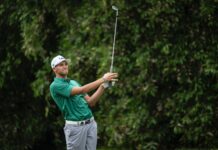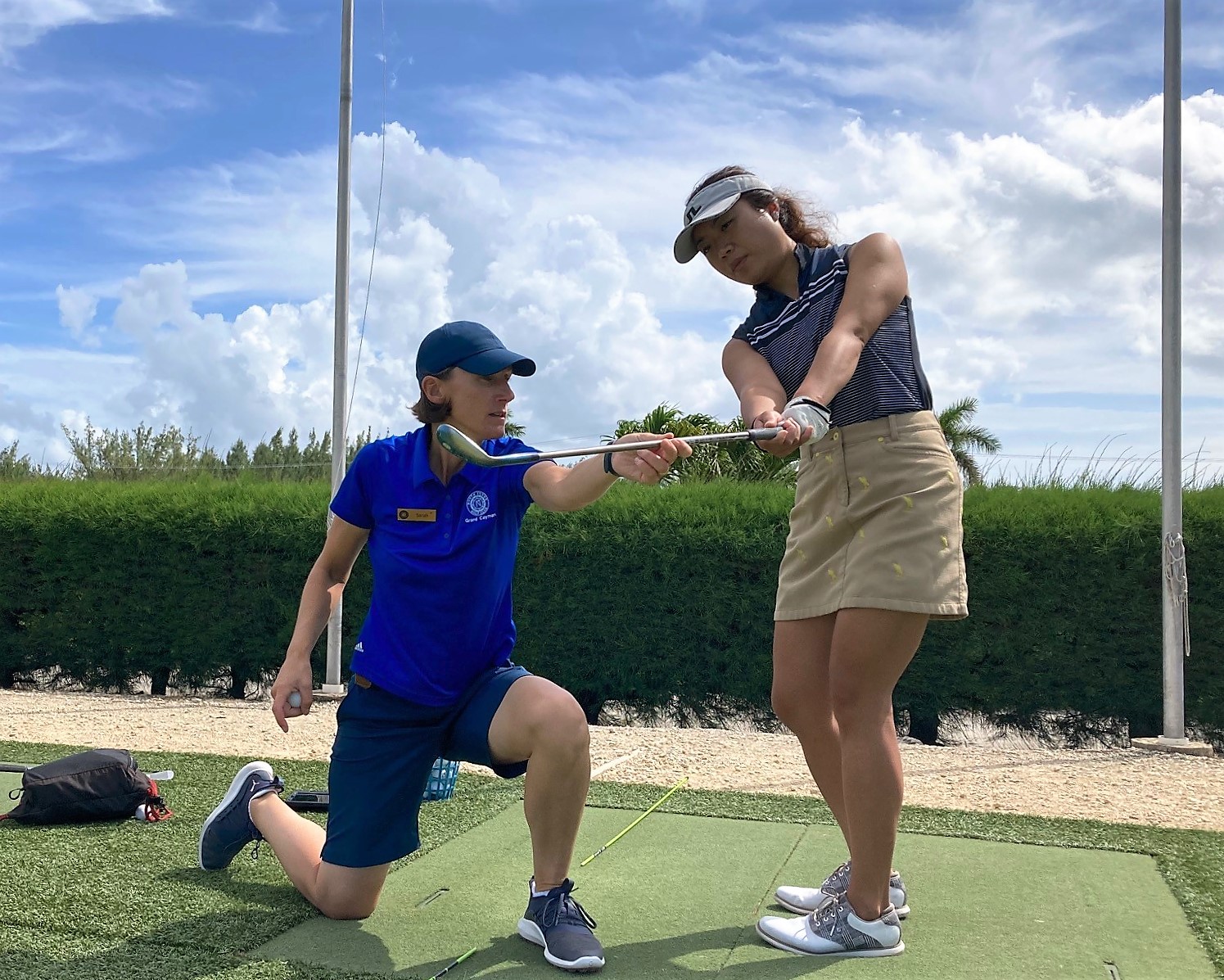
At the North Sound Golf Club, instructor Sarah Walton guides her student through a series of chipping drills.
“Twist your body a little more on the follow-through,” she explains, playing back a video on the iPad as the satisfying sound of clubs connecting with balls echoes around the driving range.
It’s another busy day for Walton, the newest instructor at the club. Her lesson schedule is already booked out for the week.
“Membership is up, lessons are up, rounds are up, the number of people on the range is up,” says the club’s general manager Jeff Sauvage.
“I hate to see a silver lining in all of this, but COVID has definitely been good for golf.”
Even without tourists on island, 2021 was the busiest year on record for the golf club, with membership up 15%. There is expected to be even more traffic on the fairways this year.
As a naturally socially distant sport played amid acres of fresh air, golf has emerged as the perfect pandemic activity, with participation surging across the globe.
It is not just golf. The Cayman Islands Tennis Club and The Courts at The Ritz-Carlton, Grand Cayman are crammed with newbies learning the sport for the first time.
Pickleball has emerged from nowhere as one of the most popular activities on the island. And, on any given weekend, the ocean is filled with novice paddleboarders, kitesurfers, scuba divers and snorkellers.
The popularity of these pastimes is evidence of one of the more subtle shifts in human behaviour that the COVID era has brought.
Sweating through workouts in indoor gyms and fitness studios has become a riskier proposition since the outbreak of community transmission of the virus in the Cayman Islands came with the hassle of vaccine mandates, testing requirements and social-distancing protocols.
After hospitality and entertainment, the fitness industry has been one of the hardest hit by the pandemic. But the need to work out has found new outlets.
In Cayman, calories expended on spinning bikes and yoga mats are now more likely to be deployed swinging a tennis racket or a golf club.
While some have been financially impacted by the pandemic, many workers in Cayman not connected to tourism have maintained their standard of living.
The inability to take vacations for the better part of a year has even put more disposable income in people’s pockets – money that they have been inclined to spend on learning something new.
“When the restrictions ended about 18 months ago, we started to see an uptick in rounds,” said Sauvage.
“With the borders closed, a lot of our members couldn’t go anywhere and so they stayed on the island and played golf.”
He said many people had taken up the sport for the first time and found that they loved it.
While the longevity of golf’s current boom remains to be seen, he believes one legacy of the pandemic – and in particular the experience of being cooped up at home during lockdown – will be a greater appreciation of the outdoors.
“People are generally spending more time outside and I think our sport and a couple of others will see long-term benefits,” he said.
Everyone for tennis
At The Ritz-Carlton, getting enough staff to meet the demand for lessons is the biggest challenge.
Uli Hoppe, director of tennis, said the courts were packed. Resident players are helping to compensate for the absence of tourists. It’s a similar story at the Tennis Club in South Sound where membership has soared.
“Tennis and golf were the first sports to be allowed after lockdown and both have really taken off,” he said.
Pickleball – a four-player adaptation of tennis that can be played on a much smaller court – is also emerging as a growth activity. The Ritz-Carlton hosts popular introductory sessions, while the Tennis Club is also adapting its courts to allow people to play.
Cayman Sports, a fitness and instruction business, is one of the premier organisers of pickleball matches. Owner Warren Urquhart said the sport – unheard of in Cayman a few years ago – has “exploded”. A 12-court complex with a bar and restaurant is now planned.
Cayman residents trying new things
Similar impacts are being seen on the water. Businesses, still hurting from the lack of tourism, are finding local residents more willing to try activities in Cayman that they previously had not considered.
At Barkers Beach, Jhon Mora surveys the array of multi-coloured kites that streak across the clear water.
“The highway is busy today,” he jokes as he patrols the bay, directing instructors, stashing away gear and keeping a keen eye on the scores of kiteboarders out at sea.
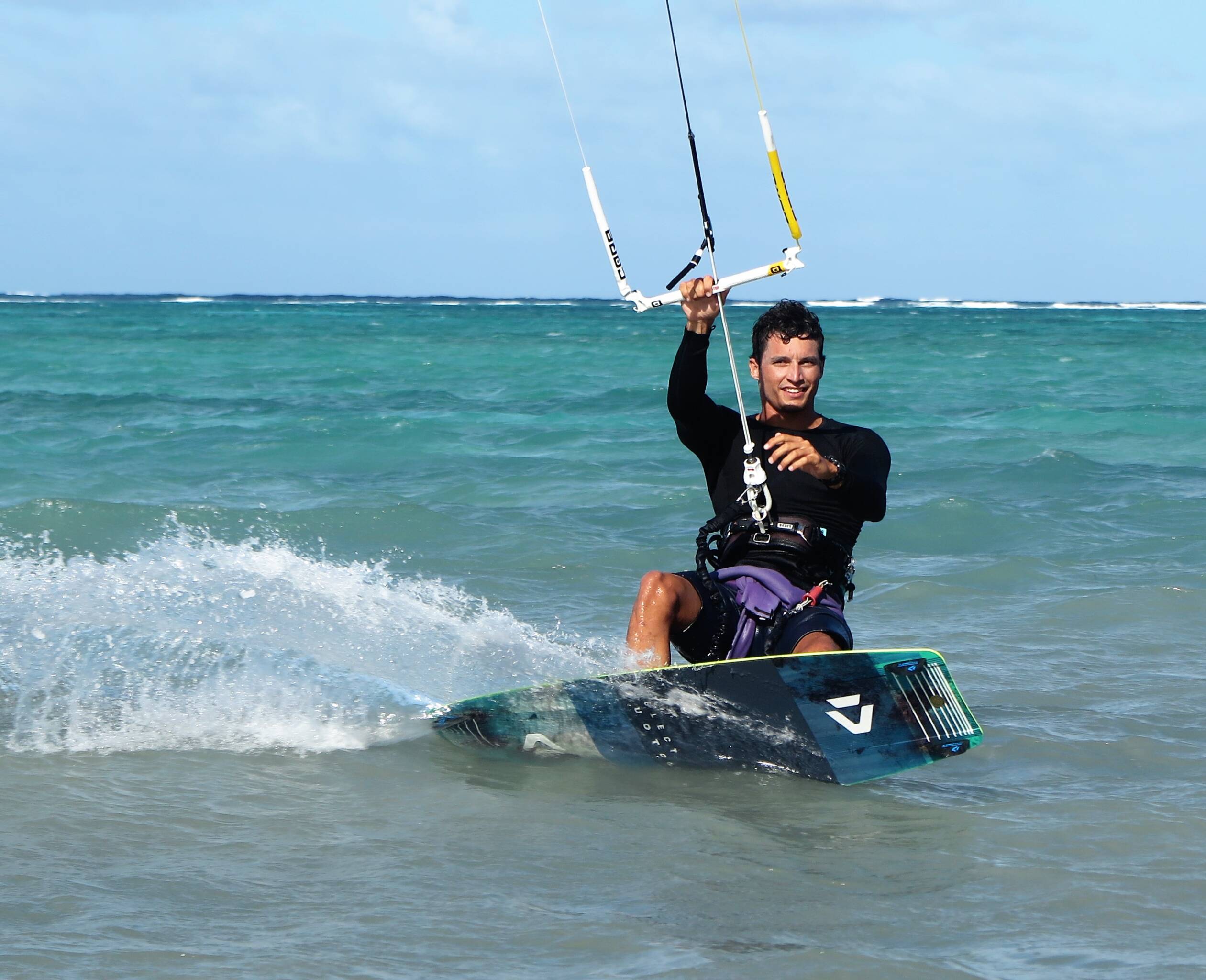
The COVID-19 pandemic has cut both ways for his business, Kitesurf Cayman. While there are fewer tourists flying in for lessons, many more locals are taking up the sport for the first time.
With cancelled vacations putting cash in people’s pockets and flexible working arrangements creating more free time during the day, he is seeing a surge in interest in the sport within Cayman.
“We are definitely seeing more people trying lessons for the first time,” he said. “It is the perfect socially distant sport because you are out on the water and in the wind. People get hooked pretty quickly.
“I think a lot more people are also working from home, so they can be a bit more flexible and come out here when the wind is good, and work in the evening if they have to.”
Gyms suffer in comparison
The flip-side to the migration of some sporting activity to the great outdoors, is evident for some businesses.
At gyms around the island, January is usually peak sign-up season, with New Year’s resolutions spurring a surge in membership.
But the outbreak of COVID, that has led to so many people taking up outdoor sports, has had a reverse impact for gyms and fitness centres.
Even those that are inclined to work out have been put off by government regulations that require members to show proof of vaccination at the door. A negative PCR test is required for unvaccinated members – a costly and time-consuming requirement that has some members balking.
The measures may also have contributed to the impression of indoor sports as hazardous activities at a time when COVID is spreading within the community.
Premier Wayne Panton highlighted the “elevated risk of potential infection” when he defended government’s decision to impose specific protocols for gyms and sports centres in November. He has since indicated government could provide financial support to aid struggling businesses in this sector.
At King’s Sports Centre, which has squash courts, indoor football and hockey, as well as a fitness centre and studio, CEO Rex Ebanks said the restrictions had impacted the business’s recovery from the initial impact of COVID.
“People have not been afraid to come to the gym; however, they are limited because of the mandate,” he said. “Our business has suffered because of the regulations.”
Compared with the hardships that hit the hospitality industry, he said he was grateful that his business had been able to stay open. He said King’s had done really well from the end of the initial stage of the pandemic in August 2020 up until the outbreak of community transmission and the social-distancing and vaccination requirements that followed.
“We just have to wait for the regulations to change, like everyone else,” he said.
Fitness industry gets creative
Perhaps counter-intuitively, group activities, like circuit training and CrossFit, have been quicker to pick up.
That might be because they help satisfy another human need that was cut off during lockdown and isolation – social contact.
People have been willing to jump through the hoops of providing proof of vaccination or negative test results in order to be back with their tribe, says Wanda Brenton, owner of Seven Mile Strength and Fitness.
“People come for the community. This is where a lot of people make friends,” she said.
The business had to get creative to survive during lockdown.
“We ended up loaning out all our equipment so people could do classes on Zoom. We hardly lost any members at all. It was actually something people needed and appreciated during the lockdown,” said Brenton.
Initially, people were cautious about coming back into the studio, but once the fears of COVID started to subside, she said, the classes were full again.
The outbreak of community transmission in September halted the recovery for a while.
“Before the holiday, people were definitely concerned. They didn’t want to catch COVID and be in isolation for Christmas.”
But the impact didn’t last long and the vaccination and testing requirements proved a minor hurdle.
“People were willing to do anything to get back in that environment again,” she said.
An increasing number of outdoor training options are available for those that don’t want to take a chance.
The business has diversified over the past few years. Its training programmes for the Flowers Sea Swim, triathlons and marathons – mixing gym work with outdoor training – have proved popular. A first 5K running group started this month.
Yoga moves outdoors
Bliss Yoga is another business that has adapted to keep up with the times.
As numbers tumbled during Cayman’s COVID outbreak last winter, the business looked to private lessons and outdoor classes to help fill the void, moving from twice-a-week to daily sessions at the Kimpton Seafire Resort, both on the grounds and on the beach deck.
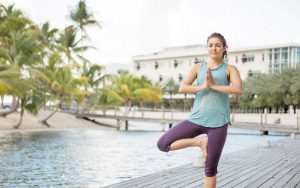
At the worst point, owner Janelle Fleur Kroon said, numbers at the studio were down about 60% compared with pre-pandemic levels. The loss of tourism plus social-distancing restrictions played a role, but the emergence of COVID on island was the biggest factor.
“People were reluctant to mix in indoor settings, particularly if they had travel plans over the holiday season,” she said.
Brisk business at the store, which sells yoga gear and equipment, has helped keep the business buoyant. “Retail has been our saviour,” she added.
Community is key
Regular testing for staff has also been implemented in an effort to keep everyone healthy. Bliss has the advantage of large studio space that allows instructors to operate socially-distanced classes.
Not every studio has that option, and others have suffered more.
Despite lean times for the sport, Kroon believes it will spring back as the fear of the virus and the measures to suppress it begin to decline.
“Anyone who has had a consistent yoga practice will want to come back to it,” she said.
“One of the biggest aspects of yoga practice is that energy you get from being around other people.
“We are social beings. We are not meant to be isolated from one another. That is human nature, and I think that is something we appreciate now more than ever, so I am confident we will pull through.”
Related Videos