

Consumers are going to face a double whammy of rising fuel costs and higher electricity consumption in the hot summer months, Cayman’s electricity provider Caribbean Utilities Company has warned.
CUC has cautioned consumers that higher fuel prices will mean higher fuel-cost charges in electricity bills.
In a customer newsletter, the utility noted that just when higher fuel costs are going to have an impact on the cost of power generation, temperatures will be rising, too.
Higher temperatures force appliances, especially air conditioners and refrigerators, to work harder and consume more energy.
“We ask that you prepare as much as possible as unprecedented increases in fuel costs that are being experienced by CUC today… will flow through to customer bills later. Combined with the increased consumption associated with summer months, there could be significant bill increases,” the electricity provider said.
In a shred of good news, CUC noted that because there is a two-month lag between changes in market prices and fuel charges for energy generation, there will not be an immediate increase of fuel costs in the bills that customers will receive in April and May.
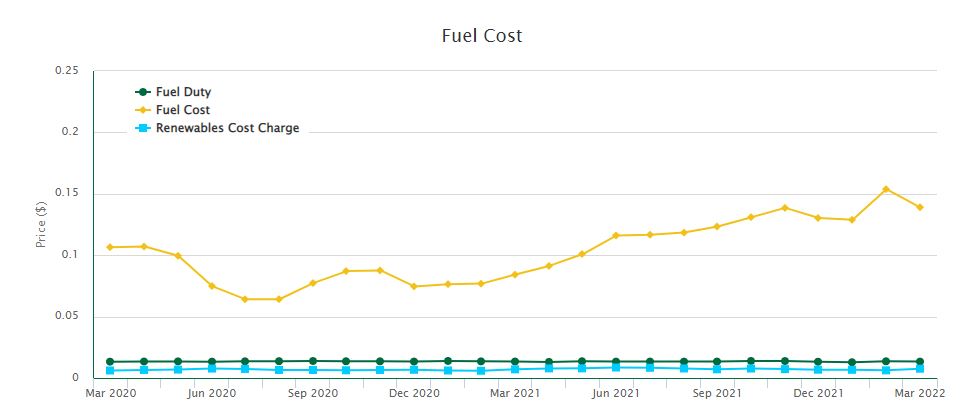
The current fuel charge will remain at approximately $0.14, slightly below the fuel cost charged in February. However, this is more than double the fuel cost applied in July and August 2020, after crude oil prices had briefly dropped below $20 per barrel.
 CUC is trying to protect against extreme volatility in fuel prices by using call options and spreads under its Fuel Price Volatility Management Programme. By buying a call option for an upfront premium, the energy provider will receive a return on the option that offsets the higher costs of fuel if the price increases. If the price declines, the company will benefit from the lower fuel cost.
The fuel hedge effectively creates a ceiling for the price of fuel at a predetermined cost.
However, the programme typically covers only a portion of CUC’s fuel needs. The cost of these derivatives also increases as fuel prices rise.
The company buys approximately 60% of its fuel from RUBiS Cayman Islands Limited and 40% from Sol Petroleum Cayman Limited.
CUC advised customers to monitor energy usage to identify areas where they may be able to reduce energy consumption. The utility noted that air conditioners are on average responsible for 60% of a household’s electricity costs. Other high-consuming appliances are washing machines and dryers, fridges and freezers, as well as gaming consoles and computers.
Related Videos













If CUC was really concerned about the increase in electric bills they would make it easier for people to use solar power rather than restricting it as much as they do.
There’s no reason why half our electricity couldn’t come from solar.