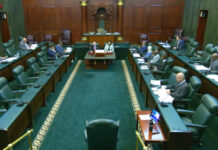
Members of the Public Accounts Committee on Wednesday questioned officials on why government still does not have an official policy in place for granting duty waivers and concessions.
Auditor General Sue Winspear, in a report issued in February this year assessing the government’s progress in carrying out recommendations based on value for money, said that since 2015, her office had been recommending that government develop “a formal, comprehensive concessions policy”, but so far, none has been developed.
“As a result, concessions continue to be inconsistently awarded and the underlying conditions, for example, employing Caymanians, are not being monitored so it is unclear if they are being met,” she said in a statement accompanying the report at the time.
Winspear noted in her report that, of 20 recommendations made in relation to Customs by her office and the Public Accounts Committee in 2017, only six had been implemented.
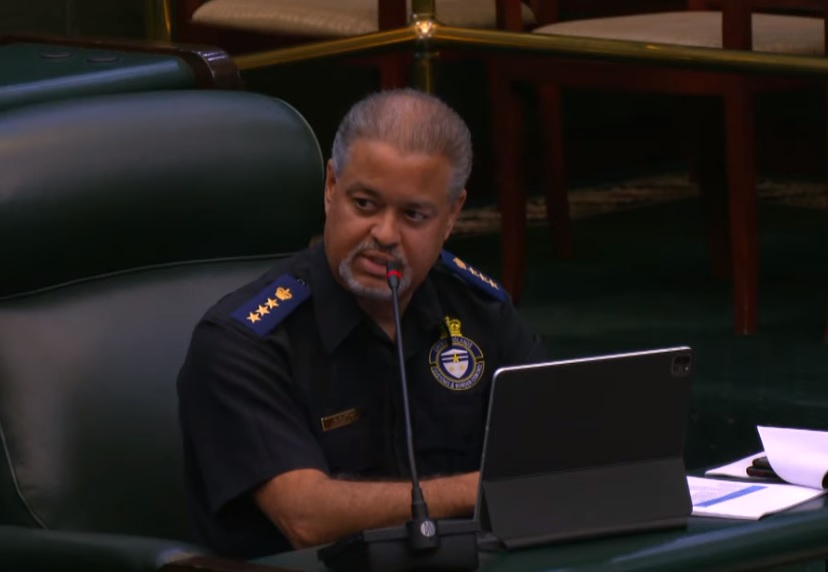
Financial Secretary Kenneth Jefferson and Director of Customs and Border Control Charles Clifford appeared before the PAC on Wednesday to explain why so many of the recommendations were still outstanding, including the one calling for government to introduce a clear policy on duty waivers.
The issue was raised in court recently, when Doctors Hospital brought a judicial review challenging the government’s continuing import- and stamp-duty concessions for Health City Cayman Islands, which were granted in 2010 and which appear set to continue for several decades. A ruling on that case has not yet been delivered.
Efforts to introduce policy

Jefferson told the committee that there had been efforts to implement an official concessions policy under a number of successive government administrations.
He noted that a draft policy had been developed to “aid the government of the day in deciding whether to grant a request for concessions on revenue, either as an outright gift of revenue being foregone, such as import duty or stamp duty, a reduction in those revenues is another possibility, or a deferral of those revenues being collected.”
He said a draft policy had been presented to caucus in November 2016 – six months before the May 2017 election which brought the Progressives-led government back to power. Jefferson told PAC chairman Roy McTaggart that in June 2017 he had asked the then-minister for finance, who at that time was McTaggart himself, if he could send the policy to the new government caucus.
In September 2019, a presentation of the draft policy was made to the Progressives’ caucus, which “asked for certain changes and refinements”, Jefferson said.
“On 4 March 2020, you asked me to make the finalisation of the policy a priority for 2020,” he told McTaggart. “Unfortunately, COVID-19 came, shut the islands down, and that really destroyed in 2020 much of an opportunity for caucus to meet and to finalise the policy, and COVID-19 matters took precedence over the finalisation of the revenue concession policy.”
Following the PACT-government being elected in April 2021, a slot for the draft policy to be presented by the Ministry of Finance to caucus was given in October, but that was deferred, Jefferson said.
He said the current finance minister, Chris Saunders, at his own request, was sent the draft policy in February this year. On 2 May, Jefferson said, he was informed by Saunders that a committee consisting of himself, Premier Wayne Panton, financial services minister Andre Ebanks, PAC member Katherine Ebanks-Wilks and chief strategist Pilar Bush had been set up to develop a concessions policy and that was expected to be completed by the end of June.
Pressed on whether this was an entirely new policy from the draft policy that had earlier been circulated, Michael Nixon, senior assistant financial secretary, whom Jefferson described as being key in developing the draft policy, said he understood the committee’s policy would be based on the draft document.
No recent large concessions
Nixon told the PAC that, in recent years, there had been no large multi-year concessions given to major developments. The last one, he said, was in 2018.
He told the committee that the Ministry of Finance did not track foregone revenue from “large multi-year concessions”, for example, ones that government has approved for 20 years or more. Those, he said, would be tracked by Customs.
“The approval [from Cabinet] would have stated a maximum amount and time period,” Nixon said. “We in the Ministry of Finance don’t see the day-to-day process, so can’t say with certainty, for example, whether $500,000 was processed this year or this month [in relation to a particular concession]. That information would have to come directly from Customs.”
Who is monitoring concession conditions?
George Town South MP Barbara Conolly raised a query that had been among the concerns expressed by Winspear in her report, about who keeps track of whether a developer or employer, who has been granted concessions, adheres to conditions attached to these waivers, such as employing a specified percentage of Caymanians.
Nixon said, in those circumstances, companies typically would give an undertaking to report the number of Caymanians on their staff to the Department of Labour and Pensions, although he noted that there had been one instance of which he was aware where a developer reported monthly to the Ministry of Finance on the number of Caymanians being employed there.
Conolly asked, “Shouldn’t that be the requirement for every developer – that it be monitored to ensure they are following the conditions they’ve been granted the concessions under?”
Nixon responded, “These are some of the exact points we would hope to be addressed comprehensively in the concessions policy and the concession agreements.”
Stamp duty concessions
Jefferson told the committee that the Ministry of Finance had recorded foregone revenue of $7.5 million in 2021, a large proportion of which was accounted for by the granting of stamp duty concessions to first-time Caymanian property buyers.
Some of that foregone revenue, referred to in the meeting as a ‘tax gap’, included import duty waivers to schools or charities who applied directly to the ministry to bring in a vehicle or furniture, he said.
Jefferson said the $7.5 million in foregone revenue amounted to 1% of the $961 million in revenue recorded by the ministry last year. This, he said, compares to the UK’s 5.3% ‘tax gap’.
However, he acknowledged that the “1% number is too low”, that there are some foregone revenues that would be recorded by CBC and not shared with the Ministry of Finance, such as those revenues relating to multi-year concessions for major developers. He said the ministry and CBC were working on creating better cooperation between the two entities.
‘Not ideal’
Responding to questions from Savannah MP Heather Bodden, Clifford said his own department was “certainly looking forward to the finalisation of the concessions policy”, noting that, at times, CBC had to seek clarity from Cabinet regarding some of its instructions on concessions, “and that’s not an ideal situation”.
“We do the best we can with the information we have available to us,” he said. “We follow the decisions in Cabinet very, very carefully and usually the concessions have an end date and that’s flagged in our system.”
Asked by East End MP Isaac Rankine if CBC keeps track of the “tax gap”, Clifford said the concessions policy will help to establish an “annual cap in relation to concessions”, thereby making the forecasting of foregone revenue easier.
Responding to a question from the PAC chairman McTaggart, Clifford confirmed that CBC keeps track of the value of concessions granted to developers to ensure that they do not benefit more than the amount that Cabinet has approved.
Read the Auditor General’s report here.
Related Videos