

For the majority of the more than 4,000 civil servants employed across the Cayman Islands government, the daily task of clocking into their ‘9-to-5’ requires them to show up and complete their duties no matter how complex or mundane.
But this isn’t the case for all government employees.
A massive loophole in the Personnel Regulations of the Public Service Management Act means that, for a select few, their government jobs have become extended paid vacations – whether they like it or not.
A Cayman Compass Freedom of Information request to the Deputy Governor’s Office revealed that, as of 7 Feb. 2022, 13 government employees were on required leave while being paid their full salaries and receiving other benefits as per the Labour Law.
The situation has cost the public in excess of $1 million over the past four years, according to analysis by the Compass. The auditor general has previously highlighted the level of funds being wasted on salaries for suspended public service employees, and successive governments have indicated plans to close the loophole. No action has been taken, however.
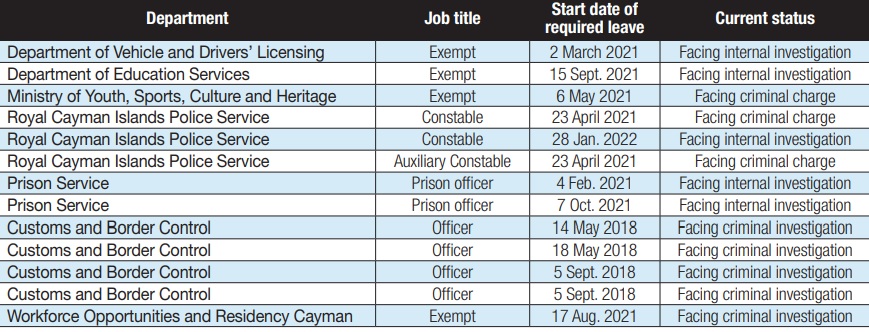
Of the 13 civil servants currently suspended on full pay, four are Customs and Border Control officers who have been out of office since 2018 amid ongoing criminal investigations.
Six others from various departments are facing ongoing internal disciplinary investigations.
Only two of the 13 have been formally charged with criminal offences, both of whom were formally charged last year.
Although the FOI data goes back to 2018, it does not give the full picture because the Office of the Deputy Governor does not keep records of employees who have been terminated following the findings of investigations or court procedures.
The DG’s office also does not keep records of employees who were cleared of allegations and have since returned to work.
That means the number of civil servants who have been off work on full pay and benefits during the past four years could be higher than the FOI information indicates.
While it is possible to obtain such records, the DG’s office told the Compass that individual FOI requests would have to be sent to each government department, statutory body or and government-owned company.
The loophole
Government’s hands are tied by the Personnel Regulations, which address the suspension of a government employee for ‘gross misconduct’; and, to a lesser extent, by the Public Service Values and Code of Conduct policy which sets out a list of expectations that should govern the actions and decisions of civil servants.
“The Civil Service is a fair workplace with measures in place to appropriately respond to instances such as the need for administrative leave,” said a statement issued on behalf of Deputy Governor Franz Manderson, in response to questions from the Compass. “These regulations allow the government to balance the needs of both the public and civil servants in a fair, transparent and impartial manner.”
Section 40(2)(b) of the regulations states that when deciding whether to fire a staff member on grounds of gross misconduct involving allegations of criminal activity in the workplace, the employee must be given an oral and written warning from an appointing officer who is to “arrange for the suspension on full-pay to take immediate effect”. That section of the regulation also requires the appointing officer to notify police.
Section 41(2)(b) prescribes the same course of action for instances where a civil servant has been charged with an offence relating to alleged misconduct outside the workplace.
The law makes no mention of a time limit, therefore, in theory, allowing civil servants an unlimited amount of time to receive a full salary while awaiting the outcome of an investigation. This issue was flagged by the Auditor General’s Office in a 2018 report on ‘Fighting Corruption in the Cayman Islands’.
“The Cayman Islands Government’s policy on required leave may also not provide sufficient incentive for civil servants accused of fraud or corruption to conclude their cases quickly as they can continue to be paid for long periods of time while their cases are investigated,” reads the report.
In November 2017 during an interview with Compass, Manderson said his team was looking to revise the Personnel Regulations to limit paid leave to 12 months.
“We believe [that] is sufficient time for a criminal case to be concluded,” Manderson said at the time.
In the months prior to that interview, the number of civil servants on required leave fell from 26 to 16, and during a report to the government that year, Manderson stated that 11 civil servants were released from employment following their period of suspension, while another 14 returned to work – noting that the list of suspended employees was “not static”.
It is now five years and two governments later and still, no changes have been made to the regulations.
In May this year, Gloria McField-Nixon, chief officer in the Portfolio of the Civil Service, told the Compass the regulations were “under active review”.
“I can confirm that the provisions are drafted and under active review, including legal review,” said McField-Nixon. “Once vetted, the policy will proceed to Cabinet.”
Cost to the public purse
Due to the sensitive contractual nature of salaries and other benefits, it is impossible to arrive at an accurate dollar value of how much civil servants on required leave are costing the public purse.
There is no average monthly salary for civil servants. However, if the 2020 Fall Labour Force Survey, which states that approximately 60% of civil servants earn $2,400 per month, is to be used as a baseline, then the 13 civil servants who have been on required leave for a combined total of 438 months have cost the government a minimum of $1 million.
But the true figure is undoubtedly higher, as $1 million does not take into consideration the civil servants who were either fired or returned to work during the same time after being placed on suspension.
Proof of this is that in 2019 five civil servants were convicted of fraud-related charges in what is thought to be the country’s largest corruption case, and, more recently, two prison officers were fired after being placed on required leave while being investigated for smuggling ganja into Northward prison. Some of these individuals, who were not included in the FOI, were on required leave from 2015 and had their matters finalised in 2019.
No value for money
The Auditor General’s Office has flagged that, by placing staff on required leave for extended periods, government is not receiving a fair exchange.
“Our view on this policy, therefore, remains the same as it was in 2018; we do not think this provides value for money and may not be in the best interests of the Cayman Islands Government,” said Angela Cullen of the Auditor General’s Office.
When asked about the possibility of recouping funds from government employees who were convicted of a criminal offence after being placed on required leave, the DG’s office said, “There are no current provisions in the Regulations for recouping funds paid to individuals who are placed on administrative leave.”
Although the true number of civil servants who were either terminated, have returned from required leave, or are still on required leave is difficult to obtain, anecdotal evidence suggests that, at any given time, less than 1% of the civil service is on administrative leave.
The DG’s office said this, in context, shows that the vast majority of civil servants are productive.
“The number of persons placed on administrative leave demonstrates just how seriously the civil service takes performance management and the misconduct of its employees,” said the DG’s office. “There are over 4,000 civil servants employed within the service, when these numbers are considered, it demonstrates that the vast majority of civil servants perform their duties in a manner that is consistent with the public service values and code of conduct.”
While this may be true, the issue isn’t that only a small amount of civil servants find themselves on extended required leave, rather it is the fact that, despite multiple administrations and years of promises, no action has been taken to close or reduce this loophole – which the Auditor General’s Office says is a decision for the government to make.
Related Videos







This is yet another significant blot on our “world class” Civil Service. With more than 4 years of full salary and benefits these people if they know they are guilty have more than likely found other jobs.
This is an untenable situation yet it has been going on for decades and Manderson has done nothing about it.
As I have always said: “It’s easy to be generous with someone else’s money. ”
Ridiculous. No wonder these cases are dragged out.
We have so many people going without food, shelter and income. CIG Civil Service needs to be audited and reviewed and recommendations need to be made to ensure all Caymanians are treated fairly.
The problem isn’t just on the accused employee side, its on the other side where investigations apparently aren’t concluded for years. Someone did something wrong? Fire them. You accuse someone of doing something wrong but can’t prove it? That’s on you, put them back to work. (Somewhere else if necessary.) Just do it faster. But since they’re not rushing to put a timeline in place for concluding their investigations they can’t put a timeline in place for not paying staff accused of unproven wrongdoing.