Evidence presented on Friday in the fraud trial against Canover Watson and Bruce Blake shows that Fidelity Bank was told that funds used by the Cayman Islands Football Association to repay a troubled CI$1.6 million loan with the bank did not come from the association’s usual sources of income.
The court heard that Fidelity also agreed to remove a charge on CIFA property securing the loan after receiving a US$500,000 deposit from CONCACAF in relation to a prepaid card services contract given to the bank.
In the case, the prosecution alleges that criminal proceeds from three false invoices sent by Watson to regional football body CONCACAF for sporting goods that were never delivered were ultimately transferred to Cayman’s football association.
To justify the large cash injection to CIFA’s auditors and banks, it is alleged the defendants produced two fake US$600,000 loan agreements.
One agreement supposedly involved CIFA and Forward Sports, a sporting goods manufacturer in Pakistan, which supplied sports equipment to the association.
The Crown alleges, the loan agreement instead featured a Panamanian company, Forward Sports International Management Inc, secretly controlled by Watson.
Internal Fidelity Bank emails read at the trial showed that Watson, who was an executive at CIFA and CONCACAF at the time, had informed senior banking executives of plans to repay most of the loan before the end of the year 2013 with some of the money coming from “an Indian” sports equipment manufacturer.
CIFA loans ballooned
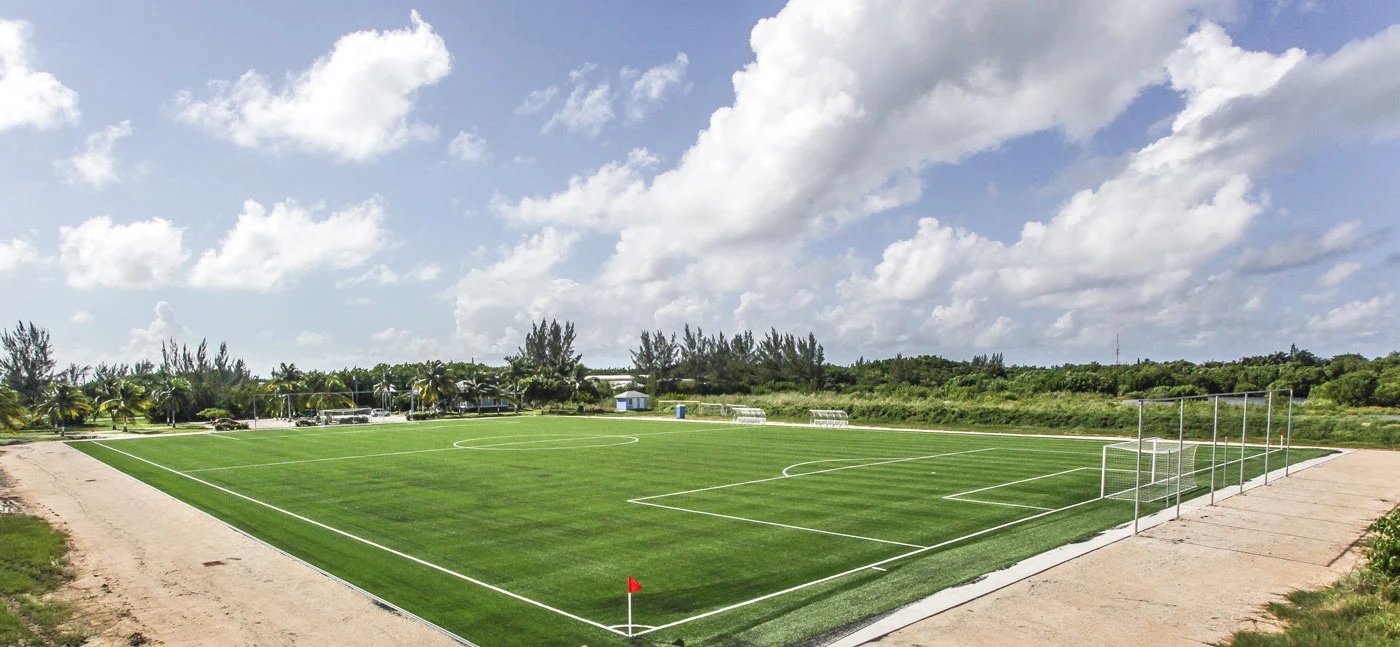
The jury was told that in 2010 the football association’s various loans and lines of credit with Fidelity were restructured into a single CI$1.622 million loan, an amount the bank felt was sufficient to finish construction of CIFA’s Centre of Excellence.
The loan was secured by a charge over the field and premises at CIFA’s headquarters on Poindexter Road, as well as personal guarantees from Watson and Jeffrey Webb, the CIFA president at the time.
The court heard from former Fidelity Bank Cayman CEO Brett Hill that CIFA had missed some quarterly loan repayments and covered mostly interest charges.
Hill testified that although the CIFA loan had not always been current, the bank had believed it would be eventually repaid with grants from world football governing body FIFA. These included the FIFA GOAL project to support the development of football infrastructure.
Fidelity had a cordial relationship with Webb and Watson, two former employees, and Hill said he trusted Watson.
However, Cairns Nelson, QC, defence attorney for Bruce Blake, suggested the loan was problematic for the bank, not only because of the way it was serviced but also because it was secured by leased government land.
The lease agreement, Nelson said, prohibited the transfer of the lease, yet the land register recorded the bank’s charge over the property anyway.
The bank’s internal emails revealed Watson had informed Fidelity’s management that Webb needed to have the charge removed, because the football association’s headquarter was financed with FIFA money.
In one September 2013 email to the now deceased Fidelity Group chairman Anwer Sunderji, Hill summarised a telephone conversation with Watson.
“Under new FIFA rules which are due to come into effect in 2014, none of the properties falling under the GOAL project are allowed to be encumbered. Given Jeff’s position and since the security we hold for the CIFA facility is indeed part of the GOAL project, Jeff needs to get himself out of a tricky situation to avoid criticism,” Hill wrote.
A month later, on 25 Oct. 2013, Sunderji sent an email to Fidelity’s executive committee, which referred to a meeting with Watson and Hill in the wake of the CONCACAF Sports Summit in Cayman.
At the meeting, Sunderji wrote, Watson had promised to pay $600,000 “this week” and a further $600,000 before year-end, which would reduce the CIFA loan balance to $450,000.
“It appears that the funds are coming from an Indian sports manufacturer that got a contract with CONCACAF that apparently was brokered by CIFA and the amounts represent a fee,” the email stated.
Charge released after prepaid card deal
Sunderji wrote, “Canover [Watson] also promised to deposit a further US$500,000 with us as a long-term deposit ostensibly for the prepaid card business which they awarded to us, but really to provide us with comfort against the remaining outstanding loan balance.”
He added, “In exchange, we agreed to release our charge on the soccer field by year-end. This was important to them as it was outside FIFA policy and they wanted to make sure that this was not a deficiency that could impact on their future plans.”
Nelson, in his cross-examination of Hill, pointed out that the agreed monthly loan balance under the pre-paid card programme was just $20,000, but that the bank had received $500,000 to release the charge.
“Was the finance director at CONCACAF aware that you were leveraging the payment of $500,000 before you would release the charge?” Nelson asked.
Hill responded that there was never an agreement to get the $500,000 and the amount was never used as an asset against the loan.
Nevertheless, according to internal Fidelity emails shown to the jury, the bank released the charge before the end of 2013, the deadline set by FIFA.
The ‘full monty’ of due diligence
Asked if he had ever done due diligence on the funds, knowing that it apparently came from “an Indian sports manufacturer”, Hill said the money came from CIFA’s bank account at Butterfield Bank, and it was down to Butterfield to carry out due diligence on where the money came from.
“I am not party to any deals, I certainly would not trace money back to any sports manufacturer in India or anywhere else,” he said.
However, Hill agreed that if the money had come directly to Fidelity, the bank would have required copies of the agreements and an explanation of the source of funds.
“The full monty?” Nelson asked. “Yes,” Hill replied.
Related Videos