


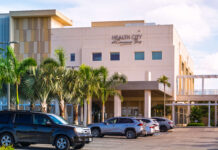
A Grand Court judge has described as “inappropriate” the granting of decades-long duty, stamp and work permit fee waivers, worth hundreds of millions of dollars, to Health City Cayman Islands in 2010.
The waivers were made as part of a contract signed between Health City founder Dr Devi Shetty and the United Democratic Party government 12 years ago. Subsequent governments, including the Progressives and the current PACT administration, have kept the duty waivers in place.
Judge Richard Williams, in a ruling dated 19 Aug. but released publicly today, 26 Aug., determined that a government’s statutory power to refuse to waive duty was “unfettered” – meaning that subsequent governments are not bound indefinitely by an agreement made by a previous administration.
In the judicial review, Doctors Hospital, under the name CTMH Holdings Ltd., challenged the wide-ranging concessions granted by the UDP to Health City, and to similar waivers given to Aster Caribbean Holdings Ltd, which signed a deal with the Progressives-led government in 2020 to pave the way for a proposed new $350 million hospital in West Bay.
Health City and Aster appeared as ‘interested parties’ at the judicial review hearing.
The granting of waivers by a government to stimulate development and attract inward investment was not the matter in question, Williams wrote in his judgment.
In this case, it became an issue “due to the insular process Cabinet adopted to reach that decision” to grant concessions over an extended period of time, followed by an assumption by the UDP government and successive administrations that they were then bound by the contracts to continue to give the waivers without further review.
CTMH had sought for the court to declare that it was unlawful to grant the waivers to Health City and Aster, but to refuse to grant similar concessions to Doctors Hospital. While the judge said he would not grant that “wide declaration”, he did find that the government “acted inappropriately in awarding waivers and concessions for the extremely lengthy periods that they did without any meaningful reference to Parliament”.
Under the concessions agreement, Health City was exempt from paying customs or import duty on the first US$800 million it spent on equipment and medical supplies. Once that US$800 million had been exhausted, for the next 15 years, the duty fee would be 5%, and then 10% in the following 15 years. Also, for the first 50 years of operation, it would not pay duty on any life-saving equipment. The hospital was also given indefinite concessions of 15-30% off work permit fees for medical staff.
CTMH barrister Chris Buttler had told the court that, if regular import duty of 22% was levied on $800 million worth of imported equipment and supplies, it would have brought in taxes of $176 million.
No published criteria for duty waivers
The judicial review also dealt with the lack of transparency in the government’s granting of duty waivers.
CTMH had asked the court to declare that the government is “obliged to publish a transparent statement of the criteria it will apply when determining applications for waivers of customs duty, work permit fees and stamp duty”.
Judge Williams, in his ruling, said that “despite the clear merits of the clarity which would derive from a criteria” being issued, he determined it was not appropriate for the court to declare that the government is obliged to publish a transparent statement of the considerations it applies when weighing whether to grant concessions.
But he added that the government “would be well advised and would be acting in a manner consistent with good governance if it did so, something it seems to have recognised since publicly stating in 2015 that it would draft and publish a policy”.
The issue of “poorly managed” revenue waivers had previously been highlighted in a September 2015 report by then-Auditor General Alaistair Swarbrick, which the judge quoted from in his ruling.
In that report, the auditor general found that there was “no checklist with established criteria and requirements against which revenue waiver applications were assessed for approval or rejection”, adding that such a checklist would help ensure that applications were assessed “fairly and consistently”.
The report also noted that there was no reporting of revenue waivers as a basis to summarise the total amount granted over a given period of time.
In response to that report, the judge noted, government had agreed to implement a concessions criteria on 31 December 2016, “with responsibility being given to the Financial Secretary and Chief Officer”. That deadline passed, and despite Swarbrick’s successor, Sue Winspear, reiterating his concern, and repeated assurances from government over the years that it would the criteria would be implemented, “there is still no policy in place,” Williams said.
Institutionally-registered practitioners
Another element of the judicial review brought by CTMH was where medical practitioners who are registered under what is known as the ‘Institutional List’ can work.
Medical staff under the ‘Institutional List’, drawn up initially to enable Health City to hire staff who received their qualifications from outside the seven countries on the ‘Principal List’, can only work at designated medical institutions.
CTMH had requested that the court declare that government must formulate criteria for designating an institution as a place at which institutionally-registered practitioners may be employed, and establish “some sort” of criteria for reviewing those designations.
A few days prior to the hearing, the government produced written ‘Guidelines for Designation as an Institutionally Registered facility to employ practitioners on the Institutional Registration List’.
Then, on the second day of the hearing, Tom Hickman, QC, representing the government, said, “I accept my instructions that there should be and must be and will be a review of designated instructions against the designation criteria at reasonable intervals.”
He said that, following the formulation and distribution of the designation criteria, a review mechanism needed to be set out, and that it was clearly in the medical profession’s and patients’ interests that such reviews be required and take place.
Equal educational qualifications
During the hearing, both parties had also agreed to interpret the Health Practice Act and its associated regulations, as stating that the educational qualifications required for medical staff on the ‘Institutional List’ be the same as those on the ‘Principal List’.
“I agree with the parties that such an interpretation is most desirable and is to be commended, as it deals with the safety of patients and would ensure that all doctors have the appropriate level of experience,” the judge said.
He added there would be “great merit” in legislators considering the wording of the regulations, “to remove any potential uncertainty in this important area of patient safety”.
The judge did not make any ruling on costs in the case, saying that neither party had been “fully successful in this matter”.
Dr. Yaron Rado, chairman of the board at Doctors Hospital, told the Compass Friday the judge’s ruling was a victory for his hospital.
“We feel that we absolutely won on all the key points,” he said, adding he was looking forward to a conversation with government on some of the issues addressed in the judicial review.
He said a fuller statement from Doctors Hospital would be issued next week after consultation with its lawyers.
The Compass has also reached out to government and to Health City for comment and is awaiting a response.
Related Videos











The
Ruling appears to confirm that these concessions to Health City developers by the UDP, and subsequently the similar to Aster Cayman by the Progressives were both unprefedented “sweet heart” deals. Equally troubling is that there seems to be weak controls and record-keeping to track the application of these Concessions. Hopefully these, and other anomalies, can be rectified soonest.