
Chief Justice Sir Anthony Smellie, who retires later this month, says a critical report by the Office of the Auditor General on the efficiencies of local courts ignored the ongoing impact a “chronic” lack of courtroom space has on how the system operates.
Three years after an initial report on efficiencies at the courts, the Office of the Auditor General issued a follow-up, which found that recommendations like a workforce development plan for court staff and an Outline Business Case for a new court building had not been completed.
The chief justice, while welcoming the recommendation of a development plan, said the audit report had failed to discuss “the real reason that such a workforce plan could not yet be developed and deployed: the chronic lack of accommodations for staff and the constant adjustments that must be made to alleviate its impact”.
In a statement issued Monday, he said the judiciary and staff at all levels of Judicial Administration had been “in a constant state of adjustment (much aggravated by the impact of the pandemic) as they sought to meet accommodation needs”.
He added, “The impact of this constant state of flux has been substantial at all levels, yet the judiciary and support staff continue to deliver justice (an incredibly sensitive and testing objective in itself) while coping with these challenges.”
The workload of Cayman’s courts has grown substantially since the main courthouse was built in the early 1970s. To address the shortage of courtroom space at the existing courthouse, which only has three courtrooms, the government has leased nearby Kirk House where four courtrooms operate, and has purchased the old Scotiabank building, where one courtroom is currently operational and a second one is expected to be completed this month.
The chief justice has previously repeatedly highlighted the impact of a lack of available courtrooms on the work of the courts in successive speeches at the opening of the Grand Court.
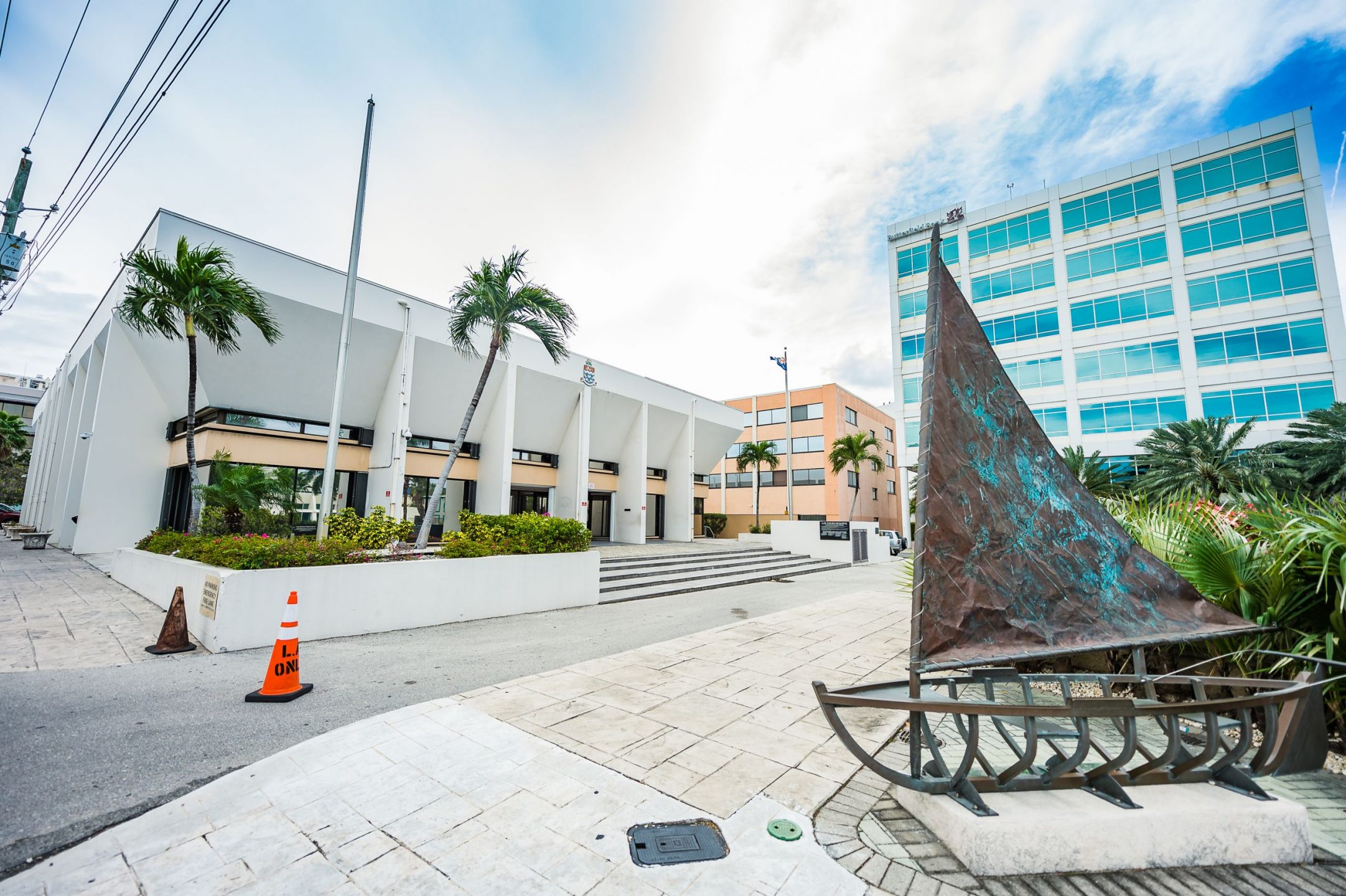
Smellie pointed out that the 2019 audit report acknowledged that the existing court buildings are not fit for purpose, but “paradoxically, the Report does not examine what impact this must have on efficiencies and effectiveness – although that is the objective that the Report sets for itself”.
He said his responses to the auditor general had neither been included in the report nor acknowledged.
“The failure to respond to or even acknowledge our concerns becomes even more telling in the context of what had prompted the audit – a request from the Public Accounts Committee for an audit regarding whether a new Court building, which had been promised by successive governments for more than two decades, was really needed,” he said. “Yet, ironically, the OAG had, perhaps unwittingly, answered that remit in its own assessment as referenced above – that the ‘existing court buildings are not fit for purpose’.”
The Office of the Auditor General confirmed to the Compass that it had received a response from the chief justice to its clearance draft of the report on 30 Oct. 2019, but said Auditor General Sue Winspear had then formally responded to these comments in a letter to Smellie on 18 Nov., and also made “some wording changes in the final version of the report as a result of his comments”.
Outline Business Case
The follow-up report by the auditor general noted that the status of the Outline Business Case for a new court building was “not entirely clear” and that it appeared that it was “still being prepared”.
The chief justice, in his response Monday, said the Office of the Auditor General had been advised from the outset that a team of professionals from PricewaterhouseCoopers, in consultation with the NORR Group of architects, engineers and planners, had been retained to develop an Outline Business Case. Their work was suspended when the pandemic struck, but has now resumed, he added.
Smellie said, “Disappointingly, this context is not explained in the relevant aspect of the OAG 2022 Report, which insists: ‘ ..there is still no Outline Business Case. Without taking these steps, … the project will be flawed and result in a court building that is not fit for … purpose.'”
He added, “A much different impression would have been conveyed by the unfurnished context: an acknowledgement of the involvement of the PWC/NORR team, the intervening impact of the pandemic on the completion of any pending proposal, and the clear response of the Judicial Administration in 2021 to the OAG that ‘a proper business case must and will be presented to Government before any decision could possibly be taken to invest in a new building'”.
Smellie said that, as the outgoing chief justice, he was “obliged not to leave the public record in a state of doubt on so important a matter: There has never been any uncertainty that a proper business case will be presented for the Government’s consideration.”
He added, “Regrettably (but hopefully not irretrievably), the result is that public attention is now being diverted away from the underlying obvious need for modern court facilities.”
He stated that even with the addition of two new courtrooms at the Scotiabank building, “there will likely be many occasions when cases will need to be postponed for want of a suitable courtroom”.
Pandemic challenges
The chief justice described the efforts of the judiciary and court staff in rising to the challenges during the pandemic, when businesses across the islands had to shut down but the courts continued to operate, as “nothing short of heroic”, adding that the “results are remarkable”.
“Unlike other businesses,” he said, “… at the Courts we did not have the option of reducing our outputs. Family matters, rather than declining, increased; the number of complex cases filed in the Financial Services Division increased by more than one-third; the intake of cases across the other divisions continued apace.”
Cayman was among very few courts globally to continue to operate during the worst periods of the pandemic, “pivoting almost seamlessly to continue to provide the public at home and abroad with access to justice”, Smellie said.
He noted that an independent assessment by Red Lion Consultants in London, which included Justice Dr. Mathilda Twomey, a former chief justice of Seychelles, and Ben Yallop, an adviser to the Lord Chief Justice of England and Wales, on the administration of courts, in March this year revealed “no significant backlogs in any of the criminal divisions of our courts”, including the Summary Courts.
He said he had engaged Red Lion as a consultant well before the auditor general’s report to examine and advise on the administration of the courts, focusing on the criminal divisions of the Summary Courts and the Grand Court.
Judicial Administration ‘victim of its own success’
The chief justice ended his statement by saying, “As we look to the future, I fear that in the continuing absence of adequate modern court facilities, the Administration will become the victim of its own success, the result of a false perception that such facilities are not really needed.
“A much more nuanced and balanced OAG response, based upon a more rigorous assessment process than soliciting annual responses to the flawed original Report, would contribute much to avoiding that ill-advised outcome.”
Smellie will step down as chief justice, a position he has held for 25 years, later this month, and Margaret Ramsay-Hale will take up the post on 26 Oct.
Read the Office of the Auditor General’s report here.
Read Chief Justice Smellie’s response here.
Related Videos