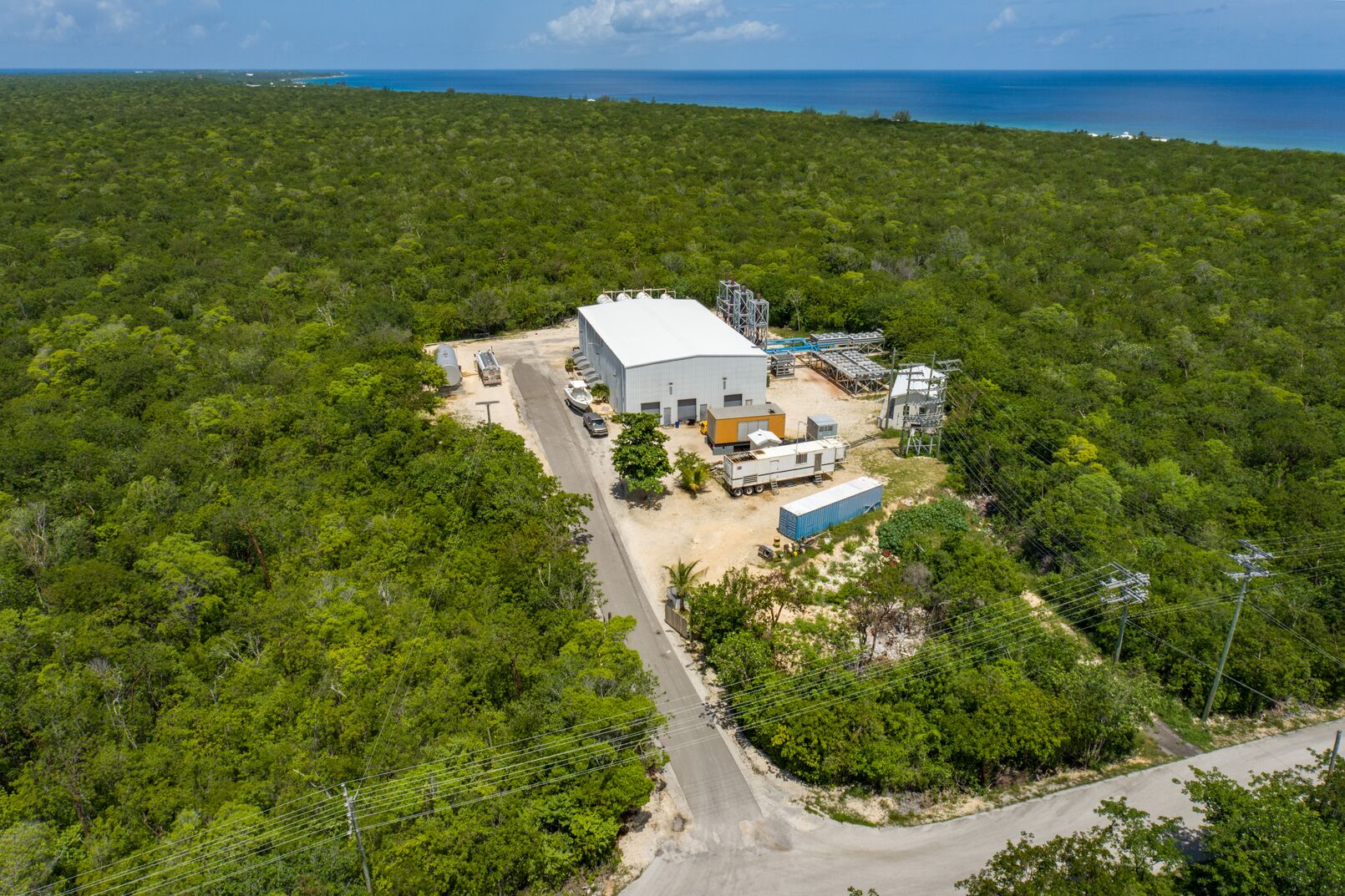
Dart executives have outlined ambitions for a fossil-fuel-free future on Cayman Brac and Little Cayman following the takeover of the main utilities provider on the Sister Islands.
The goal of a quick transition to green energy is being tempered, however, by the desire to keep price, consistency and quality of service stable according to Matt Bishop, CEO of Dart subsidiary Active Capital.
Dart’s acquisition of the assets of Cayman Brac Power & Light Company was approved by regulator OfReg and finalised last month. The business will operate as ‘Island Energy’.
But Bishop said there would be no other immediate changes, with all staff, including senior management, being retained.
“Our number one priority is business continuity,” he said.
While Dart has longer term goals for a green transition on the Sister Islands, Bishop said nothing was set in stone at this point.
Andrew Small, a former CUC engineering chief and Dart’s in-house electricity expert, is part of a team looking at the potential for green investment on the Sister Islands.
He said the group would spend some time understanding the nuances of the grid in the Brac and Little Cayman before formulating a plan to transition to renewables.
“The ultimate goal is to take that shift as far as possible,” he said.
“While we think that solar is the way to go, we are not completely ruling out other options, including wind, to see how they factor into the mix. We are keeping our options open until we have done more detailed work.”
Any transition would need to be approved and managed in consort with OfReg.
Solar remains the likeliest option and it would be theoretically fairly easy to meet the entire electricity demands of both islands with a single solar farm.
Cayman Brac’s energy requirement of 3.9 megawatts and Little Cayman’s 1 MW need is less than the output of the solar farm in Bodden Town.
Technical challenges
But the logistics of running a fully renewable grid, without back-up from other sources, remains a significant technical challenge.
“It is not just generation, it is storage as well. We have to be able to guarantee power at night, when there is cloud cover and after a hurricane,” said Bishop.
“We have to ensure the consumer is looked after in a reliable and safe way.”
Jan Feik, an investment analyst with Dart, who was part of the acquisition team, said a credible medium-term goal was to get as close to 100% renewables as possible. But he warned the last 10-20% would be the most difficult and expensive to achieve.
He said the places that had got closest to 100% tended to be larger grids that could use a combination of wind, solar and multiple other sources that could provide the versatility and resilience required to make power supply stable.
Despite those challenges it was, at least in part, the potential for renewable transition that attracted the company to the acquisition.
“I think we all see the potential, particularly for Little Cayman, to be a completely decarbonised location,” said Bishop.
“That’s an extremely exciting proposition and I hope the community over there is excited by what we are planning.”
He said Dart had a long interest in renewable energy, with some of the largest private solar installations in Grand Cayman.
“We are not new to this,” he added, indicating the company would be investing heavily in infrastructure on the Sister Islands in the coming years.
He emphasised, however, that Dart would not do anything to reduce the reliability or increase the expense for customers on the Sister Islands, who pay more for power than their neighbours in Grand Cayman.
“We want to move in a measured and strategic way that prioritises continuity of service, stability and safety for consumers over the long term.”
Related Videos