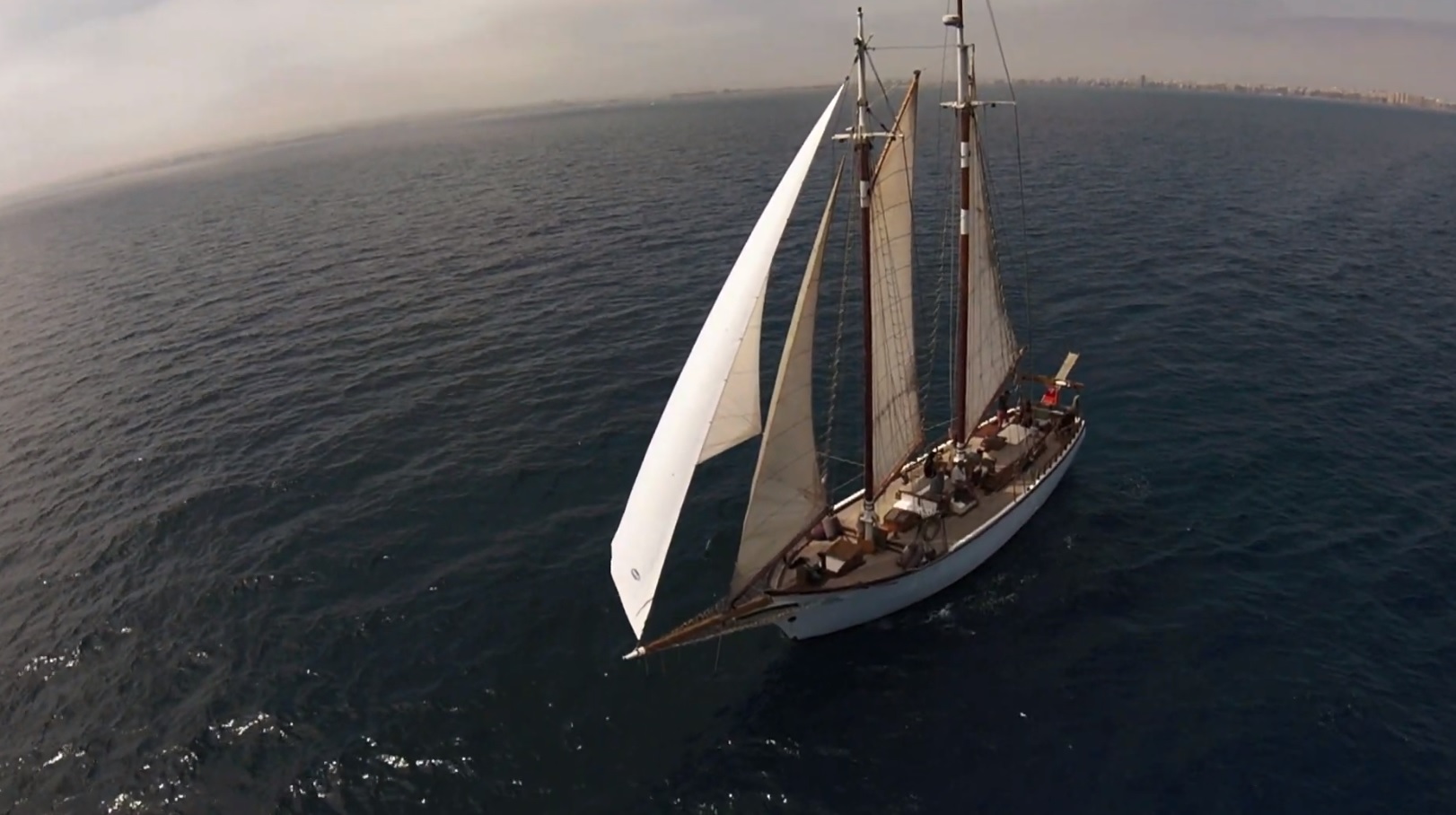
The Fair Weather, a 72-year-old wooden schooner with a storied history connected with famous film stars and authors, including Errol Flynn and Ian Fleming, is preparing to return to the Cayman Islands.
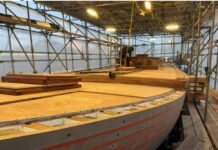
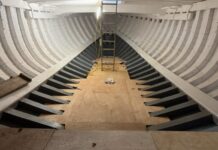
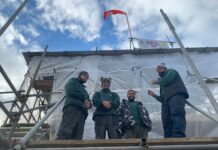
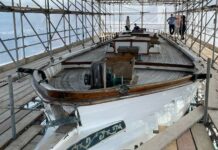
The yacht, built in shipyards on Cayman Brac and Jamaica, is believed to be the last of the wooden schooners built by Cayman Boats Ltd. that is still seaworthy. It is currently in Gloucestershire, England, where it is undergoing repairs, after being transported from Spain in recent weeks.
The plan is to bring the ship back to Grand Cayman, where its new owners hope it will act as an impetus to revitalise interest in Cayman’s maritime history and of the talented boat-builders that once lived here.
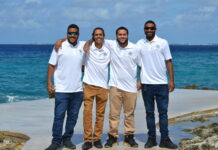
Paul Deegan, one of the people behind the plan to bring the Fair Weather to Cayman, says he hopes that the return of the prodigal boat will be just the beginning of a push to honour, and perhaps even emulate, the islands’ relationship with the sea and seafaring.

Ambitious plans
While the boat was constructed in Jamaica, its sails were made in Grand Cayman, at the site of the old Fish Shack, by captains Benny Bodden and Rayle Bodden, Deegan said.
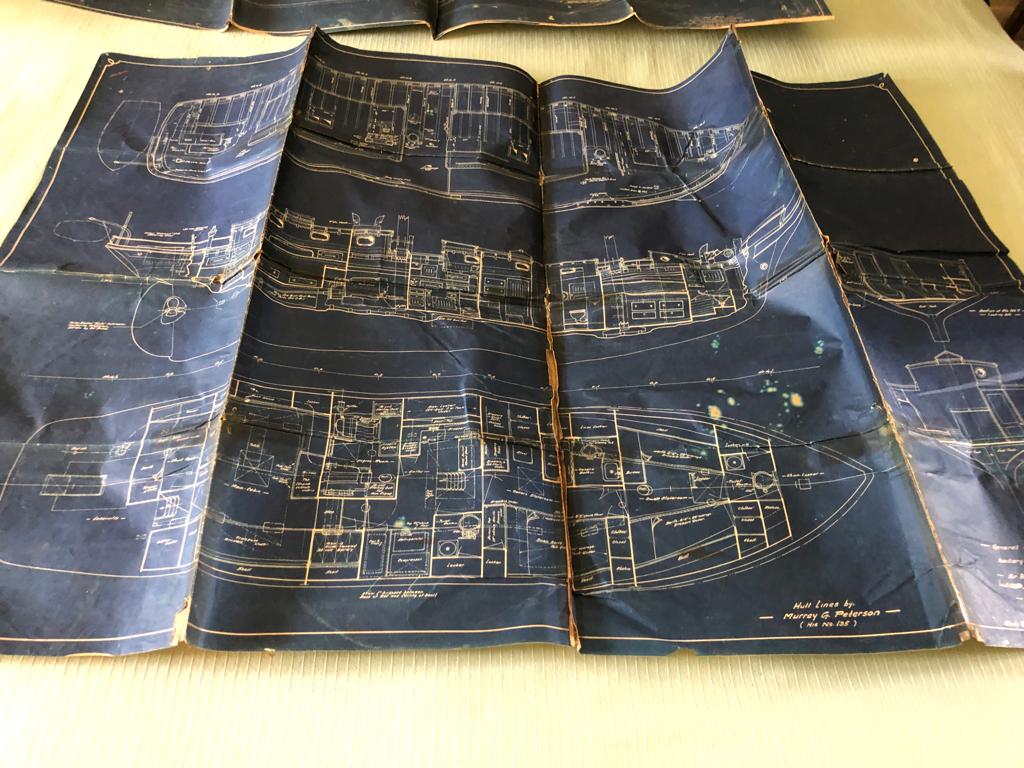
Bringing the Fair Weather to Cayman is the start of a series of ambitious plans that include building a second boat – an exact replica of the Fair Weather – based on its original blueprints; reintroducing Cayman’s youth to its maritime past, via education programmes in the schools and training on board the ship; and eventually building a maritime museum where the original boat, as well as artefacts that many families have from their seafaring ancestors, could be displayed.
But before any of this happens, the first step is repairing the boat to its original state and transport it to Cayman, a project that Deegan expects to cost about $2 million, and which he is hoping contributors interested in Cayman’s maritime history and future will be willing to support.
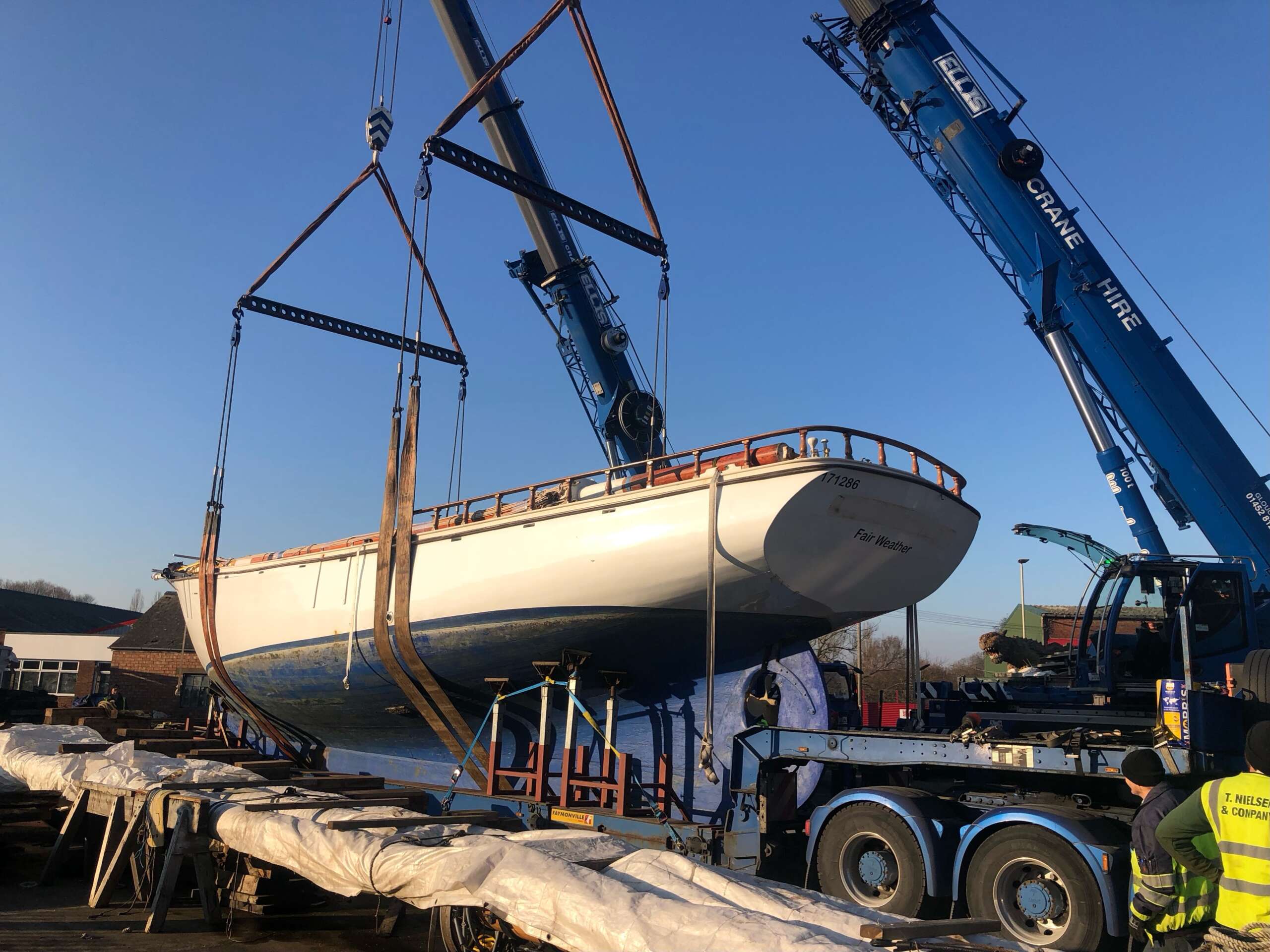
Referring to the condition of the boat, which was purchased from its owner, Luis Perez-Solero Puig, in Spain last year, Deegan said, “She’s sailable; I mean, I could sail her off Seven Mile Beach, but the problem is she’s a 70-year-old wooden boat, so we need to bring her to the UK first for repairs.”
He said that work could take from eight to 12 months, and he is hopeful that the Fair Weather will be in Cayman around this time next year.
Deegan, who owns Six Senses Cayman Adventures water-sports company, explained that the idea of reclaiming the schooner for Cayman came to him during the COVID-19 lockdown, when he spent a lot of time surfing the internet and came across the Fair Weather online.
“We’re using private funds at the moment to buy the boat, which we own, and then there’s going to be a trust owned by the Fair Weather Foundation. Then we’ll be a not-for-profit trust which essentially means the people of the Cayman Islands will own the boat,” he said.
The process of setting up the foundation is under way, he added.
Initially, the Murray Peterson-designed boat will be used for exclusive, luxury charters, but those will be limited to 20-25 people, because, as Deegan explained, “we don’t want high footfall traffic because it’s an old boat”.
Once a replica is built, that would be more widely available for use, he said.
How it all began
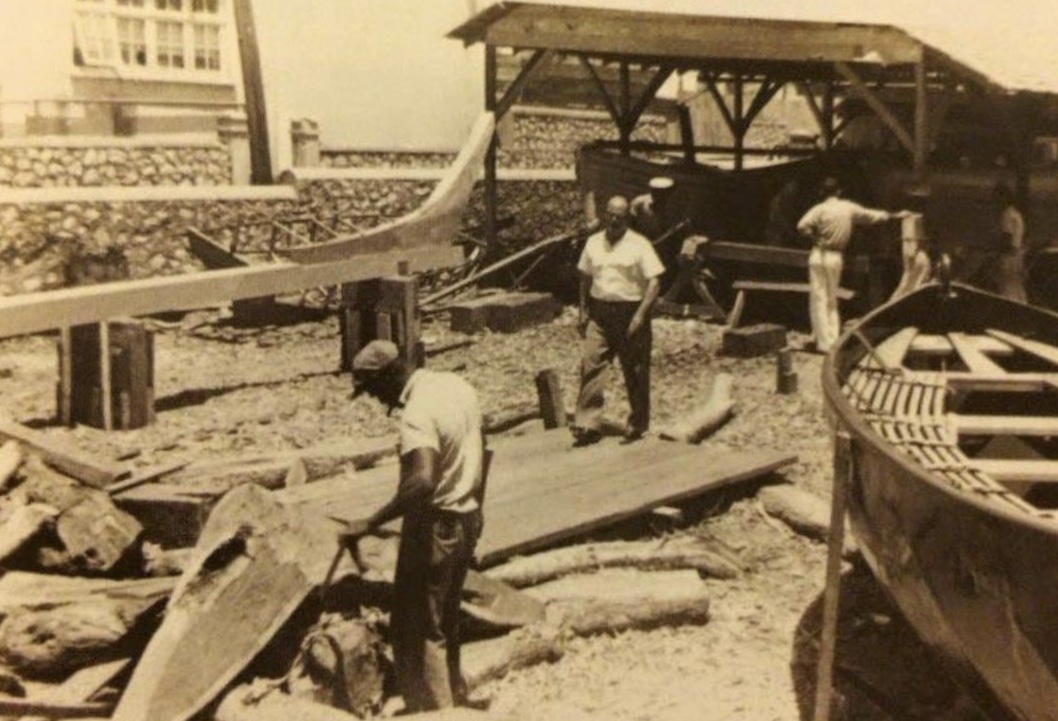
Before Cayman Boats Ltd., owned by Sir Anthony Jenkinson and Arnold ‘Cappy’ Foster, set up in Jamaica, it ran a boatyard in Cayman Brac.
Jenkinson’s son, John, who lives in Cayman, noted in a recent interview with the Cayman Compass that after the National Bulk Carriers shipping company began recruiting seafarers in Cayman, the Brac boatyard lost most of its workers, so his father moved the operation to historic Port Royal in Jamaica.
Boats that were in the process of being built were transported to Jamaica and completed there.
“It was built by Caymanians in Jamaica, because they were pretty much all Fosters in the boatyard,” Sir John Jenkinson said.
“We started the boat building on the Brac and then they all went to sea with National Bulk Carriers and we had no shipwrights to finish the started boats, so we had a choice of the Bay Islands [in Honduras] or Jamaica. And we chose Jamaica.”
Leicester Hemingway, brother of famous author Ernest Hemingway, was also involved in the shipyard. Both brothers were friends of Anthony Jenkinson. A regular visitor was actor Errol Flynn, whom Jenkinson had met in Hollywood while working as a journalist in the US.
John Jenkinson says his dad “wasn’t very talkative” and while he did not leave many handwritten details of the shipbuilding years, he left a huge number of photographs. As a former photojournalist, taking “copious photographs” was his method of documenting major events.
He said when the boatyard left the Brac and relocated to Jamaica, “it went to a place in Kingston called Breezy Castle, which is at the bottom of Water Lane in Kingston, next to the penitentiary…. Then we got a lease for the old Royal Naval Dockyard in Port Royal, and we moved from Breezy Castle to Port Royal, which is where I really grew up.”
Jenkinson family lived on board
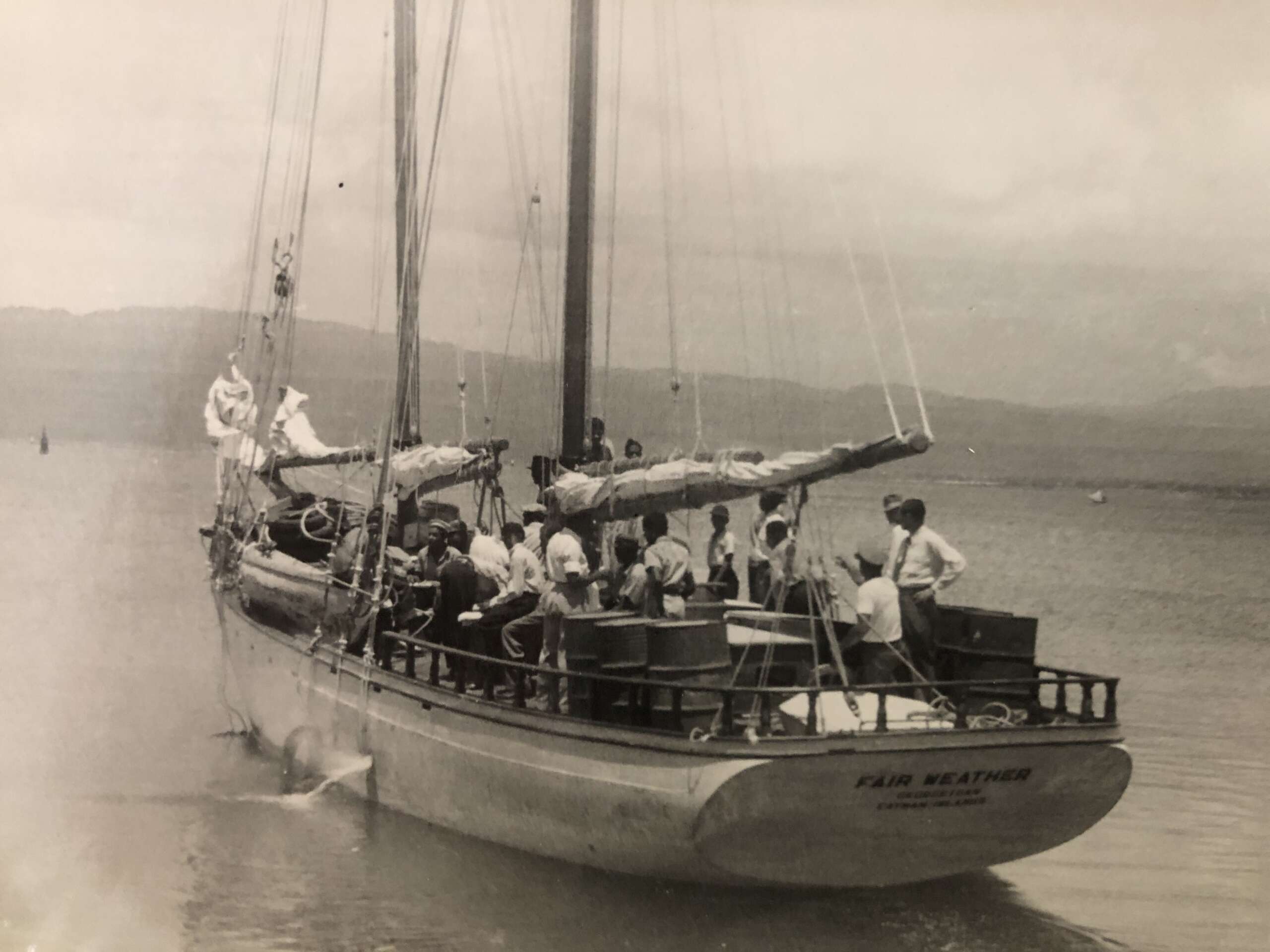
The family lived on board the Fair Weather for two or three years at least, he recalls, describing it as a roomy boat that comfortably accommodated his parents, his two sisters, himself and a nanny.
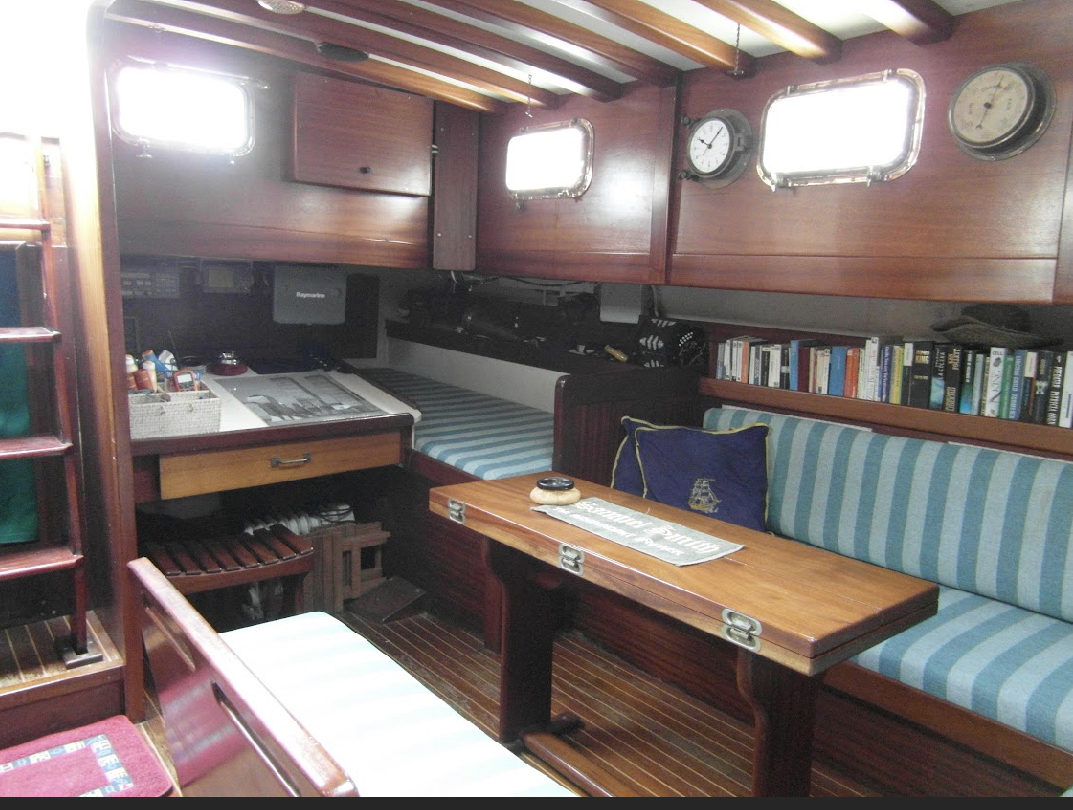
“The Fair Weather’s 72 feet from bow to stern,” John said. “I lived in the forward cabin. Nanny and the two girls lived in the main cabin, and my mum and dad lived in the aft cabin…
“She’s an American-designed schooner, so she’s broad of beam. There’s lot of space. My dad, who was 6 feet, 4 [inches], could stand below without too much bending, and I think he could stand straight up in some places. I was 10 years old or so at the time, so I didn’t have that problem.”
The family, who was based in Morgan’s Harbour in Port Royal, eventually left the boat-building business and went into running hotels, clubs and marinas.
After moving to Jamaica, Anthony Jenkinson rekindled his friendship with an old school pal, Ian Fleming, author of the James Bond books.
‘Dr. No’, the first Bond movie, was filmed in part in Morgan’s Harbour – which was a bone of contention for the younger Jenkinson, who at the time was attending school in the UK.
“I only went back to Jamaica from school in England for the summer holidays. The other school holidays were too short. … I beseeched my father to let me come home for the Christmas holidays when ‘Dr. No’ was being filmed, and he told me no. So, I’m 15 or 16 years old… and I missed Ursula Andress coming out of the water in her bikini with a diving knife strapped on. Never forgiven him for that since,” he says with a laugh.
They sold the boat in 1959 because by then they were living in their hotel and “she wasn’t going anywhere and [my father] wasn’t using her. She hung on a mooring for a couple of years and because we had a slipway, when that wasn’t busy, she could be hauled out and the bottom painted once a year. So, I think he probably just sold her for somebody to use her.”
The last time John Jenkinson saw the Fair Weather was in the summer of 1967, in San Francisco.
“I took my car up from Jamaica and I spent a summer driving all around the US,” he said. And when I was in San Francisco, I went over the bridge to Sausalito, and she was there, but I didn’t try to track down any owners.”
‘Thrilling’ to see Fair Weather return
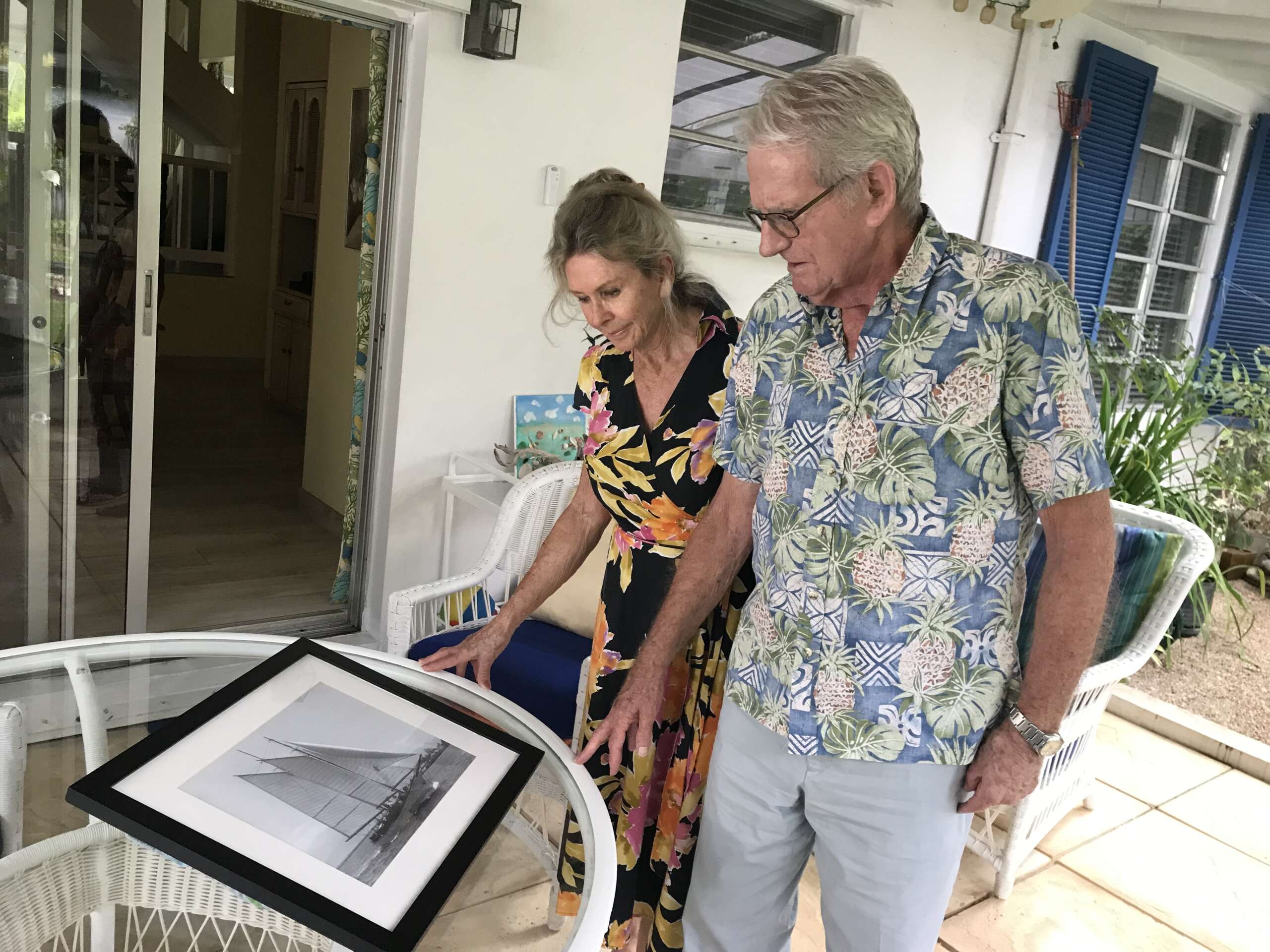
More than 55 years after his last sighting the ship, he’ll get to see it again in May this year, when he and his wife Louise visit the shipyard in Gloucester where it is being repaired.
Asked how he feels about the schooner coming home to Cayman, he said, “It’s obviously very thrilling. It’ll be a trip down memory lane because I did sail on her a few times. We used to charter her, and take people for a day ride.”
He said it was a “tribute to the shipwright skills of Caymanians that she’s still with us all these years later – 70-odd years”.
“Thank goodness she was sold to somebody who absolutely loved her and maintained her,” Louise Jenkinson said.
She added, “It’ll be marvellous when it’s all done, seeing her sail into the harbour.”
The Jenkinsons are also excited about the prospect of bringing education about boatbuilding and maritime history into the schools. “It’ll be absolutely wonderful giving the children a little bit more knowledge about the history of their forefathers, and hopefully try to reignite a bit of boatbuilding in Cayman too. It’d be amazing to get youngsters involved in that,” Louise said.
Round the world
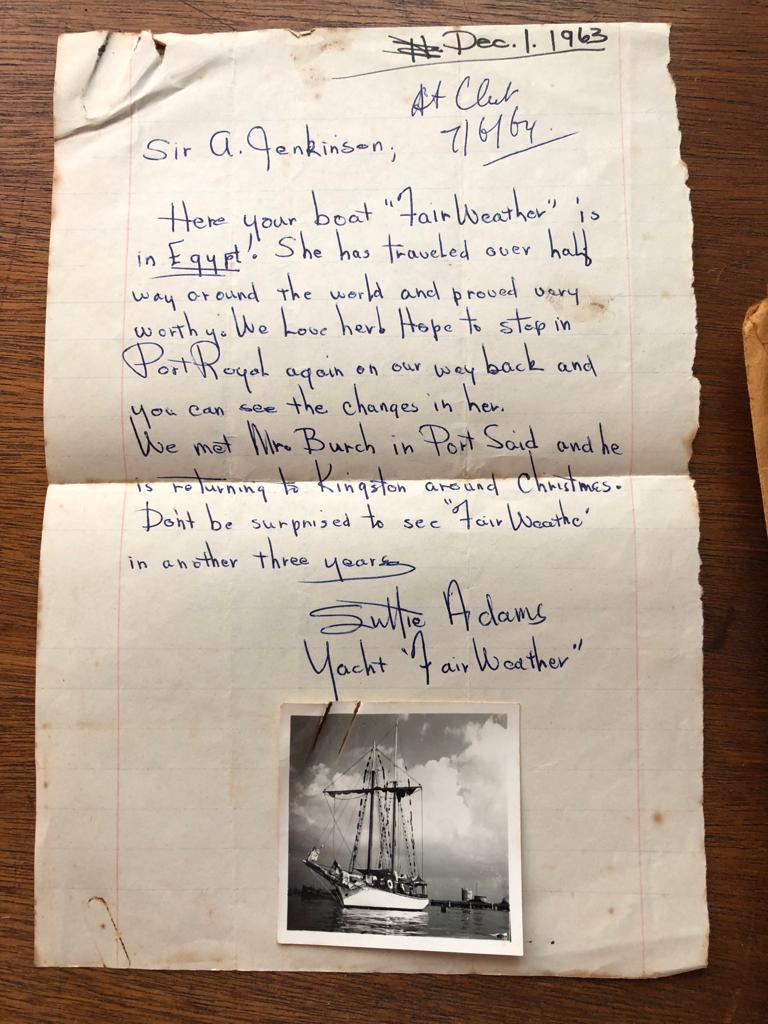
In November 1958, Anthony Jenkinson sold the Fair Weather to former Royal Navy Commander Angus Alexander MacKenzie of the Hong Kong and Eastern Shipping Company, according to Shipping Registry records held at the Cayman Islands National Archive. Less than a year later, Bill Adams of Saratoga, California, bought the boat, which was then based in Florida.
Adams, his wife Suttie, their two eldest sons, Rick and Jon, and some friends decided to sail the schooner from Fort Lauderdale to San Francisco. No one on board had much sailing experience. After a near-catastrophic encounter with a shallow coral reef off Cuba, they sailed the ship to Jamaica and docked in Port Royal, where they dropped anchor off a resort owned by none other than the original owner.
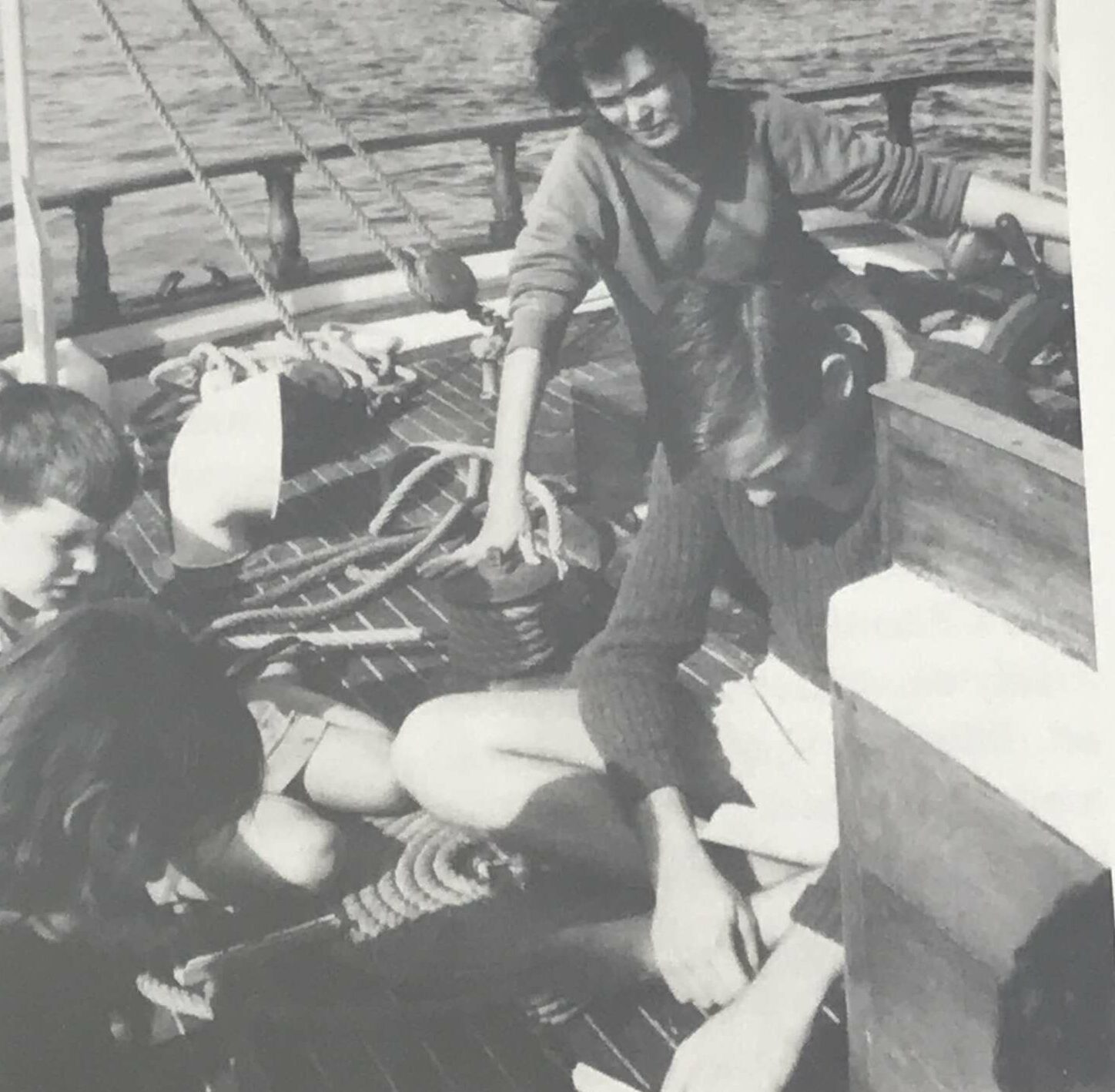
The introduction to a book chronicling a round-the-world voyage on board the Fair Weather notes: “Anthony [Jenkinson’s] hospitality, the tropical weather (in winter), the thatched roof bar on the end of the bay was all – especially after a few days sailing from Florida – an influential experiment. It was what Suttie assumed cruising on a yacht was all about.”
This was just the start of their adventures on the Fair Weather.
The Adamses and their four children, aged between 8 and 19, began a round-the-world cruise from San Francisco in March 1961, a trip that would last four years.
The couple broke up in New Zealand. Bill flew back to the United States, and Suttie continued the journey as captain, becoming the object of interest at many of the ports along the way where a female skipper was very unusual. Several media outlets in countries on the route carried stories about Suttie Adams and the voyage of the Fair Weather.
During the cruise, the Fair Weather sailed 35,566 miles, spent 349 days at sea, and visited 103 ports.
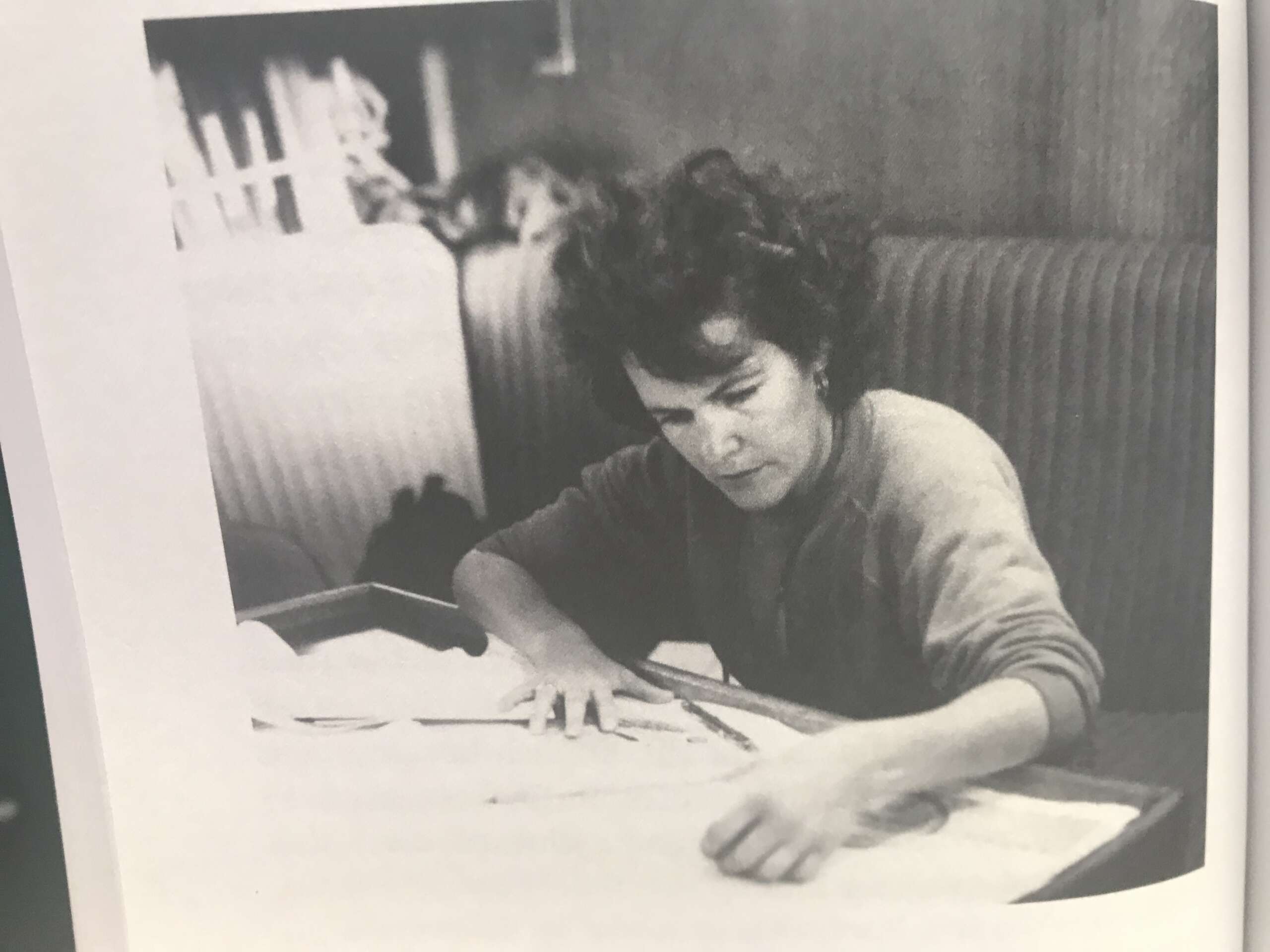
The tale is outlined in Suttie Adams’ book, ‘The Cruise of the Fairweather’, which is a combination of journal and log entries kept by her.
In one entry, dated 29 May 1962, she tells of a huge storm off Norfolk Island in the southwest Pacific Ocean, where she and the crew worried that ship would not be able to handle the waves and wind. The weather was too treacherous for the boat to attempt to enter the island’s harbour so stayed out at sea for the duration of the storm.
Suttie wrote of this trying day, saying, “By noon the waves were breaking on deck and the boat was heeling over so far that the lee rail was continually in the water. Then the staysail broke. We took both sails in, turned downwind, and ran under bare poles. [The crew] tied everything they could to mooring lines and threw it overboard to act as a sea anchor – planks, tires and jerry cans. And we were still making seven knots. The waves were breaking over the stern every so often.”
The seas finally calmed next morning. Standing at the helm for five hours afterwards, Suttie said she had thought at the height of the storm, “we might not make it”.
“I thought of that storm as a test of strength and endurance for the boat, the crew, and myself. The Fairweather came through like any well-built boat,” she said. “The crew was well satisfied that they were able to handle such a storm. And I knew from now on, nothing could stop us.”
And nothing did. The Adams family and crew made it safely back under the Golden Gate Bridge on 8 May 1965.
A move to Europe
The ship was then sold to Stephen Hornet, an American adventurer, who aimed to repeat Suttie Adams’s feat by sailing around the world in a westerly direction.
According to a history of the boat, by its most recent owners, Hornet crossed the Pacific and “made the majority of the trip with few resources, which finally forced him to abandon the challenge”. After he arrived in Mallorca, Spain, the online historical account states, he sold half of the boat to a Spanish nobleman – the Count of Caralt – and they had the boat’s deck renovated by shipbuilders in Monte Carlo, Monaco in 1982. After the restoration work was complete, the boat returned to Mallorca where it spent the next 16 years.
In 1998, Luis Pérez-Solero Puig came across the boat, which at that stage was in a state of semi-ruin.
The boat underwent extensive renovation work and a change of name. He called it La Bella Lola, “a name given for a mix of personal reasons and as a homage to the famous Havana song of the same name”.
It sailed around the Mediterranean for more than 20 years, before Deegan and others in Cayman bought the boat, with their plan to relaunch it in local waters.
For more information on the Fair Weather, visit fairweather.ky or email [email protected].
Related Videos