Newly promoted first officer Jessica Ebanks brings to five the number of Caymanian female pilots at Cayman Airways.
Cayman Airways CEO Fabian Whorms, in an interview on the Cayman Compass talkshow ‘The Resh Hour’, on Wednesday, 8 March, announced Ebanks’s promotion as Cayman marked International Women’s Day and the airline celebrated Women of Aviation Worldwide Week.
“We have 43 active pilots inclusive of those five, so they represent 12% of our pilot complement,” Whorms added, saying that the airline is looking to better those numbers.
The West Bay resident, along with 13 other pilots, was celebrated at a special event at the George Town Yacht Club Tuesday night.
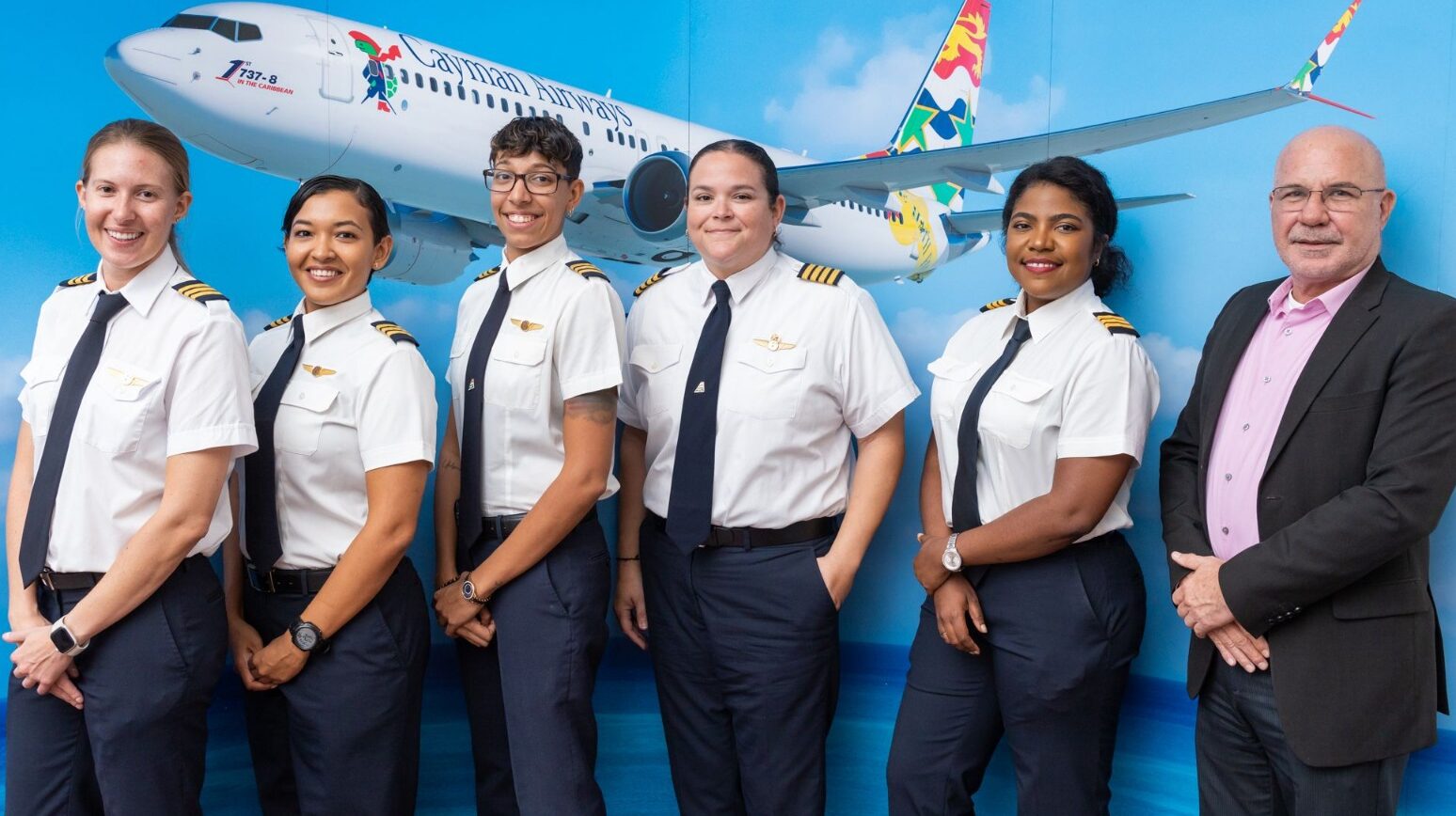
Captain Perry Panton, Cayman Airways director of flight operations, lauded the increase in female pilots, which includes the recent promotion of Leanni Tibbetts, the reigning Miss World Cayman Islands.
“We’ve been working towards hiring more females as they finish flight school. We try to get them in as quickly as we can,” Panton said, adding that soon there will be six female pilots as there is another young woman in training, who is set to join the Cayman Airways roster in 2024.
Panton explained that to join the airline’s training programme, a pilot is expected to be fully qualified with a commercial instrument pilot’s licence.
The pilot will typically be accepted in the cadet programme, and trained on entry-level aircraft, if that’s their level, and “will join on the Twin Otter and become a first officer in that programme”, he said.
That will involve about 50 hours of instruction, which includes “actually flying the airplane for training periods”, Panton added.
He said this is why sometimes in the evenings, or daytime during slow periods, the Cayman Airways Twin Otter can be seen flying over the islands.
Panton said at roughly around the 50-hour mark the airline is able to move the training pilots into “line flying” under one of its supervisory pilots, for another 50 hours.
He added that the length of training depends on whether both Twin Otters are available, since at certain times of the year, the planes are sent off for regular maintenance, but generally it takes two to three months.
Whorms disclosed, however, that the airline is seeking a third Twin Otter.
Panton added that the vast majority of Cayman Airways pilots are trained in the United States and they come with their Federal Aviation Administration licences.
“Now once the pilot is hired and trained, they will then gain their flying hours [which will] allow them to move up the ladder to the various aircraft types that we operate,” he said.
Panton said the entry level is a Twin Otter, the midpoint is the Saab and the jet is the last rung.
“By the time someone is ready to get onto the jet they have already acquired their airline transport ratings licence”, which is required, he said, adding that the licence is not a regulatory requirement, it is a Cayman Airways-imposed mandate.
Whorms said that the training programme is “very stringent” and though it rarely happens, there are some who do not make it through to the end.
More than an airline
Whorms expressed pride at the airline’s ability to continue to be a training ground for Cayman’s best and brightest who dream of a career in aviation.
He said being able not only to hire Caymanians to work for the airline, but also to train the next generation of pilots, speaks to the benefits of having a national flag carrier.
As for the number of Caymanian pilots overall on the roster, Whorms said, the goal is to always be 100% Caymanian.
“Generally when you think about Cayman Airways, think about it as an airline that always has a 100% Cayman pilot complement,” Whorms said, adding that from time to time as the need arises in the short term, contracted pilots may be required.
He added that the airline does not have difficulty in finding or hiring Caymanians.
“It is one of those professions that a lot of young Caymanians aspire to and we have good take-up. We generally don’t have problems in maintaining that [100%] quota,” he added.
He did say, however, that there are those who go through the training at the national flag carrier and then join other larger commercial airlines.
This, both he and Panton said, is testament to the training done at Cayman Airways.
“We don’t like when we lose any of the youngsters… who are trained and develop and grow within Cayman Airways… to other airlines, but we’re also proud when they spread their wings,” Whorms said.
Panton said there are pilots who have moved on to fly with United Arab Emirates, FlyDubai, Cathay Pacific and Qatar.
Whorms said though the public may say the airline should try and hold onto those people, the airline does not want to hold any Caymanian back.
“They have to and they will come home eventually with [international] experience that they would not have been able to get here,” he said.
Panton said there are many opportunities for various aviation careers at the national flag carrier outside of the cockpit and urged young people to consider other paths in the field.
A recruitment drive is under way for new cabin crew members and pilots.
“We’re actually targeting an additional four on the pilot side and on the cabin crew side, we’re targeting at least 20 by the end of the year,” Panton said.
Whorms also announced the airline recently hired its first female flight dispatcher.
Related Videos