A gruelling climb up a US mountain was a true labour of love for one man and his rescue dog, in his quest to raise awareness and money to help all strays find permanent homes.
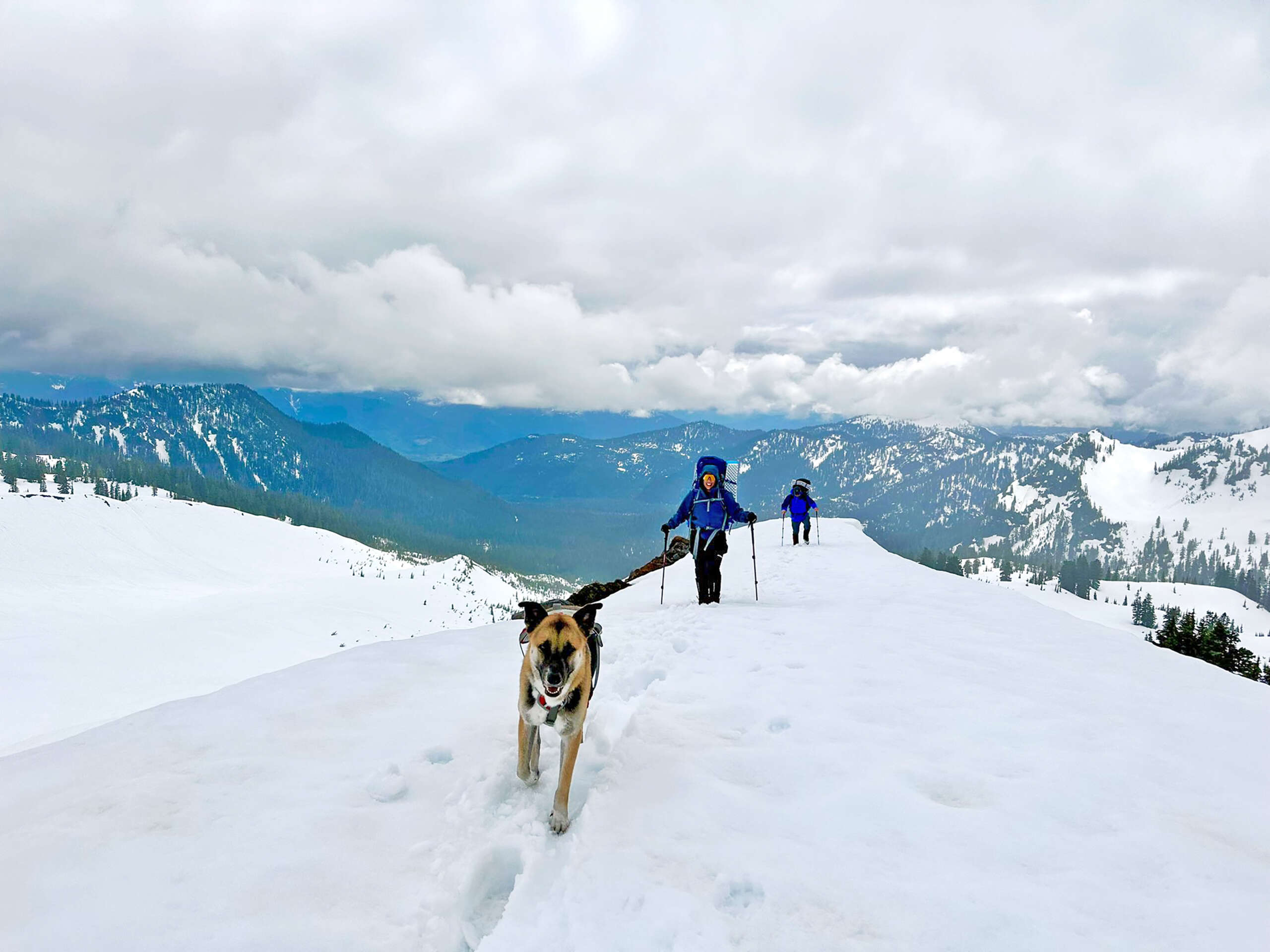
James Tucker, along with fiancée Natasha Rocha and his dog Roger, climbed Mount Baker in the Cascade Volcanic Arc in Washington state, where they reached nearly 8,000 feet of elevation – an altitude that is considered high risk.
“What I did will count for nothing unless people hear about it, and change their views on shelter dogs,” Tucker told the Compass.
His goal is to raise upwards of US$50,000, which will be donated mainly to two local charities: The Cayman Islands Humane Society and One Dog at a Time, while also trying to encourage landlords to allow pets in their rental units.
Tucker has planned a series of climbs, starting with Mount Baker. Next, he will take on Mont Blanc in Europe, then Machu Picchu in Peru, and finally Mount Everest. His motivation comes from his ‘best friend’ and service dog Roger, who he rescued over two years ago as a 9-month-old pup, on the verge of being euthanised after being found in the street.
Two-hour setback to begin
Tucker detailed the three-day journey up Mount Baker, calling it a mix of delight and disaster.
“We flew a long way to Seattle and drove up into the mountains,” Tucker said. “Day one, we started early morning with our tour guide and there was no time-wasting. We checked our food supplies, our equipment supplies and moved straight to the mountains.
“When we got to the mountains, the road was actually blocked by snow, so we had to start our ascent 2½ miles down from the start of the trail head. So, it took nearly two hours to get to the trail head and that was only the start of it. We made it to low camp on the first day.”
At the end of that first day, Tucker and crew began to set up their tents before sundown, just as it started to rain, which continued throughout the night.
Wildlife encounter
He said that being in the wilderness was quite an experience, with the different noises, sights and smells, adding that while in his tent, an unknown animal was lurking outside.
“Something was approaching the tent,” he said. “Maybe it was a bear, maybe it was a wolf. I wasn’t sure, but Roger barked, and you heard it run off; it was big, whatever it was, and I’m just pleased that it ran off, rather than towards the tent.”
Outside of that one scare, Tucker had one other visitor, only this was much smaller and less afraid of Roger.
“I got visited by a squirrel who wanted to steal my breakfast, and he would come right up into the tent,” Tucker said.
However, while there were brief moments to enjoy, the majority of his journey up Mount Baker was filled with agony in the cold. He said that day two started before the sun came up because they needed to make it to high camp by the end of that day.
‘Why are you taking so long?’
“This was the hardest day,” Tucker said. “This was serious distance, serious vertical gain, in absolutely terrible conditions. It was dark, gloomy, rainy, the snow was soft and literally every 10 steps, one of our legs would slip through the snow and break through up to our knees or higher. Then you would have to use all of your energy to get your foot back out while carrying a 50-pound pack.”
To make matters worse, Tucker said, while aching and exhausted, the crew needed to go up a very steep slope in order to make it to their high camp.
“We were on all fours going up. We had spikes on our feet to dig into the ice,” he recalled. Meanwhile, Roger, geared up in his thermal suit and dog goggles, was having the time of his life.
“As we were going up the steep slope, Roger was literally running up and down. He couldn’t figure out why we were taking so long, and he would run back down to us, to sort of say, ‘Why are you taking so long?’, and then he would run back up to the top again.”
At the end of day two, Tucker said that his feet were swollen but it was rewarding to see a clear view of Mount Baker’s peak.
‘No signs of life’
“Day three was the summit attempt,” Tucker said. “Roger wore his climbing harness because now we were in the danger zone… it’s almost a clear drop on one side and, unfortunately, it was a very sunny day, which was great for morale, but it started to melt the snow again… It was so mentally challenging to keep going.
“Once you’re up on the glacier, it’s like a desert; there are no signs of life and the only way I can describe it, is being very, very lonely once you’re high up.”
Around this point, Tucker and crew members were north of 7,000 feet. He described the cold air, noting it felt like it was cutting through his skin.
“If you had any exposed areas on the body, it would just spread throughout, straight to
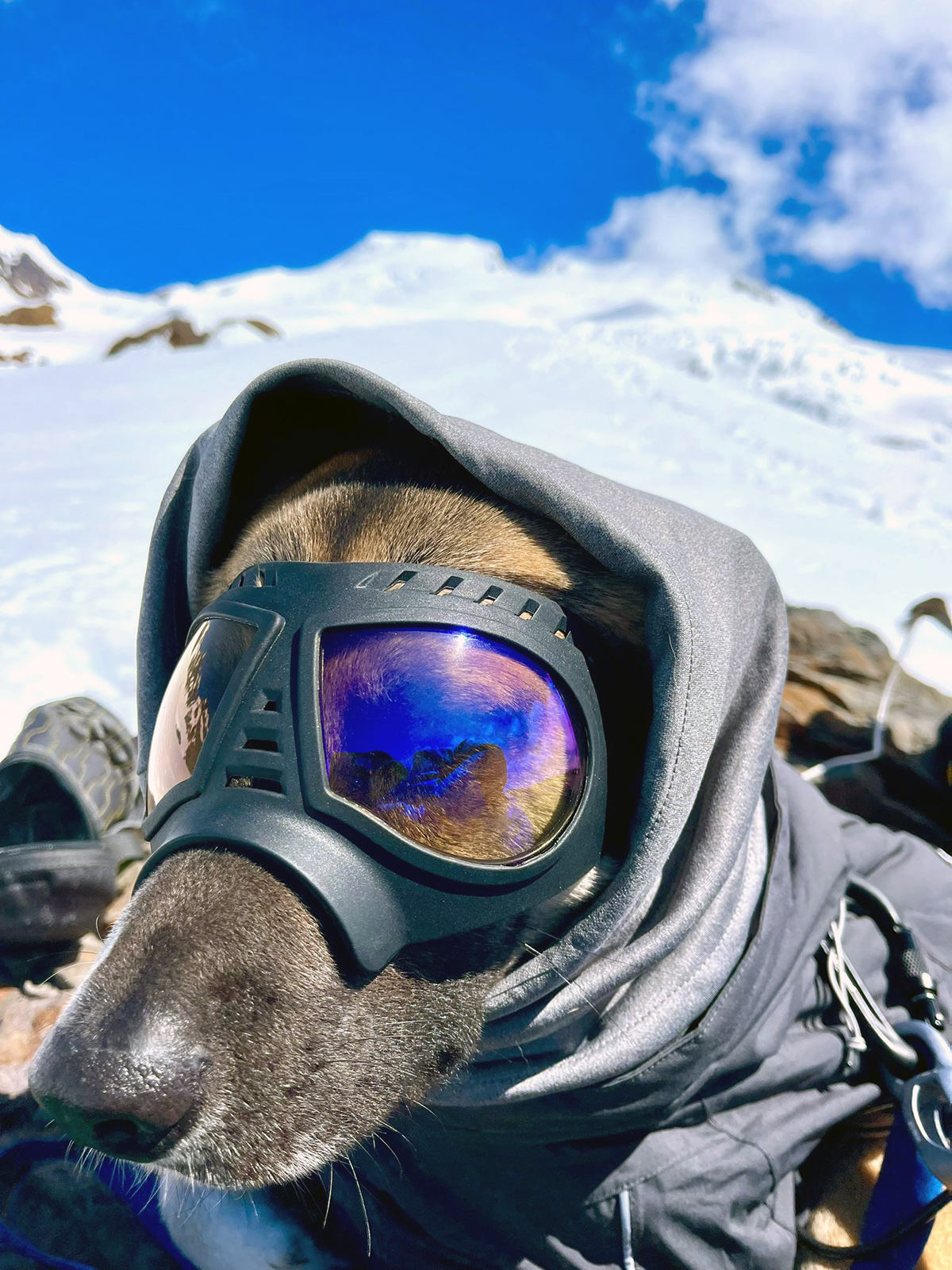
your bones,” he said. “Roger had his thermal suit on; he didn’t show any signs of coldness, or fatigue, but for me, if I stopped moving for more than five minutes, [I] would start to get cold very quickly and after 15 minutes you could freeze if you didn’t wrap up fully.”
Up at such a high elevation, which can cause low oxygen-saturation levels leading to altitude sickness, the only means of rescue is by way of a helicopter, which Tucker recalled seeing from a distance assisting another couple who had encountered difficulties.
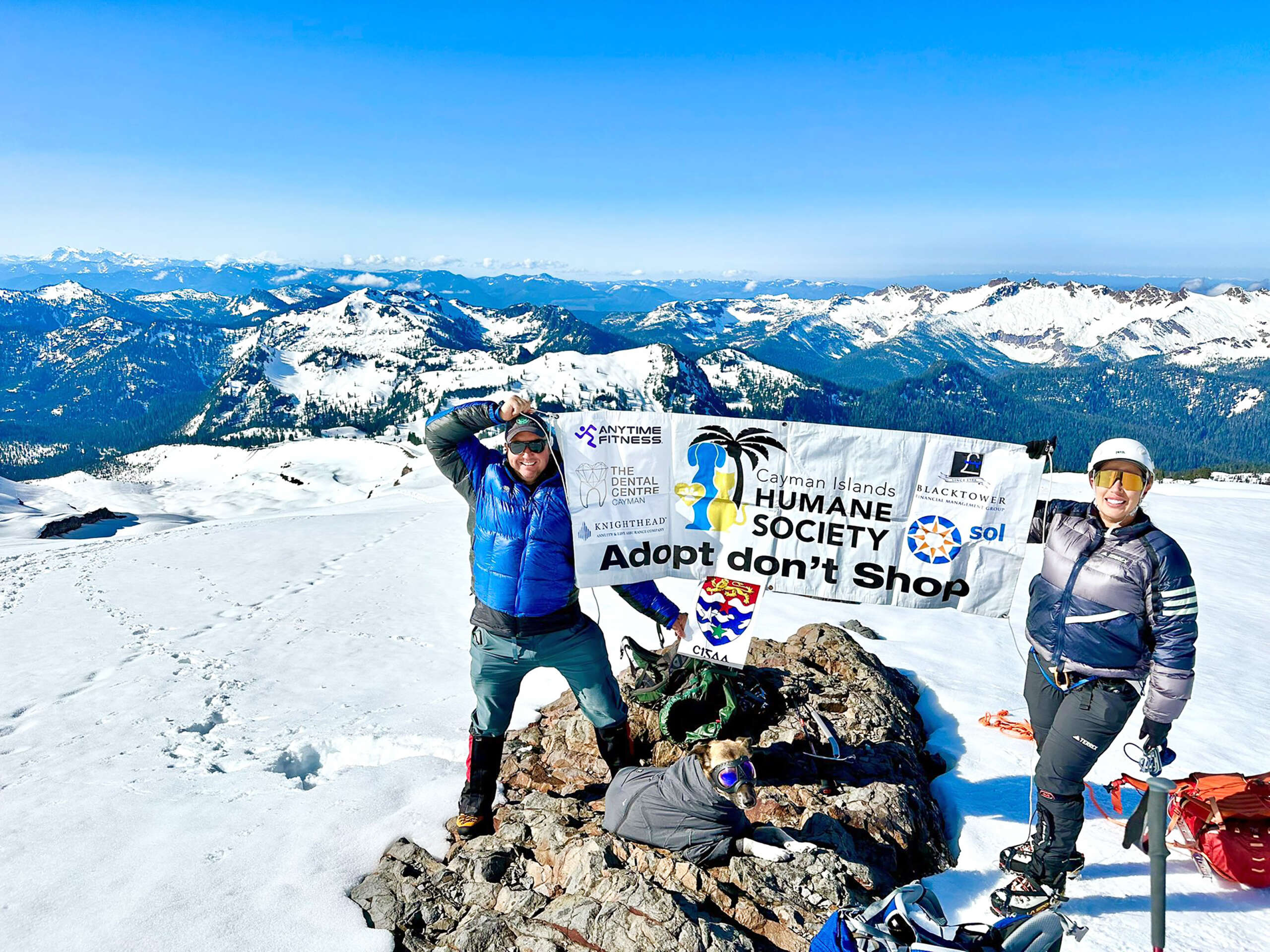
“Just for complete clarity, we didn’t actually make the summit,” Tucker said. “The guide turned us around because the snow had got so soft and, at that stage, obviously, we had Roger’s safety to consider. But we were right underneath the summit, we were right there.”
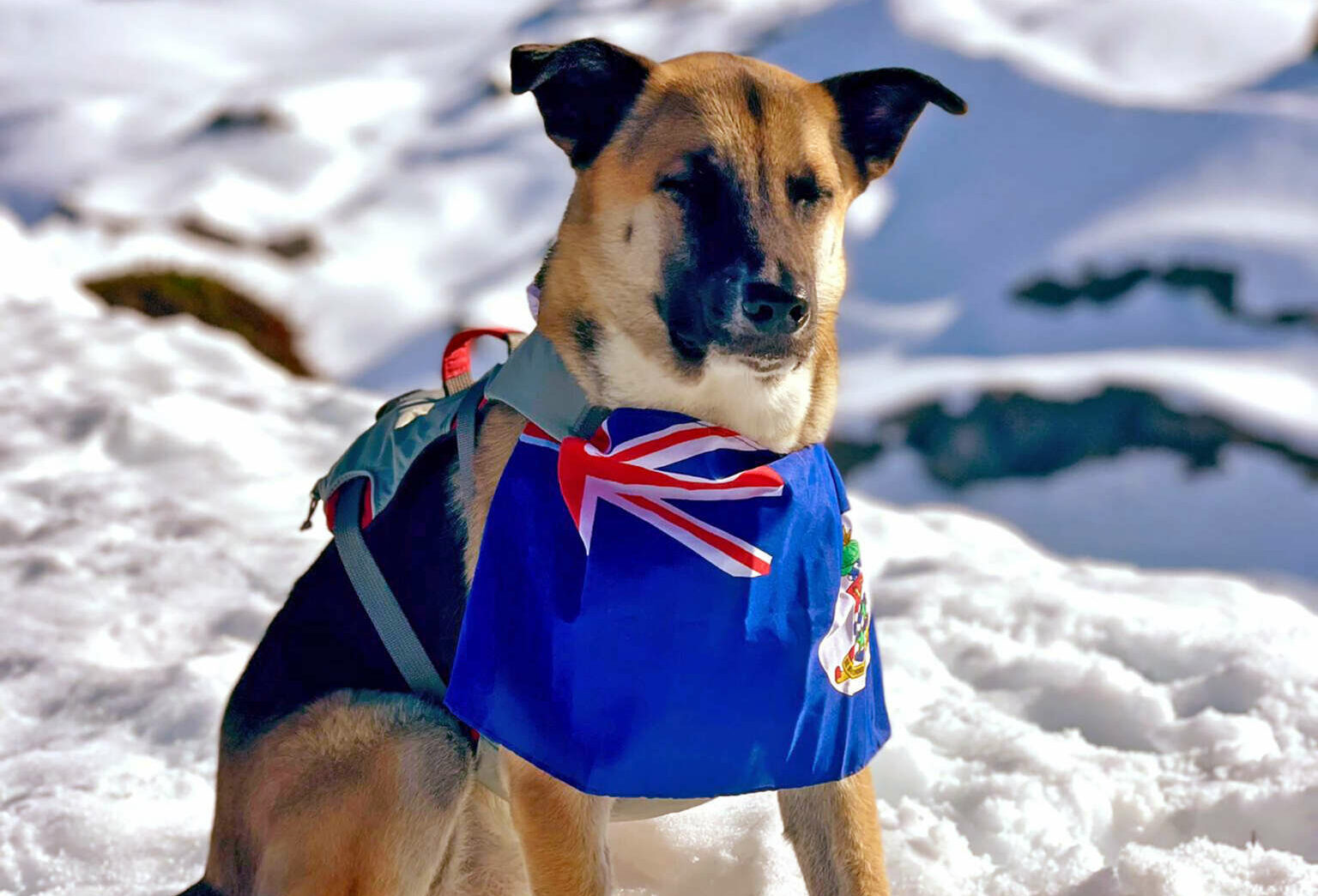
And, it was there beneath the summit, that Tucker, Rocha and, of course, Roger flew the Cayman Islands Humane Society banner.
“It was great,” he said. “This is just the first step, because I’m determined to do more, bigger, and harder mountains. More people will take notice and hopefully change their whole view of what they perceive shelter dogs to be.”
‘Roger saved me’
Last year, according to the Humane Society, 400-500 dogs are euthanised yearly by the Department of Agriculture. One of the main reasons behind that is the islands’ stray dog population, which continues to rise – an issue many blame on breeders.
“I think if landlords allowed a lot more dogs, then the shelters would be under a lot less pressure and a lot more people who are willing, would take the dogs in,” Tucker said. “A part of this trip was to get that awareness out there.
“I’ve had dogs from breeders, and I’ve had dogs from shelters, and I can 100% say that the dogs from the shelter are more loyal and more well behaved than dogs from breeders, because they know they have been rescued, they want a master because they know what it’s like to live on the streets.”
Two years ago, Tucker was diagnosed with a cardiac condition that could be catastrophic if not monitored. However, he explained that Roger played a big part in helping him stay healthy.
“My heart would get overly stressed, but a couple of hours before the body became stressed, Roger would start acting very peculiar around me… and he was trying to alert me because he sensed a change,” Tucker said. “I told my cardiologist about it, and he said your body will be releasing adrenaline and cortisol… and he’s picking up on it.
“I’ve done a lot of testing with the cardiologist, and I’m pleased to say, because of the advance warning that Roger gives me, my heart is actually improving, and it’s avoided the need for me to have a pacemaker.
“This is why I’m so passionate about giving back, because he’s literally changed the course of my life. I could’ve gone on and ended up with a heart attack without knowing what he had helped me realise. I’ve saved Roger but he has also saved me.”
So far, Tucker has raised more than US$13,000.
Related Videos