

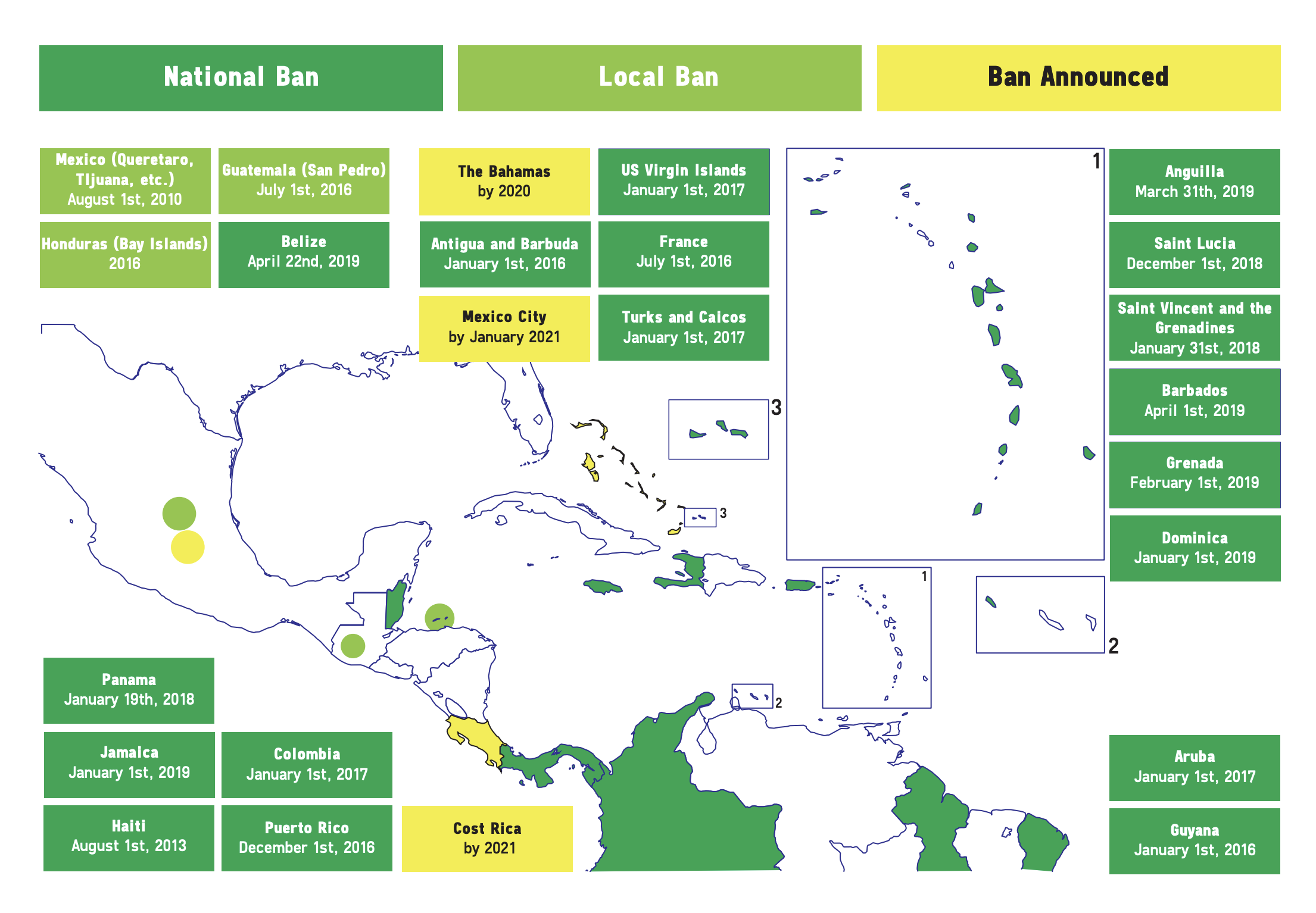
Single-use plastics have been banned in countries and territories all over the Caribbean – but continue to be widely used and sold in the Cayman Islands.
The latest UN Environment report on the status of polystyrene foam and plastic bags in the Caribbean region said 18 out of the 40 listed nations already had a national ban in place.
And in the four years since the 2019 account was published, several others – including the Bahamas, Dominican Republic, Sint Maarten and Trinidad and Tobago – have signed up.
Despite years of promises from successive Cayman Islands governments on movement towards outlawing single-use plastics, tangible action has yet to materialise.
However, the biggest movement on a Cayman ban in several years may be coming soon, according to the Ministry of Sustainability and Climate Resiliency on 25 May.
A ministry spokesperson said it is “in the process” of submitting a proposal for the ban of eight single-use plastic products to Cabinet, but declined to provide further details.
Marine plastic litter
Every year 60 to 100 million barrels of crude oil are used to create plastic bags – a process that emits vast amounts of pollution, according to the United Nations Environment report.

About 100,000 marine animals die globally from ingesting or getting caught up in plastic bags, and it takes about 400 years for one bag to biodegrade.
Meanwhile polystyrene foam contains benzene and styrene. These chemicals are two known carcinogens that can leach into food or drinks.
When it enters oceans, marine organisms can mistake it for food and choke, starve or suffer a build-up of toxic chemicals which can eventually end up in the human food supply.
About eight million tonnes of plastic end up in the world’s oceans each year – the Caribbean is the second most plastic-contaminated sea in the world after the Mediterranean Sea.
Estimations of the volume of plastic waste range from 600 to 1,414 plastic items per square kilometre. Of that 70% to 85% is from land-based sources of solid waste.
Along with killing sea creatures, the plastics are also unsightly, can choke waterways, block sewage systems and provide breeding grounds for mosquitos.
The report’s author Marco Ferrario described plastic pollution as “one of the most relevant and important issues of our time”.
He said the traditional linear production, use and disposal of conventional plastics is ecologically unsustainable and has caused “adverse and unacceptable” environmental harm.
Clean seas
The United Kingdom signed up in 1986 to United Nation Environment’s Cartagena Convention – a regional legal agreement for the protection of the Caribbean Sea.
It is supported by three technical agreements on oil spills, specially protected areas and wildlife, and land-based sources of marine pollution.
Within the third agreement, the UN requires nations to adopt laws and regulations to prevent, reduce and control pollution of the marine environment from land-based sources.
These include pollution from ships, caused by dumping, from land-based sources, from sea-bed exploration or exploitation, and from atmospheric discharges.
In 2017 UN Environment launched a five-year long Clean Seas Campaign to engage governments, the public and the private sector in the fight against marine plastic litter.
The goal of the campaign was to address the root cause of marine litter by targeting the production and consumption of non-recoverable and single-use plastic.
Sixty-nine governments, including 20 from the Caribbean and Latin America, accounting for more than 60% of the world’s coastline signed up to the campaign.
The United Kingdom also signed up, but no mention was made of its territories including the Cayman Islands.
In 2019 World Bank Group published ‘Pollution in the Caribbean: Not a Minute to Waste’, which discusses a 12-point action plan for the region’s nations to cut waste.
Point ten is: ‘Make a decisive commitment to reduce consumption of common and persistent litter items including plastics.’
“Priority action on common and persistent litter items including single-use plastics and Styrofoam is necessary and a realistic goal for countries in the region,” it reads.
“It can be accomplished with a well-planned, phased approach without major financial investment, but with substantial gains.”
Later in 2019 UN Environment published its report titled: ‘Status of Styrofoam and Plastic Bag Bans in the Wider Caribbean Region’.
The report includes all the Caribbean islands – six of which are incorporated into France and the Netherlands – along with all countries bordering the Caribbean Sea and El Salvador.
Of those 40, 18 of their governments had already signed up to single-use plastic bans with several more since joining them, leaving the Cayman Islands lagging behind.
Vincent Sweeney, head of the Caribbean sub-regional UN Environment office, said the future of the Caribbean is to be free of single-use plastics and plastic pollution.
“A Caribbean that is sustainable, resilient and growing economically must take care of the people and the industries upon which it depends.
“One of the ways we can effectively do this is to reduce our dependency on single-use plastics.”
Last week, UN Environment’s Intergovernmental Negotiating Committee met in Paris, France, to develop an international legal treaty to eradicate global plastic pollution.
Its aim is to complete this industry-changing work by 2024 – but until then it is up to individual governments to make moves to eliminate harmful plastics in their own nations.
Related Videos









Regarding: “ Priority action on common and persistent litter items including single-use plastics and Styrofoam is necessary and a realistic goal for countries in the region,”
Our Island is permeated – land & sea – by litter. One cannot go anywhere with out seeing trash intentionally tossed into the bushes as if those tossing it there are convinced that the vegetation will consume it. There are fines for littering however I have yet to see any indication that they are enforced. Yes, we need to eliminate single use plastics. However additionally, we need to eliminate the mindset of this Island’s inhabitants that littering is acceptable. Until then, I will continue to walk daily with bag in hand to pick up trash and dispose of it appropriately.
Anne Evans
Subscriber’s Spouse