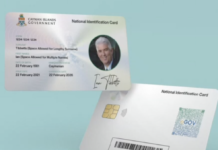
Cabinet has given the green light for work on the roll-out of Cayman’s digital identity register and the issuance of ID cards to begin, as it approved the partial commencement, by mid-June, of the Identification Register Bill 2022.
The bill, passed in December, creates the legislative framework for Cayman’s first national ID system.
The Ministry of Investment, Innovation and Social Development, in a statement Wednesday, said Cabinet’s approval now enables regulations to be drafted for both the Identification Register Bill 2022, and the National Identification Card Bill 2022, both of which should be finalised later this year.
“The partial commencement facilitates components of the Register to be developed and tested before any live applications can be processed. It is therefore necessary for the Office of the ID Registrar and the ID Register to be established, which are tasks being led by the Ministry,” the statement said.
The proposed identity register will enrol all Cayman Islands residents, anyone born in Cayman and Caymanians born abroad, and will be voluntary.
It will also record changes to work permit and other residency rights, as well as asylum grants.
It is the first time government will have centralised identity information, reducing the amount of data collected and ultimately eliminating the need to submit the same documentation, such as birth certificates, to different government departments or multiple times.
Tamara Ebanks, acting chief officer in the ministry, welcomed the legislation to enable the ID register to become operational over the coming months.
“The Cayman Islands ID card will enable our residents to identify themselves online and in person – and enable Government entities to re-imagine how they can serve our people. It will enhance existing services, and enable people to avail of myriad new digital services. We look forward to collaborating with our colleagues in the public and private sector to leverage this new technology for the benefit of our people, community and Government,” she said in the statement.
Deputy Governor Franz Manderson, it added, has committed his ongoing support to the civil service leadership in deploying the underlying systems, processes and solutions of the Cayman Islands ID card.
Addressing concerns about data protection, the legislation contains criminal penalties of up to a $10,000 fine and two-year imprisonment for misuse and unauthorised collection of personal data, and doubles those penalties for unlawfully accessing the register and an individual’s personal data.
Cayman delegation visits Estonia
Meanwhile, the ministry said its eGovernment personnel have been working collaboratively with Estonia’s e-Governance Academy.

It said a civil servant technical delegation representing three ministries of the Cayman Islands government recently concluded a four-day visit to Estonia, from 29 May to 2 June.
The delegation attended the e-Governance Academy’s ‘Digital Innovation as a Catalyst for Social Change’ conference. Key stakeholders from the Ministry of Investment, Innovation and Social Development, Ministry of Financial Services and Commerce, and Ministry of Border Control and Labour attended.
Ministry of Investment Acting Deputy Chief Officer Charles Brown, in the statement, said the conference was an unprecedented opportunity to learn from Estonia’s leaders as well as others who are adopting its e-governance systems.
“Every person representing the Cayman Islands Government benefitted from this information sharing at a high level and gained inspiration for the digital transformation of the Cayman Islands. We look forward to re-imagining delivery of Government services in line with these insights and the core principles of efficiency, security and integrity,” he said.
Related Videos