Government’s proposed national identity card and digital register is likely to cost around $8 million over a five-year period; however, Innovation Ministry acting Deputy Chief Officer Charles Brown says Cayman will save double that amount through an efficient rollout.
Brown, speaking on the 23 Nov. episode of the Cayman Compass weekly talkshow ‘The Resh Hour’, said the $8 million, which will cover the cost of the system and card production, was a worthy investment that will make accessing government services easier when implemented.
He noted that the new system would mean less time waiting in line for members of the public, less manual data entry, and improved processing time and accuracy.
“Conservative estimates that were done in the business case were at $18 million when you translate benefits into cash,” Brown added.
Law changes proposed
Government has gazetted the Identification Register Bill 2022 and the Identification Card Bill for the creation of a digital identity register and the issuance of ID cards to improve how residents interact with the government and businesses, and reduce red tape.
They will be debated at Parliament’s next sitting in December. The proposed identity register will be available to all Cayman Islands residents, anyone born in Cayman and Caymanians born abroad.
Innovation Minister André Ebanks, speaking on the show, said the initiative and the vision behind it are user-driven and aimed at making life simpler for citizens accessing services within government.
He said having the digital ID will assist with information sharing between departments and reduce the hassle at the counter for customers.
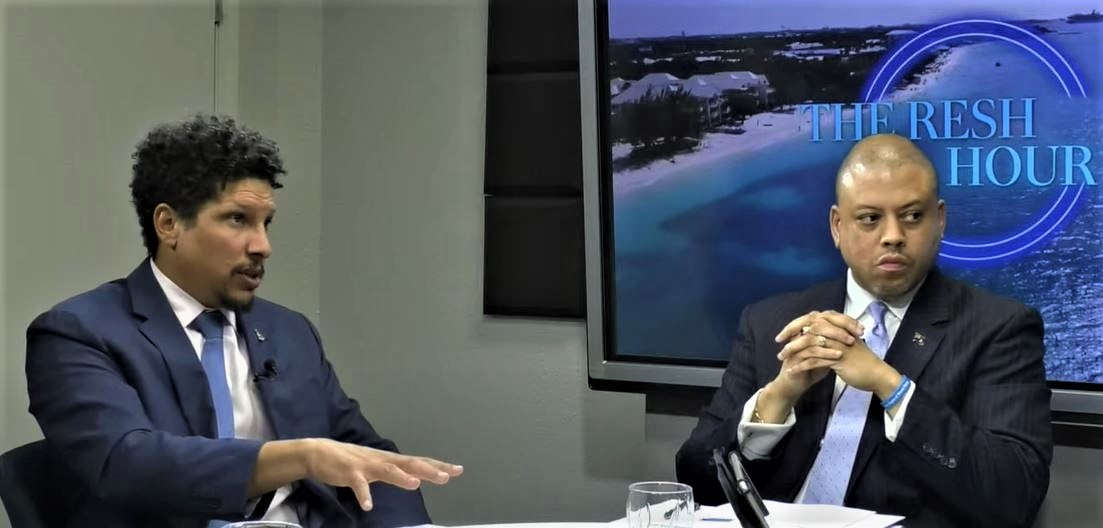
“We have a system that’s more system centred than client centred. So the system has asked the person, particularly Caymanians, to walk around and submit five or six different documents to prove that it’s you and hope that government department now accepts that information. [But for] another transaction with a different department, you have to repeat the steps all over again. What this provides is a collection of that data and linking the different government systems so that they speak to each other,” he said.
This is the first time government will have centralised identity information, reducing the amount of data collected and ultimately eliminating the need to submit the same documentation, such as birth certificates, to different government departments or multiple times.
Ebanks said extensive consultations were held before the bills were published and consultations are still ongoing with key groups, such as the Bankers’ Association.
“We are trying to find a comfortable way to motivate people to do this for themselves rather than to force you to do it and… that is where I’ve seen lots of positive anticipation for the tool,” he said.
Control in hands of citizens
Ebanks said signing up for the national ID and digital identity register is purely voluntary, and obtaining a physical card will be up to the individual when they enrol in the programme.
This, he said, is why he believes Cayman’s ID system will be successful, unlike what happened in the UK and Jamaica when citizens rejected the implementation.
If the ID card were compulsory in Cayman, Ebanks said people might reject the idea “on principle” because they were being forced to comply.
“But the fact that it’s voluntary, I think you’ll begin to see more and more people just adopt this organically,” Ebanks said.
Through the initiative, an individual will be able to select, through their profile, the data they want to be shared and can see who has accessed their information and for what purpose.
“A key principle of giving you back that access is giving you control to see who has accessed your data in the register,” Brown said, adding that is not the case now.
There is no cost involved for anyone signing up and, he said, if the accompanying laws are passed, the team behind the project can hit the ground running to get the regulations completed to begin the implementation.
Brown said some of the infrastructure, like the machine for the card production, is here so he expects all systems to be ready for a July 2023 start.
Data protection is a priority
Questions have been raised within the community about data protection for those signing up for the programme; however, the minister assured that safeguards will be built in to keep the data safe and secure.
Data controllers, Brown said, will be part of the process when requests are made and the data is encrypted in transmission and “at rest”.
“A government entity could request this information on your behalf to satisfy another act or another service… it has to be done in compliance with the Data Protection Act. The concept that I just have access… or any other government entity, or anybody can just willy-nilly go and get access to information… that’s completely false,” Brown said.
Ebanks said it will operate within the data protection legislation and rules which have “provided me with a great deal of comfort that the citizen is protected, the resident is protected.”
The system will be transparent so people can see “nothing was going on behind [their] back. You can have a report of that information, you can see and query that information. I think that’s vital to the integrity of the system.”
The data, Brown said, will be held within the Cayman Islands government.
“The data is not being sent all over the place. The only element that has an external feature, which is how the system works anywhere internationally, is the digital signing capability. When you go to sign a document, it actually… gets qualified in Europe with the trusted certificate authority, but that’s how all digital signatures work. And this just gets you a little public key that says you have permission to access it and see it,” Brown explained.
The actual card, he said, will contain a QR code and can be used as a tap-and-go, similar to debit and credit cards in use.
He said this will also have ‘know your customer’ capability, which will prove useful for identity verification for financial transactions, and a facility for information sharing across government and the private sector.
Ebanks said this will be an asset for the ‘unbanked,’ those who do not have a bank account.
Related Videos