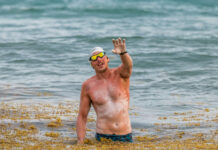
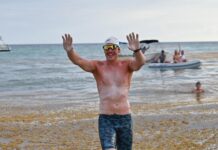
Imagine pushing your body to the brink – complete with aching muscles, sore shoulders, sunburn and jellyfish stings on your face. Oly Rush endured all that, and more, for almost 20 hours in the sea.
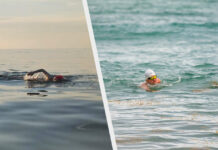
After training for five months, on 9 Sept., Rush completed a gruelling swim around the Greek island of Ithaca, that lasted 19 hours and 41 minutes, to bring awareness to the issue of plastic pollution.
This is not the first time Rush has displayed otherworldly determination to advance the cause. Last year, he became the first man to swim around Grand Cayman, which took 37 hours. Prior to that, he swam around the Isle of Wight.
“There is no better way that I can reach the masses, other than doing these big swims,” Rush told the Compass. “I can shout from the rooftops, but no one will listen. But if you do a big swim like this, people tend to want to know a little bit more and why you’re doing them.”
He added that while long-distance swims are difficult, he believes they are the only way to call attention to the dangers of plastic pollution – something he has been advocating for over the last decade.
“After Cayman, I honestly said to myself, that I was never going to do it again because I was in a world of pain,” Rush said. “The problem is, pain soon fades, and you still have the memories, and the videos to see how much we actually achieve in regards to the awareness, so I just had to do it again.”
The Ithaca journey
However, Rush, a former plasterer from Upton in Dorset, England, underestimated how arduous the journey around Ithaca would be.
“It wasn’t as brutal as Cayman, but it was still up there,” he said. “I wasn’t naïve, because I know how difficult these swims are, but I was perhaps a little too confident going into the swim.
“I did some 10-hour training swims, and they are kind of bread-and-butter for me now, so going into it I was just a bit confident.”
But Rush quickly realised that a ‘superhuman’ state of mind was needed to complete the swim.
Zinc poisoning
“The sea conditions change within minutes, literally,” he said. “You could go from flat conditions, and then the wind picks up and it’s just brutal, into currents. It seemed to be more jellyfish out there as well.
“To make it even worse, I managed to give myself zinc poisoning,” he added, noting that he covered himself with a 40% zinc oxide cream prior to entering the water.
“I felt really sick for a lot of the swim,” he said. “Everything in my head was telling me to give up but I remembered what people spent a lot of money on to help me.”
Plastic pollution
Completing the physical challenge was only part of Rush’s mission when he travelled to Greece, as he was also focused on promoting a cause that was important to him. But he encountered difficulties in Ithaca communicating his message of ending plastic pollution, noting the language barrier proved a challenge.
He spoke of the difficulty of getting his message across, as he noted that beaches in Greece were covered with plastics.
“The amount of plastic washing up on the beaches in Greece… I’ve never seen anything like it,” he said. “We get a lot of plastic washed over here in the UK but it’s on another level out there,” he said.
According to an article posted on the Greek Reporter website earlier this year, microplastics “were found in 25 marine animals examined (eight dolphins, two Mediterranean monk seals and 15 sea turtles), with a total of 10,639 microplastic fibres detected in their gastrointestinal tracts”.
In addition, the article noted, the Mediterranean is one of the worse affected seas in the world when it comes to this kind of pollution, with an estimated 43.55 pieces of litter per 100 square metres of seabed, of which 70-80% is plastic.
“It’s getting into the fish,” Rush said. “This stuff is just everywhere now and we don’t really know the true scale of it but we see the impact it has on animals first hand. They wash up and have plastics in their stomach.”
Plastic in Cayman’s waters proved fatal on Wednesday, 20 Sept., with the Department of Environment reporting that a baby Caribbean reef shark had been found dead off South Sound – stuck in a plastic sandal.
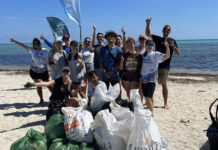
That discovery was a bitter reminder of why Rush continues his quest to spread awareness on the impact of plastic usage and littering. He plans to return to Cayman to emphasise his message in the schools and through beach-cleanup initiatives.
“I’d love to come back next year and do some more school talks; I think that’s where you have the biggest impact, in the schools,” Rush said, adding that people should get involved in supporting local charities like Plastic Free Cayman.
“There’s a few groups… just spread the message, be aware that our planet is fragile and we do need to look after it better.”
During his next visit to Cayman, Rush may also hit the water again.
“I’d love to swim around the Sister Islands; we have talked about it. So I really hope we can perhaps make that a reality next year.”
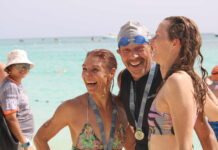
For his swim around Ithaca, Rush thanked Krystal Arch and Jon Schutte, who flew from Cayman to support him through his epic journey.
Related Videos