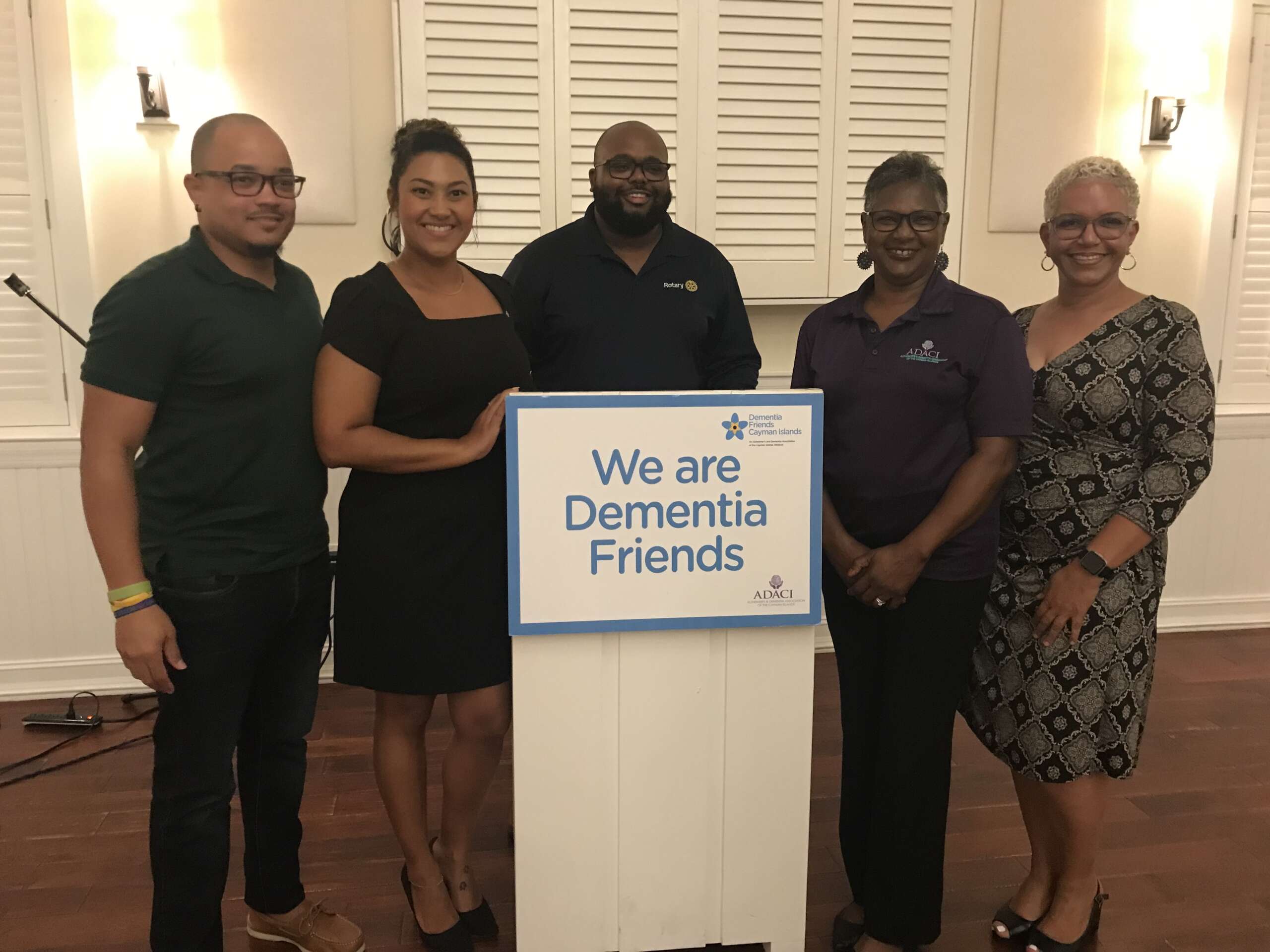
Organisers of a new community programme called Dementia Friends is working to help the Cayman Islands become a potential tourism destination where sufferers of Alzheimer’s or dementia can safely visit.
The Alzheimer’s and Dementia Association of the Cayman Islands introduced the concept of Dementia Friends at a public meeting at the George Town Yacht Club on Tuesday evening, which was attended by about 150 people, including Tourism Minister Kenneth Bryan, who pledged $10,000 from his ministry to the endeavour.
The idea behind Dementia Friends to help train people, through a short 35-45-minute session, to familiarise themselves with the symptoms of dementia, how to approach sufferers, and how to overcome the frustration that can come with dealing with a person who repeatedly forgets.
Samantha Conolly, deputy chair of the Alzheimer’s and Dementia Association of the Cayman Islands, or ADACI, explained at the meeting that individuals, businesses or organisations that become a ‘Dementia Friend’ can then display the distinctive yellow and blue floral logo that shows that their premises are dementia friendly.
She gave the example of a server at a restaurant, trained as a Dementia Friend, not becoming impatient when a customer can’t remember ordering a certain dish once it arrives at the table, or a nail technician at a salon who doesn’t get annoyed when a client claims they didn’t choose a certain nail polish colour they had selected minutes earlier.
It’s simple interactions like this that can make a business – and, by extension, the entire island – more attractive for people with dementia, and for the caregivers who look after them, and can help make Cayman “the destination of choice” for visitors with the condition who still want to travel.
By taking part in the Dementia Friends programme, “you would get an insight into dementia and be able to use this slogan, just as you might show you accept Scotiabank Visa cards, on the door at your facility, your bank, your hospital, your nail salon, your restaurant, your personal location.
“We are hoping that it goes as far as this slogan being seen as you enter the Cayman Islands… so you know we are a dementia-friendly destination and you can bring your loved ones here because our community will understand and will treat them with the kindness and care they deserve,” Conolly said.
Government support pledged
Bryan, whose aunt Dorothy Davis founded and is the chair of ADACI, agreed that Cayman could become a dementia-friendly tourism destination.
“Yes, we can become a society, a country, a nation that is [dementia] friendly… we can develop the emotional skill and tell people they can come to the Cayman Islands because we’re trained as Dementia Friends… and Champions,” he said.
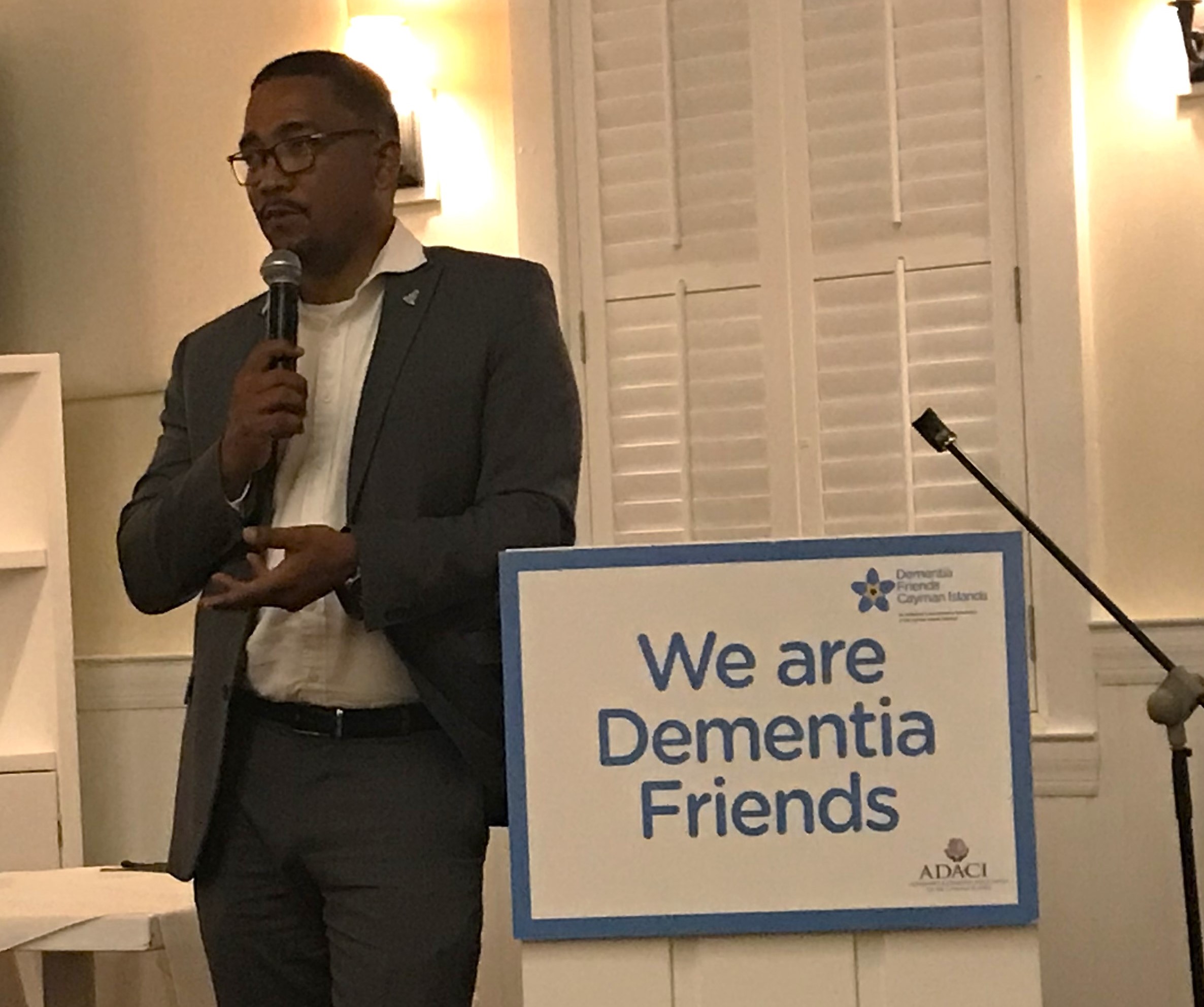
He added that, because his own grandmother had suffered from the condition, he felt he had a personal stake in the issue, and promised that “the PACT administration will do everything we can”.
He added, “I will make sure there is a voice within caucus to show support for this, whether that’s financially or from a government perspective, potentially through regulations or training…”
Later in the meeting, Bryan called from the back of the room that the Ministry of Tourism would donate $10,000 to ADACI to help with funding to launch the Dementia Friends programme.
Raising awareness
ADACI has partnered with Dementia Friendly America, whose director Mary Ek also spoke to the audience, via a Zoom link. Dementia Friendly America has 150,000 Dementia Friends. The US has an estimated 5 million Alzheimer’s sufferers, with 15 million caregivers.
While the exact number of sufferers in Cayman is unknown, the 2021 Census recorded 193 people who responded that they, or a family member, had been diagnosed with Alzheimer’s, while 182 said they suffered from dementia. According to Health Services Authority statistics in 2021, 1,053 people in Cayman had been diagnosed with dementia, the majority of whom had Alzheimer’s.
The Ministry of Health and Wellness has committed to tracking the true prevalence of the condition and other illnesses in the Cayman Islands. As part of that, the ministry undertook a nationwide STEPS health survey to collect data on non-communicable diseases and their risk factors in Cayman, which was completed earlier this month.
Conolly explained that one in four people over the age of 65 will be diagnosed with some form of dementia in their lifetime. She urged people to look around them and realise that the condition will inevitably impact either themselves or someone close to them.
She added that the Dementia Friends concept is about increasing awareness and changing the way people think about Alzheimer’s and dementia.
Worldwide programme
The Dementia Friends programme was first developed in Japan in 2013, and within two years, 1 million people had availed of it. By 2020, there were almost 20 million Dementia Friends. There are now 67 Dementia Friends programmes being run in 56 countries, ADACI director Charmaine Elias told the audience on Tuesday.
People who are Dementia Friends can go on to become Dementia Champions, like Conolly, who in turn train others to be ‘friends’.
While there is no cure for dementia or Alzheimer’s, people can continue to live “and live well” with the condition, Conolly said. However, this can only happen if they have a support system, which includes an inclusive and understanding community, which is where Dementia Friends come in – by offering assistance, being patient and kind, engaging in meaningful conversations, and talking directly to the person with the condition, rather than to their caregiver.
Ensuring that first responders and 911 operators are also trained to recognise and deal with dementia sufferers is also an aim of the programme, as some people with the condition may call emergency services, thinking they’ve being kept prisoner or been locked up, or may not recognise their own surroundings.
Following Tuesday’s meeting, dozens of people signed up to take part in the programme, so many that the sign-up sheet overflowed and additional names and contact details had to be recorded on additional slips of paper.
To find out how to become a Dementia Friend, visit adacayman.ky or email [email protected].
Related Videos