


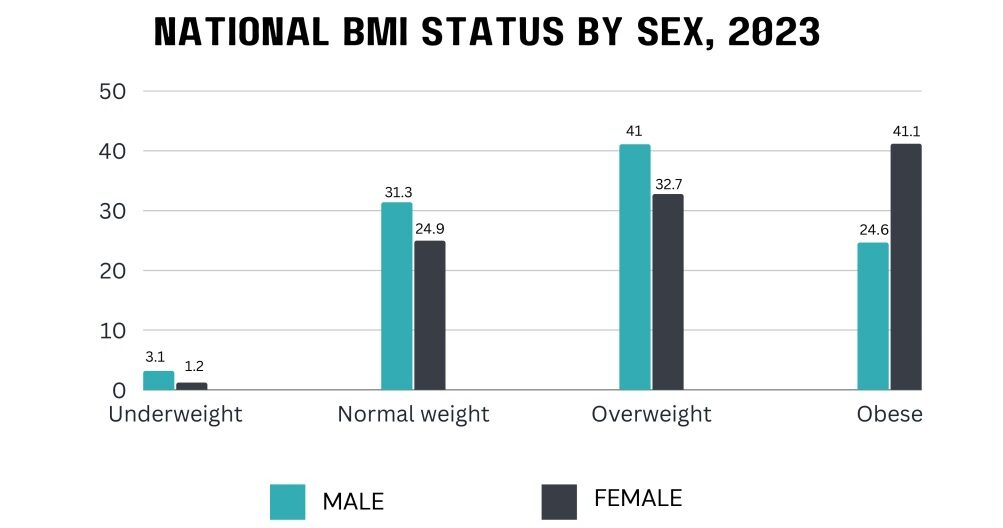
Seven in 10 adults in Cayman are overweight and one-third are obese, according to the preliminary findings of the STEPS national health survey.
Chief Medical Officer Dr. Nick Gent said the survey results, which showed 69.6% of Cayman adults are above a healthy weight, indicated an “epidemic of obesity” that was taking a costly toll – both in terms of healthcare financing and quality of life.
Similar results were also found in the last STEPS survey, in 2012 – which, Gent told attendees at the annual Healthcare Conference at The Ritz-Carlton on Thursday evening, meant obesity was intergenerational and was being accepted as the norm locally.
In the 2012 survey, 70.6% of people were found to be overweight, and 37% were obese.

National epidemiologist in the Ministry of Health, Rachel Corbett, who presented some of the preliminary results of the latest survey at the conference, explained that a higher proportion of men were overweight than women, but a higher number of women were obese than men.
The survey, carried out between June and August this year, involved 3,300 households of people aged between 18 and 69, with the aim to gather information about the prevalence of non-communicable diseases and their associated risk factors, such as weight issues, alcohol and tobacco usage, poor diet or lack of exercise.
Addressing attendees on Thursday, Corbett said collating national data was still a “huge challenge” for Cayman, “due to our hybrid of public and private healthcare”.
The importance of gathering and analysing the type of data collected in the survey was highlighted by Health Minister Sabrina Turner, who spoke at the opening of the conference. She said it was vital to help inform national health strategies in Cayman.
The 14th annual National Healthcare Conference, which ran from Thursday evening to Saturday afternoon, brought together hundreds of medical professional and others in associated fields, as well as members of the public, to explore various elements of healthcare. The theme of this year’s conference was ‘Bridging the Gap Between Patient and Practitioner – Pathways to Optimal Health’.

7.7% of population has diabetes
As part of the STEPS survey, participants underwent blood glucose and blood pressure checks. This resulted in a finding of 7.7% of participants with high blood sugar readings.
Corbett said one in 13 people surveyed were diagnosed with diabetes and were on medication for the disease; 4.9%, or one in 20, were diagnosed with diabetes but were not on medication; and 1.7%, or one in 59 people, had diabetes but, prior to the survey checks, had been undiagnosed.
This meant, she elaborated, that between 3,300 and 5,500 people in Cayman were on medication for diabetes; between 1,800 and 3,500 had diabetes but were not on medication for it; and between 450 and 1,400 were undiagnosed.
She stressed that the statistics she had shared were preliminary results, and may change somewhat when finalised.
“There is a wealth of data that we now have that we can use to inform our policies moving forward, so keep an eye out for that coming out next year,” she said.
Accepting obesity as ‘the norm’
Chief Medical Officer Gent, who spoke after Corbett, said the prevalence of obesity in Cayman had not changed much over the past decade, and said he was concerned, as an epidemiologist, that during that period, only a third of the population had been at a healthy weight.
“It tells me that we have become used to obesity being the norm and we have accepted it as an established fact of life,” he said.
He added, “It also tells me this is not just a generational problem, but [there are] multigenerational cohorts of people with significantly unhealthy weight.”
The “growing burden of disease and disability” from obesity was “destroying the quality and quantity of life for too many Caymanians and their families”, Gent said.
Pointing out that Cayman is not alone in facing this problem, as it was becoming a worldwide issue, he noted that in 1990, 4.5% of deaths internationally were attributed to obesity. By 2020, that had reached 8%; and is much higher in some countries, including Cayman, he said.
“Few other countries can claim that two-thirds of their populations are at unhealthy weights and one-third of their population are dangerously overweight, and that this has been the norm for so many years – although, in fairness, many other countries are catching us up,” he said.
Gent described Cayman as being “hand in hand with the United States” in terms of obesity rates.
According to the US Centers for Disease Control, in 2020, the prevalence of obesity was 41.9%, and diabetes was 14.8%, among adults aged 20 and over.
The chief medical officer said he suspected that one of the reasons Cayman’s obesity levels were not too dissimilar to the US was because the islands had imported that country’s processed food diet and eating habits.
“When a child, asked what a traditional Caymanian diet is, answers Burger King and KFC, then we are in very great trouble,” Gent said.
Changing lifestyle an unpopular option
Another element adopted from the US was the “medicalisation” of weight issues, he told the audience, with people in Cayman often turning to pharmaceutical solutions or surgical interventions to lose weight.
“Changing lifestyle is not a decision that many people choose to take here,” he said.
“Ask yourself, why risk the complications of bariatric surgery when a conservative approach to treatment is as effective and can be more sustainable? Surgery does not change behaviour. Whilst it can give some people body mass control, for many it is a stop gap and it is not risk free.”
Semaglutide weight-loss drugs, used to treat diabetics, such as Ozempic, are growing in popularity worldwide, and in Cayman. Gent warned against relying on such medications as a solution for losing weight, noting that the pounds lost using these drugs usually come back after treatment is halted.
He said people in Cayman had rationalised their fears about the health impacts of obesity, convincing themselves that the consequences of being overweight are “treatable” and refusing “to take responsibility for own lives”.
But he noted, “To be treatable, disease must be detected. And between 450 and 1,400 Caymanians have undetected, and so untreated, disease (diabetes) at this time.”
He added that, to be treated, people need access to affordable care – and between 1,800 and 3,500 individuals on island know they have diabetes, but are not being treated for it.
“For treatments to be optimal, their care must be delivered through well-defined care pathways, using appropriate clinical services with good outcome data – not something I am confident happens for a large proportion of the Caymanian diabetics,” he said.
Related Videos











Interesting to note that 50% of the speakers (in the attached photo) are overweight too.
It is time to remove import duty from “unprocessed” fruit and vegetables, that can not be grown on island.
This will help encourage healthy eating and reduce obesity in the community, lowering public healthcare costs and providing a net gain for the government in the long run.
It is time for comprehensive and holistic solutions for this growing health issue.
Here here! .. care “delivered through well-defined care pathways, using appropriate clinical services with good outcome data” would be brilliant.