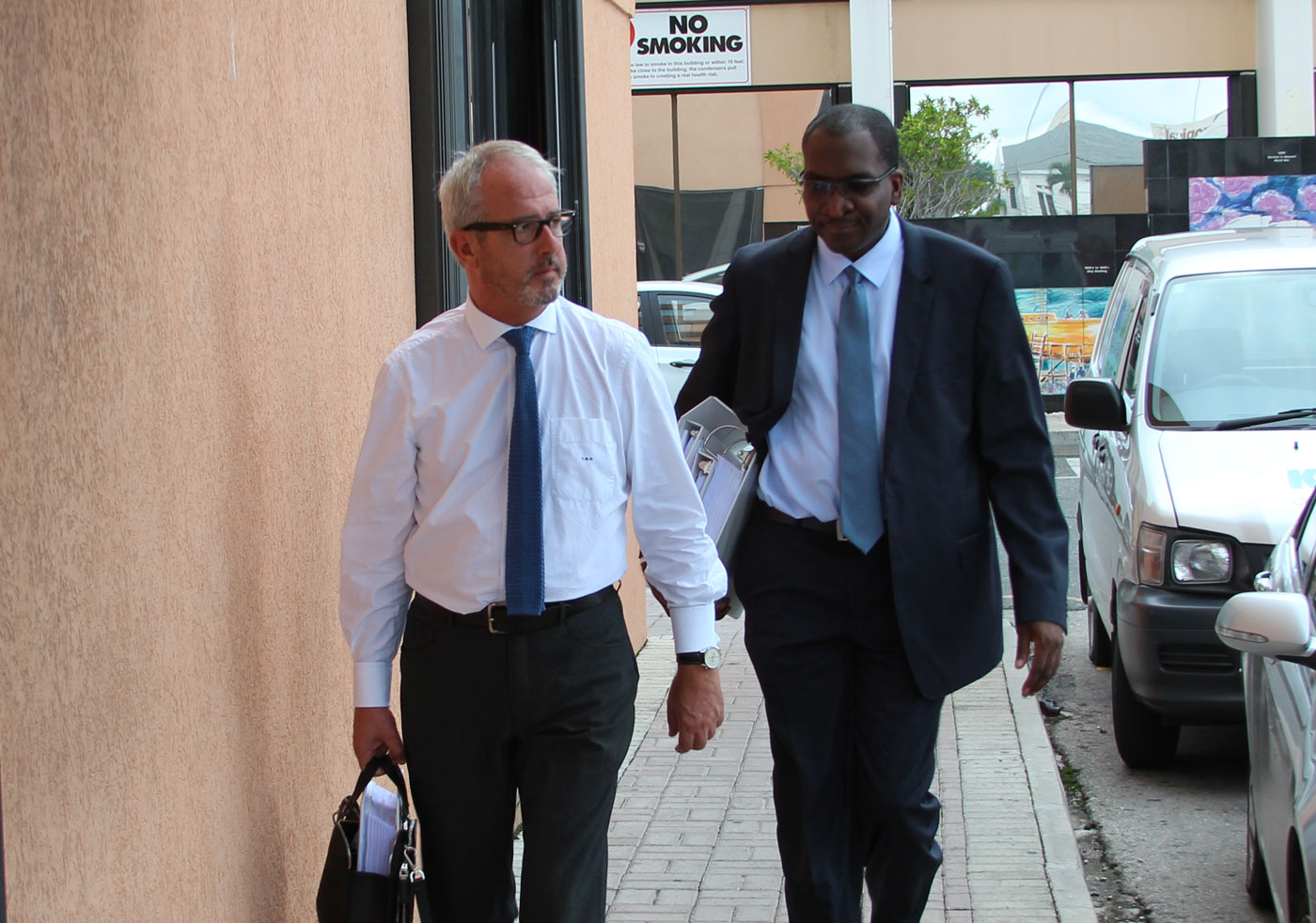
A UK High Court judge has referred British barrister Trevor Burke, KC, who has appeared in a number of high-profile cases in Cayman, and another lawyer to legal regulators for what he described as “indefensible” conduct driven by an opportunity to make vast amounts of cash.
Justice Robin Knowles, in a 160-page ruling issued on 23 Oct., overturned a US$11 billion arbitration award made against the Nigerian government in 2017 for breach of a gas supply agreement with British Virgin Islands company Process & Industrial Developments Ltd (P&ID), a client of Burke and solicitor Seamus Andrew.
Knowles, in his judgment, found that the arbitration award was obtained by fraud.
He was harshly critical of Burke and Andrew, whom he said handled confidential legal documents that P&ID should not have had access to.
Both men have issued statements rejecting the judge’s findings against them.
Burke has been involved in several major cases in Cayman over the years, including the Euro Bank Corporation money-laundering trial, the Canover Watson CarePay fraud case, and a civil fraud case relating to Hurricane Ivan insurance claims.
An arbitration tribunal in 2017 ruled that Nigeria had been in breach of its contract with P&ID, and owed the company – which was owned by Irish businessmen Michael Quinn and Brendan Cahill – US$6.6 billion. With interest added on, that figure has now grown to more than US$11 billion, equivalent to the entire federal budget of Nigeria, Knowles noted.
Nigeria challenged the tribunal’s decision, alleging bribery, corruption and perjury. It claimed that some of its own lawyers at the time of the arbitration had been bribed by P&ID.
Confidential documents
P&ID had been represented in the arbitration by Andrew. Knowles noted in his ruling that on 11 Dec. 2012, Burke, who was Quinn’s nephew, was sent a file of documents to read into P&ID’s claim.
Knowles wrote, “Mr Andrew and Mr Burke, KC, among others, have very significant personal interests in this matter. They may have a claim to what were described by [Nigeria’s counsel] as ‘life-changing sums of money’, contingent upon success for P&ID in this matter.”
He said Burke had stood to make up to £850 million (more than US$1 billion), and Andrew would have made up to £3 billion (US$3.65 billion) if the arbitration deal remained in place.
Nigeria argued that legal documents leaked to P&ID in the course of the arbitration were subject to legal professional privilege – meaning confidentiality between lawyer and client – and had been obtained by corruption.
Knowles noted that by improperly retaining these documents, P&ID had been able “to track Nigeria’s internal consideration of merits, strategy and settlement during the arbitration, and allowed it to monitor whether Nigeria had become aware of the fact that Nigeria and the tribunal were being deceived”.
He wrote in his ruling, “Mr Andrew, Mr Burke KC and Mr Cahill were among those who received Nigeria’s internal legal documents. As legal professionals, Mr Andrew and Mr Burke KC appreciated that these at least included documents that were privileged. They did not know how the documents had come into P&ID’s hands.”
But, he noted, both lawyers knew that P&ID was not entitled to see these documents.
‘Indefensible’
He described their decision not to inform Nigeria or immediately return the documents, as “indefensible”.
He added that the two lawyers behaved in this way because “of the money they hoped to make”.
The judge said, “Mr Burke KC told me in his evidence that: ‘the money is a complete irrelevance here… [r]eputation and career are far more important to me than this notional money.’ But that is now, and was not then.”
He said he had not been convinced by both Andrew’s and Burke’s evidence that they had considered the privileged documents to be of little importance.
Knowles said he would be referring a copy of his judgment to the Bar Standards Board in the case of Burke, and to both the Solicitors Regulation Authority and the Bar Standards Board in the case of Andrew.
“I trust that these two regulators of the legal profession in England & Wales will consider the professional consequences of the conduct of Mr Burke KC and Mr Andrew in relation to Nigeria’s Internal Legal Documents,” he said.
The judge also noted in his ruling that this case had “sadly, brought together a combination of examples of what some individuals will do for money.”
He added, “Driven by greed and prepared to use corruption; giving no thought to what their enrichment would mean in terms of harm for others. Others that in the present case include the people of Nigeria, already let down in so many ways over the history of this matter by a number of individuals in politics and administration whose duty it was to serve them and protect them.”
Lawyers reject judge’s criticism
Burke, in a statement, said, “I do not accept the criticism that have been made of me in relation to Nigeria’s internal legal documents. I gave my evidence in the English proceedings in good faith and to the best of my ability. I am confident that my conduct will be exonerated by my professional body, with whom I shall cooperate fully.”
Andrew, in his statement, said, “I do not accept the criticism in the judgment concerning Nigeria’s internal legal documents. I believe I acted in accordance with my professional duties, and I am confident that my conduct will in due course be vindicated by my regulator.
“I appeared voluntarily before the High Court as a witness and did my best to answer the questions asked of me carefully and accurately, as the judge observed. I shall not be making any further comment at this time in relation to today’s judgment.”
Knowles’s judgment came after an eight-week trial in the first quarter of this year.
The full ruling can be read here.
Related Videos