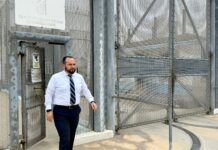
“Where will I be staying?” George General wondered aloud over video link when he appeared before a magistrate at Mental Health Court in early December.
“I’m a better man, sir, I didn’t do anything wrong.”
Special report
It was the end of another fruitless discussion about what to do with the 61 year old who has been imprisoned at HMP Northward for more than a year, in an as-yet-unresolved burglary case.
“We have to keep you in jail,” Chief Magistrate Valdis Foldats answered, with seeming reluctance.
The court typically seeks to find alternatives to incarceration for people with mental health challenges, who are accused of relatively low-level crimes.
But in this case, as in several others, those efforts have been stymied by an absence of appropriate housing.
Before he was arrested in late 2022, General was homeless and itinerant – “living on the road” as he put it in an interview with the Compass at the prison in November.
“I am just here because I have nowhere to go home to. It has been more than a year and all I need is to find somewhere to stay, and I can go,” he said.
Foldats echoed this message at the December hearing, telling him the court had made widespread but unsuccessful efforts to help him find accommodation.
“We have tried to find places for you, but at some point we have to say we have done everything we can and I don’t know where you are going to stay.”
General is far from the only prisoner in that predicament. At the same hearing, another inmate was told, “As soon as you can identify a safe, appropriate residence, I will release you on bail. Think outside the box in terms of finding another place to live.”
Another young man, facing drug charges, was remanded to HMP Northward.
“His father is not able to assist with a residence, he has no residence and that means custody,” said Foldats, who has since retired.
The court is filled with similar stories. Some defendants arrived with family members who could guarantee a place to stay and support to meet the conditions of their bail.
One inmate was released from the women’s prison at Fairbanks into the custody of her grandmother, who, the magistrate noted, “has given you one last chance”.
Brent Hydes, who runs the Hope for Today Foundation, appeared alongside several defendants bailed to the halfway house he runs in West Bay for recovering addicts.
“I want to thank you in public for the service you provide to the community,” Foldats told him. “If we didn’t have halfway houses, more people would be on the street.”
Addressing the causes of crime
The Mental Health Court is at the centre of a series of intersecting challenges around housing, drug addiction and mental illness.
“This is a special court. It is very different to other courts – we are trying to help you,” Foldats told one defendant.
It is one aspect of a criminal justice system that is seeking to pivot, in places, to address the causes of crime as well as the crimes themselves.
The challenges are many and varied.
The Department of Community Rehabilitation has 14 people on its client list who are considered homeless, as well as a further three, currently in custody, with no fixed address.
Probation officers report frayed family relationships, mental health problems and substance abuse challenges, among the principal reasons for lack of access to safe and consistent housing for its clients.
This group of people is often the most difficult to find homes for.
While two halfway houses in West Bay do provide much-needed accommodation to those in recovery, on referral from the court, for those that don’t need or don’t wish to participate in that type of programme, there are limited options.
All these problems are familiar to General, who says he has “no family” and who has already tried the halfway house without success.
“I didn’t have a roof over my head. I don’t have anyone to organise that for me. I am lonely but I can look after myself,” he told the Compass.
“I can get NAU (Needs Assessment Unit). If they release me. I think I can get $800 for a room.”
But there are few rooms available for that price and landlords remain reluctant to rent to NAU clients, especially those coming out of prison.
There’s a gap in Cayman’s support structure, Erica Ebanks, deputy director of the Department of Community Rehabilitation, acknowledged.
The Poinciana long-term mental health facility in East End, when it opens, might alleviate some of the burden, but it is not yet clear if the facility, which has limited capacity and a waiting list of vulnerable patients, will take residents with a criminal background.
Beyond that, there is a need for a place where people can simply get shelter and a meal if they have no other options, Ebanks said.
A homeless shelter and soup kitchen, group homes for people who struggle with day-to-day life, and halfway houses for people transitioning out of prison are on a mental-health wish list of ideal infrastructure for department officials.
Prison a refuge of last resort
In the absence of that wider network of facilities, HMP Northward has become a refuge of last resort for multiple people, who authorities agree should not be imprisoned.
Keehon Moore, a supervisor with responsibility for some of the prison’s rehabilitation programmes, sees the challenges firsthand.
The Enhanced Reintegration Unit, which can accommodate 14 prisoners, works to ensure that parolees have employment and housing before they are released.
But some inmates struggle to cope without the routine of prison life.
“We’ve had some prisoners expressly state that they actually committed a crime in order to come back,” Moore said.
In one case, a former inmate – struggling on the outside – telephoned the prison to ask if he could be readmitted. That wasn’t an option, but he soon reappeared after being convicted of another offence.
Literacy challenges
There are success stories too.
Some inmates have found housing and full-time employment through the Release on Temporary Licence programme which allows them, in the final months of a sentence, to stay in the ‘dorm-style environment’ of the Enhanced Reintegration Unit and spend their days outside the prison walls.
Moore said the Cayman Islands Prison Service has also been retooled to help deal with alarming illiteracy levels among the inmate population.
The programme is yielding “small victories”, with some inmates learning to write their names, read a story or fill in a form for the first time, he said.
Moore recalled another infamous inmate – dismissed as a lost cause – who got an electrical qualification and found steady employment on the outside.
As part of a partnership between the department and the prison, every inmate now gets a bespoke plan to address the root causes of their criminality.
Ebanks said, “We do a risk assessment on every sentenced prisoner, and whatever is causing them to commit crime, we try and target that.”
That can mean substance abuse treatment, anger management, mental health support, literacy interventions, technical training and life skills coaching, among other things.
For some inmates, prison is their first encounter with access to that kind of support, or even to a structured environment, three steady meals and a bed.
In those circumstances, incarceration has proved a positive turning point in their lives, a dynamic authorities are seeking to leverage for more inmates.
The approach is changing, but the resources aren’t always there to achieve everything that officials want.
A team of six Department of Community Rehabilitation officers is responsible for the entire prison population, and prison guards have to multitask to help run the variety of programmes on offer while keeping order in the sometimes-fraught atmosphere of Northward.
Ebanks acknowledged it will take time and resources for the approach to bear fruit.
“It’s a very long project. We have years and years of work that we can do,” she said.
Imprisoned without charge
For others – including some with mental health challenges – prison is a bewildering and frightening experience.
Cayman’s outdated laws, and the absence of a secure mental health unit, means that Northward is legally sanctioned as a ‘place of safety’.
Inmates can be held there at the ‘governor’s pleasure’ without ever answering charges.
Moore cited one example of an inmate considered unfit to plea on medical grounds, who has been behind bars for more than six years.
Another infamous prisoner – Travis Webb – is being imprisoned at Cayman Islands Hospital after being deemed ‘not guilty by reason of insanity’ of attempting to bury a child alive.
Others, as evidenced in the Mental Health Court, are being remanded to prison because there is nowhere else for them to go.
Lisa Malice, deputy chief officer in the Ministry of Home Affairs, says the situation will need to be addressed through a mix of legislation and new infrastructure.
She’s hopeful that the Poinciana mental health facility will be able to accommodate at least some of those inmates currently being held at Northward. Consideration is also being given to the concept of a secure medical and mental health facility within the design of a new prison.
Meanwhile, planned changes to the Criminal Procedure Code will make it easier for authorities to take a flexible approach to managing and monitoring people with mental health conditions who are accused of crimes.
‘Forgiveness is always possible’
It seems counterintuitive that many people can’t get help or don’t know where to turn for support on everything from drug and mental health issues to illiteracy and homelessness, without first committing a crime and ending in the court system.
Hydes, of Hope for Today, acknowledges this gap in the system and urges people to look out for their family members and seek support before it gets to that stage.
Some are simply not seeking rehabilitation, he cautions.
“When people have drug or mental health issues, it is hard to force them to deal with it.”
The halfway house only works if the individual is committed to attending meetings, going through the process, and following the strict abstinence rules.
Even then, recovery is a long road, and Hydes estimates that around eight or nine out of approximately 30 men who pass through each year, will successfully transition out and “find recovery’.
Hydes said this government – which has increased its annual grant for the foundation’s halfway house – is starting to put resources toward addressing the causes of crime.
“I think the government, the court system, and everyone involved are working hard to do what they can to assist,” he said.
But he believes more is needed in terms of housing and “family intervention” for offenders.
While – as the cases in the Mental Health Court demonstrate – some ties have been stretched to breaking point, Hydes believes Cayman’s family bonds are still strong.
“There is always a possibility of forgiveness,” he said.
“Once you clean up your act, most people are quite forgiving.”
Related Videos