


A man who advertised an endangered parrot for sale claiming it could sing like Whitney Houston, is facing possible charges in an incident that has helped shine a light on Cayman’s underground pet trade.
Black market Cayman parrots typically go for $200, according to environment officials. But the false claims about the bird’s vocal prowess apparently pumped the price up to $600 in an alarming social media advert that prompted scores of complaints.
The advert, written in broken English, claimed the Grand Cayman parrot “can soon sing withny husstion song baddy gauerd” – presumably a reference to the legendary American singer who starred in and sang the theme tune “I Will Always Love you” to the 1992 movie.
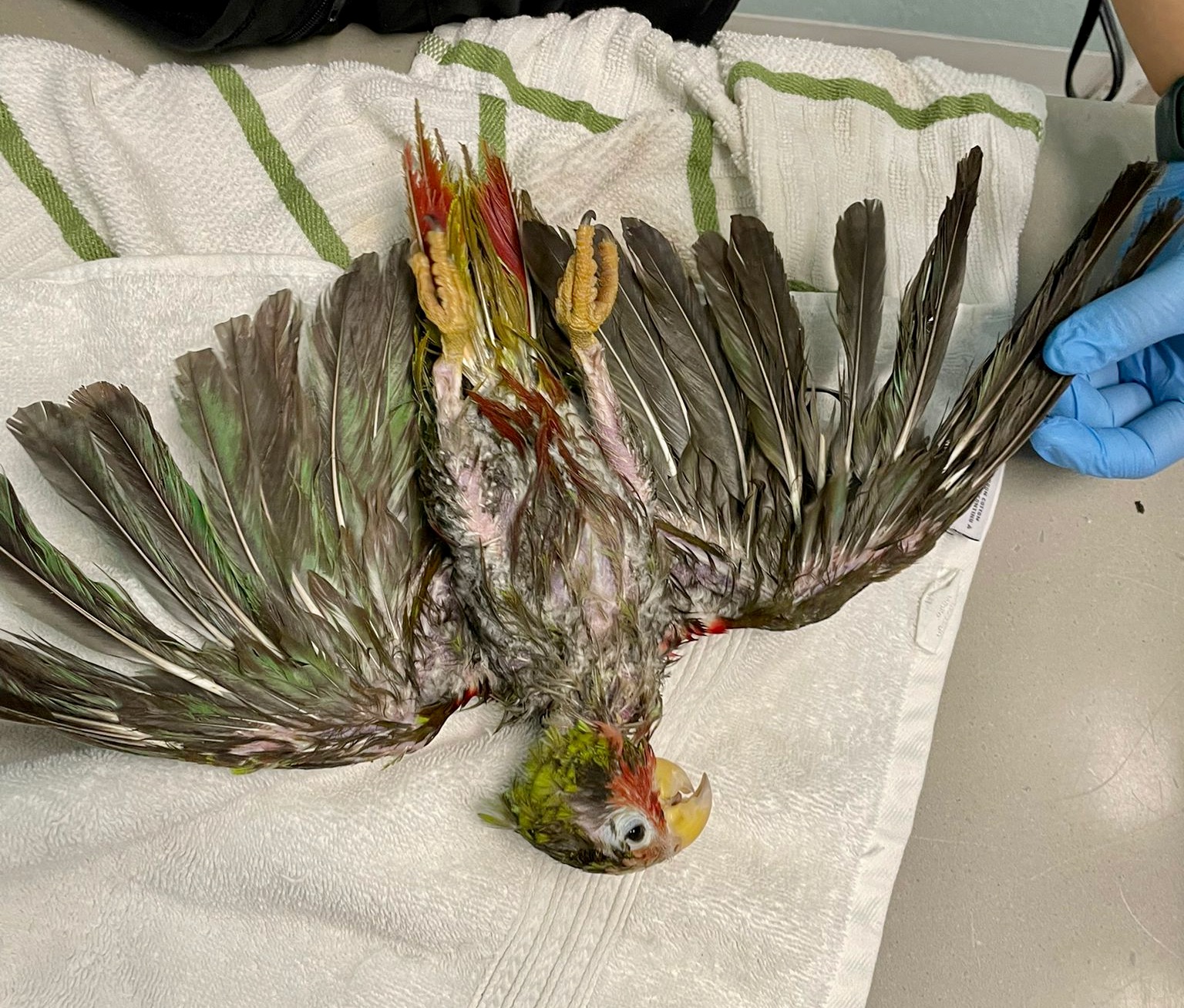
In images shared in a Facebook post, the parrot, Cayman’s national bird and a protected species, appeared scraggly and underfed in a small cage. It had seemingly plucked some of the feathers from its throat, a common reaction in stressed birds.
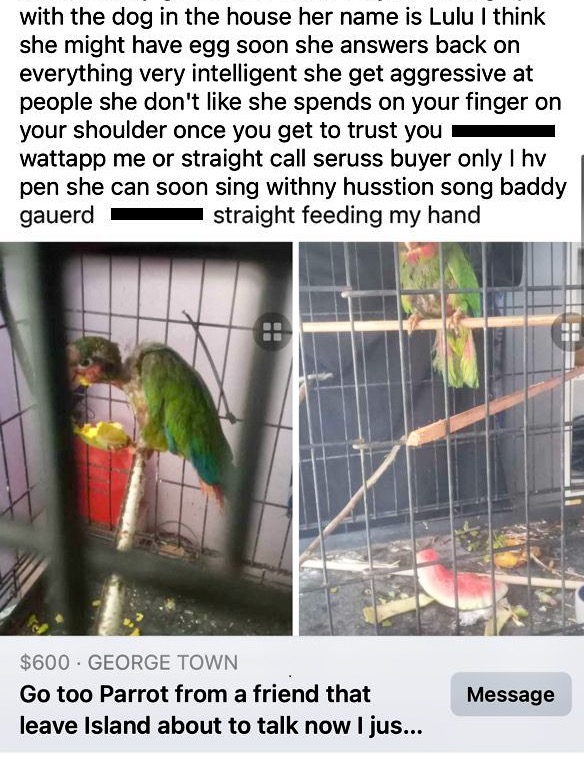
“Her name is Lulu, I think she might have egg soon,” the ad continued, boasting that the parrot would sit “on your shoulder”.
The bird is actually a male and has been renamed Charlie by rescuers.
The pictures and the ad sparked outrage, prompting the Department of Environment to investigate. An arrest was made in the case earlier this week and the parrot is receiving veterinary care in the hope that it can eventually be reintroduced to the wild.
Jane Haakonsson, research officer with the DoE, said the bird had been stressed and suffering but was now on the road to recovery after being bathed and treated for parasites. She said there was no inkling that the parrot could sing or even say hello or good morning.
“All we have heard from this bird are some angry, distressed, perfectly normal parrot calls.”
Blackmarket bird trade
The false boasts highlight a common misconception about parrots that is fuelling a surprisingly swift blackmarket trade.
Data collected during an amnesty in 2018 and 2019, when captive birds were registered as part of a push to protect wild parrots, suggests that, at that point, around 30 parrots every year were being taken from the wild to be used as pets or traded.
With an estimated 600 breeding pairs left in Cayman, thats an alarming number, says Haakonsson.
“This is our national bird. It is not a commodity to be traded or profited from. These birds are not made to sit on someone shoulder or be given a boom box to learn how to speak.”
In some cases, she said, previously wild Cayman parrots had been kept in small budgie cages with a radio attached playing 24 hours a day in an effort to teach them to sing.
Haakonsson said the Grand Cayman Parrot – which is a sub species of the Cuban Amazon Parrot – doesn’t fit that storybook stereotype. She said the typical asking price conservation officers had seen for the species was $200, compared to $1,000 for an African Grey, which has a much wider vocal range.
Poaching, trading and keeping Cayman Parrots is illegal under the National Conservation Act. Only parrots already registered during the amnesty, which were grandfathered in when ‘nest robbing’ was officially outlawed in 2020, are permitted in captivity and those should have an identifying band on their leg.
Cayman’s national bird is threatened by critically low numbers following Hurricanes Ivan and Paloma and by habitat loss from development as well as from poaching.
Since the introduction of the ban in 2020, Haakonsson believes there is much greater awareness of the rules – a positive sign that things are improving in some aspects.
“We had so many complaints which I think does demonstrate there is a good understanding out there that these birds can’t be traded like this.”
Related Videos








Thank you to the individuals who are looking out for, and caring for, these beautiful birds!! They are wild animals and deserve to remain in their natural environment!!