


Immigration chiefs have a ‘stop list’ of almost 20,000 people banned from visiting the Cayman Islands.
The list also includes hundreds of people with permanent residency or Caymanian status subject to ‘stop notices’, which could prevent them from leaving the islands
Surprisingly, there are also 11 dead people listed as being under ‘stop notices’, an open records request has revealed.
While Customs and Border Control is mandated to maintain a list of prohibited immigrants under Cayman Islands law, that status applies to less than a quarter of the people subjected to stop notices.
More than 13,000 others have been deemed ‘persona non grata’ and placed on a separate black list for a variety of reasons, including having committed a previous immigration related offence such as overstaying a tourist visa.
Law firm HSM Chambers, which obtained the data following a freedom of information request, has suggested that list could be open to challenge as the criteria for how people are put on it is not published.
The firm warns that people who have accepted administrative fines – an alternative to pleading guilty in some minor offences – could be swept up in that list without being aware of it.
Data supplied to HSM, under the Freedom of Information Act, indicate a total of 19,607 people were on the ‘stop list’ or subject to ‘stop notices’ as of August 2024. That includes 412 Caymanians and 60 PR certificate holders – most likely a reference to people prevented from leaving Cayman.
In an emailed response to the Compass, a Customs and Border Control spokesperson said it was mandated to place anyone classified as a ‘prohibited immigrant’ on the stop list.
It added that the act “does not prevent law enforcement agencies from adding other persons of interest to lists. Therefore, these lists will include prohibited migrants (non-Caymanians), other Caymanians, and residents of interest.”
In relation to Caymanians, these would be on a ‘persons of interest’ list, the spokesperson indicated – including people who may be prohibited from leaving the jurisdiction.
She acknowledged that the act does give Caymanians and permanent residents the “unconditional right to enter the islands”, adding “Customs and Border Control cannot prevent these individuals from travelling to the Cayman Islands.”
Challenges at the border
The Compass has learned of several recent incidents where visitors have had issues at the border after finding out they were on the stop list.
According to a policy document, obtained by HSM Chambers, a person can be deemed ‘persona non grata’ for a range of circumstances – including having previously “opted to be administratively fined” or been convicted of a crime anywhere in the world.
The category is separate to the ‘prohibited immigrant’ designation, which applies to more serious cases, including those who have been convicted of crimes that carry a sentence of a year or more in the Cayman Islands.
A key concern, highlighted in HSM’s email to clients, was for those who may have accepted fines for fairly minor offences, like accidentally overstaying, without realising they would be banned from the islands as a result.
“It certainly does not appear that WORC specifically warn an individual who is considering accepting an administrative fine that they might well be prevented from coming to the Cayman Islands again,” the law firm stated.
A further complication, from a legal standpoint, is that the ‘persona non grata’ policy does not appear to be published.
“Reliance upon it by the Department, potentially could lead to challenges especially for those who accept an administrative fine rather than challenge the allegation that they have breached the Immigration Act in some way,” the firm wrote.
The fact that some dead people are on the list is likely an administrative record-keeping mechanism.
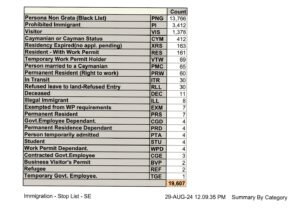
“There are 11 deceased individuals who are listed in a category of their own on the Stop List, who presumably are not considering returning to the Cayman Islands in the near future (unless duppies are crossing our borders),” the firm said.
‘Personally and wholly unacceptable’
The concept of a list of people prohibited from entering the country is not unique to the Cayman Islands.
The policy, provided to HSM under the Freedom of Information Act, includes a wide list of possible ways to be banned from visiting the Cayman Islands, including a sliding scale of bans ranging from six months to seven years for overstaying.
It defines ‘persona non grata’ as, “A person being personally and wholly unacceptable, not wanted or welcomed and thus not allowed to enter the Islands for reasons of having committed an Immigration or other penal offence and for that or other reasons his/her presence in the Islands would not be conducive to the public good.”
HSM advises clients who believe they may be on the stop list to contact the director of Customs and Border Control ahead of travel and request that they are permitted entry into the Cayman Islands.
Related Videos













If 412 Cayman citizens are prevented from either accessing or leaving the island unless they happen to be citizens of another country as well, are they are rendered stateless?
Sort of like Mehran Karimi Nasseri, an Iranian who fled the theocrats of that country, was never allowed to return and eventually died after living for 18 years in the Charles de Gaulle Airport?
Takes duty-free shopping to a new level.
Tom Hanks played him in a movie ” The Terminal”.
Might the Owen Roberts International Airport plan on creating a no-man’s-land for these 412 potentially stateless former Islanders and is that a condo-selling opportunity for an island developer?
The United Nations High Commissioner for Refugees (UNHCR) estimated in 2022 there are 4.4 million stateless people in the world. However, the actual number is likely much higher as less than half of any countries file reports on statelessness.
Statelessness occurs when someone is not considered a national by any state under its law. Strictly speaking the 412 Cayman citizens on the list have a state but, like the character Mr Hanks played, aren’t allowed access to or egress from it.
Mind you with many nations seeking to challenge the Duke of Westminster’s iconic law case’s approach to taxation — the right of every citizen to minimize his exposure to it — having no state able to tax you might soon be the ultimate in fiscal security.
Although one could imagine the condo fees at the airport getting fairly lethal.