

The U.S. Federal Aviation Administration (FAA) has issued a draft environmental assessment for new launch trajectories requested by SpaceX for launches of its Starship-Super Heavy rocket vehicle.
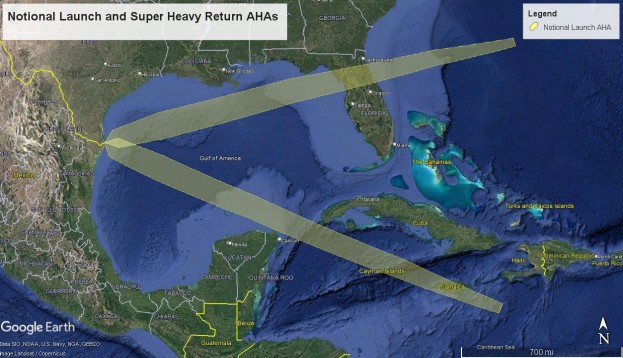
The newly requested modifications to the launch trajectories propose a flight path near or over the Cayman Islands area, that could necessitate temporary airspace closures over the Cayman Islands when the rocket lifts off from Starbase at the Boca Chica launch site in Texas.
The report states that “orbital launches would primarily be to low inclinations with flight trajectories north or south of Cuba that minimise land overflight.”
A communications officer at the Civil Aviation Authority of the Cayman Islands said they were aware of this development, adding “Discussions on the matter are ongoing with the appropriate agencies responsible for determining aircraft hazard areas affected by such operations and the closing of affected airspace prior to any launch.”
Civil Aviation added, “There are no immediate safety concerns to the Cayman Islands at this stage by the proposed trajectories. Operationally, it could pose delays to airline schedules and aircraft traversing the affected airspace.”
Modified license needed before launch
In order to change their launch trajectories, SpaceX – which was founded by Elon Musk – must first obtain a modification of its existing vehicle operator license.
Stacey Zee, manager, operations and support branch at the FAA, stated in written document that the FAA is now “evaluating the aircraft hazard areas necessary to support SpaceX’s proposed operations of the Starship-Super Heavy launch programme at the Boca Chica launch site.”
In the report, the FAA says it’s coordinating with the US State Department and Mexico, Jamaica and the Cayman Islands regarding potential environmental impacts related to the launch trajectories and the Starship’s return to its launch site.
SpaceX says the proposed changes are needed to facilitate frequent launch and landing operations to allow iterative development of Starship-Super Heavy vehicles to achieve rapid launch capability and increase operational efficiency, capabilities and cost effectiveness of the Starship-Super Heavy program.
“Demand for launch services has continued to increase over the past 20 years, and the space industry’s growth projections indicate this will continue into the foreseeable future,” SpaceX says.
Concerns over launch success rate

President of the Cayman Islands Astronomical Society Tiyen Miller, said that “the elephant in the room is what happens if there is a rapid unscheduled disassembly, the whole ‘what if it explodes’ thing is kind of a real concern,” he said, adding, “the starship rockets do not have a very good success rate so far.”
The SpaceX Starship is intended as the successor to the company’s Falcon 9 and Falcon Heavy rockets. As of 25 Sept. 2025, the Starship has launched 10 times with five successful flights and five failures. When fully fuelled, loaded and ready to launch, the Starship weighs over 11 million pounds.
In their request to change the launch trajectories, SpaceX said, “the proposed action would reduce the cost of launch and increase efficiency, delivering greater access to space and enabling cost-effective delivery of cargo and people to the Moon and Mars.”
In the FAA draft assessment, it states that, “The southernmost launch and Super Heavy booster re-entry trajectory could impact the airspace of Mexico, Cuba, Jamaica and the Cayman Islands. Mexico, Cuba, Jamaica, and the Cayman Islands would be expected to close their respective airspace.”
“Due to the length of the launch and Super Heavy booster landing aircraft hazard areas, certain flights, especially international, may elect to delay the departure time due to the inability to accept a reroute caused by fuel constraints or the flight time of the reroute.”
According to the National Airspace System assessment, the average expected flight delay for launches would last approximately 40 minutes and could last up to two hours. It is not clear at this time how many Starship launches would occur each year.
Related Videos









What is the consideration to be paid to the Cayman Islands to allow interference with its airspace? They should demand 1-year free Starlink internet service to all Cayman Island residents and the Cayman Islands Government for every 30 minutes that the Cayman Islands has to close its airspace to accommodate Starlink launches.