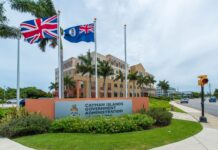
A member of Cayman’s Digital Transformation Strategy Taskforce predicts that AI could deliver 30% of the jurisdiction’s public services.
Speaking on CompassTV’s Forefront on 20 Nov., University College of the Cayman Islands director Tamsin Deasey-Weinstein outlined the potential for AI to revolutionise Cayman’s bureaucratic machinery.
Deasey-Weinstein explained that the taskforce will be looking for public-sector pilot projects to recommend to government that have the potential to make a national impact.
“It could be something around automating permitting or using AI systems to speed up the permitting process. It could be making, say, 30% of public services AI-driven,” she said.
Deasey-Weinstein’s colleague at UCCI, Cayman Compass contributor Eustache Placide, recently wrote a column about how the civil service could go about using AI to improve efficiencies.
The taskforce won’t just look at the public sector, said Deasey-Weinstein, as AI will impact every corner of the economy. Yet the potential for AI to disrupt public spending will strike a chord in a jurisdiction where the cost of the civil service is expanding at a rapid clip.
Noting that digitalisation efforts have the direct support of the premier, Deasey-Weinstein believes Cayman’s size will give it an advantage in adopting AI.
“We are a small jurisdiction, a small country, so we have the benefit of speed and efficiency,” said Deasey-Weinstein. “Whatever we want to implement, we can implement nationally fast and that’s a really big thing for us. It’s something that America can’t do. It’s something that England can’t do. If we want to make a change, we can make it nationally, quickly.”

The rapid adoption of AI, especially to complete sensitive government tasks, brings its own risks, experts say. Privacy fears have led to different regulatory approaches across the world, from the European Union’s stringent AI policies to a more open stance in the US.
“We’re looking at what’s already happening in government, what’s already happening nationally and then we’re drawing on [international] best practice,” said Deasey-Weinstein.
“I spoke to the person who leads AI Singapore, and Singapore is way ahead with AI integration. I’ve also spoken to the person who leads AI implementation in Malta, and in the UK, and we’re drawing on best practice globally to bring it to Cayman.”
AI is going to disrupt the labour market globally, so it’s natural that its impact would be felt in the civil service, the largest employer in the Cayman Islands.
“The total addressable labour pool in any country or market is now going to be confronted with a computer that can do the same job, 86,400 compute cycles per day, no sleep, no rest, same level of intelligence, if not greater,” said Brandon Caruana, CEO of Tenet, speaking on the same show.
The potential savings would help the government balance public finances, yet there would also be a social costs in the form of job losses.
“In the 1980s and 1990s, the biggest companies had millions of employees,” said Caruana, identifying companies like Exxon and GE. “Then we got to the internet boom and companies shrank to 20,000 or 10,000 people. Then the mobile boom, and companies shrank to hundreds of people creating billion-dollar companies. Instagram is a phenomenal example: 13 people created a billion dollars of value. Now I think we’re shrinking even further.”
The solution, which Deasey-Weinstein says the taskforce is investigating, is to reskill Cayman’s workforce to be AI-ready.
Related Videos