

By Cayman Compass Contributor Simon Cawdery

Everyone in Cayman knows of someone who’s been in an accident. Everyone in Cayman has seen terrible driving on our roads. Everyone in Cayman has had their blood pressure raised by the actions of another car, van, bus, taxi, bike or truck. And too often, another person dies on Cayman’s roads.
Isn’t it time we did something about all this?
There’s always a huge gnashing of teeth and wailing of arms at each road death and each traffic accident, and yet for all I can see, nothing is ever done. The roads remain as they were; drivers’ behaviours are unchanged; and another accident is right around the corner.
The perpetual state of surprise that accidents keep happening and lives are cut short too young is both bizarre and a sad indictment of Cayman’s situation. As Einstein may not have said, “Insanity is doing the same thing over and over again and expecting different results.”
Fatal attraction
Let’s start with the elephant in the room: deaths.
Most deaths or injuries are the result of a combination of excessive speed at dangerous locations or driving under the influence.
Two statistics to evidence the point, one from the RCIPS and one from the Office for National Statistics in the UK: Deaths per 1,000 in Cayman from road accidents were 0.158 people. In the UK, 0.024 people. That means Cayman has a six times greater death rate from road accidents than the UK. How can we be so complacent about this?
Delving even further into the RCIPS data, we see some odd data points. Compared to 2023, last year there was a 31% reduction in speeding tickets issued, a 29% reduction in traffic summonses, and no change in DUI convictions.
And yet, there were 1% more car accidents and five more deaths. The optics look as though enforcement fell and deaths increased. Not a terribly good look, and certainly nothing to be proud of.
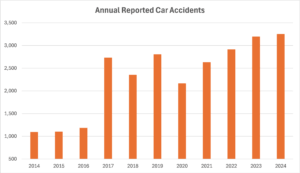 The chart above shows car accidents per year in Cayman. The number of cars has obviously increased substantially, and so more accidents might be expected, but the growth of accidents in Cayman is horrific. Thankfully, not many of these lead to serious injury, but what this data should tell us is that it isn’t just an enforcement issue, but also one relating to behaviour.
The next chart tracks fatalities on our roads.
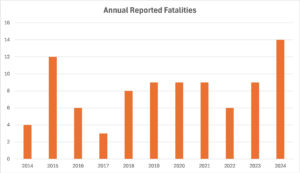 Here again the prognosis is distressing. The trend is worsening, despite cars being built with ever-more safety technology, which, all things being equal, should contribute to fewer fatalities.
Cayman may aspire to have a zero-death policy on its roads – which government officials have stated is the goal – but whoever wishes or thinks that is practical is kidding themselves. Cayman’s infrastructure and policies simply make it impossible.
How should someone get home from dinner if they can’t drive because they have had two glasses of wine? Is half of Cayman’s population suddenly going to become teetotal? Not a chance.
Even if everyone did spontaneously give up their car and hail a taxi, the stark reality is that there aren’t enough taxis on island to cater for the potential demand. Secondly, those that do exist are overly expensive, charging exorbitant rates to go short distances, some (in this writer’s personal experience) with a side-portion of poor attitude that is the exact opposite of Caymankind.
To compound the misery, and ensure no competition, there are no buses operating later at night.
A new way of testing
Every new driver in Cayman takes some amalgamation of exams that involve theory and practical. I genuinely mean my next question sincerely: Why?
Has this enlightened policy of testing reduced road accidents below international levels? Not remotely. Just remember the statistics: Six times greater death rate in Cayman than the UK.
The driver-testing system in Cayman is self-evidently an absolute shocking failure. If you disagree, ask the grieving family members of any road-accident victim what they think, and then revisit your answer.
Driver tests and examinations have fundamentally not changed in probably 50 years; you show an instructor you know how to do some manoeuvres, and you prove you know what minimum thickness tyre tread a car should have and what various road signs mean. All well intentioned, I am sure, but, clearly and self-evidently, the driver tests are not delivering on the urgent need to improve road safety in Cayman.
Those tests are necessary, certainly, but by no means sufficient. Given the level of traffic accidents and near-misses, our current system of testing and evaluation is clearly not fit for purpose.
Happily, however, technology offers a potential solution. It costs just a few thousand dollars for a high-end gamer’s driving seat setup or high-end virtual reality headset. Buy a few dozen of these and work with a software company to design a basic road layout of Cayman into which dozens of situations could be programmed. Then mandate that drivers, every five years, have to take a practical virtual test, navigating certain elements of Cayman’s roads. Charge $25 for each test taken.
At this cost, all the equipment, the software and development would be paid off multiple times, giving resources to refine and improve the system and surely improve driving standards.
What we need to be testing for and enforcing on our roads are basic behaviours that make driving safer and less stressful for everyone. Behaviours are completely different to knowledge, and it’s the behaviours where we are failing ourselves. What should we test?
Each reader will have their own view but let me throw out a couple of ideas, to get the creative juices flowing:
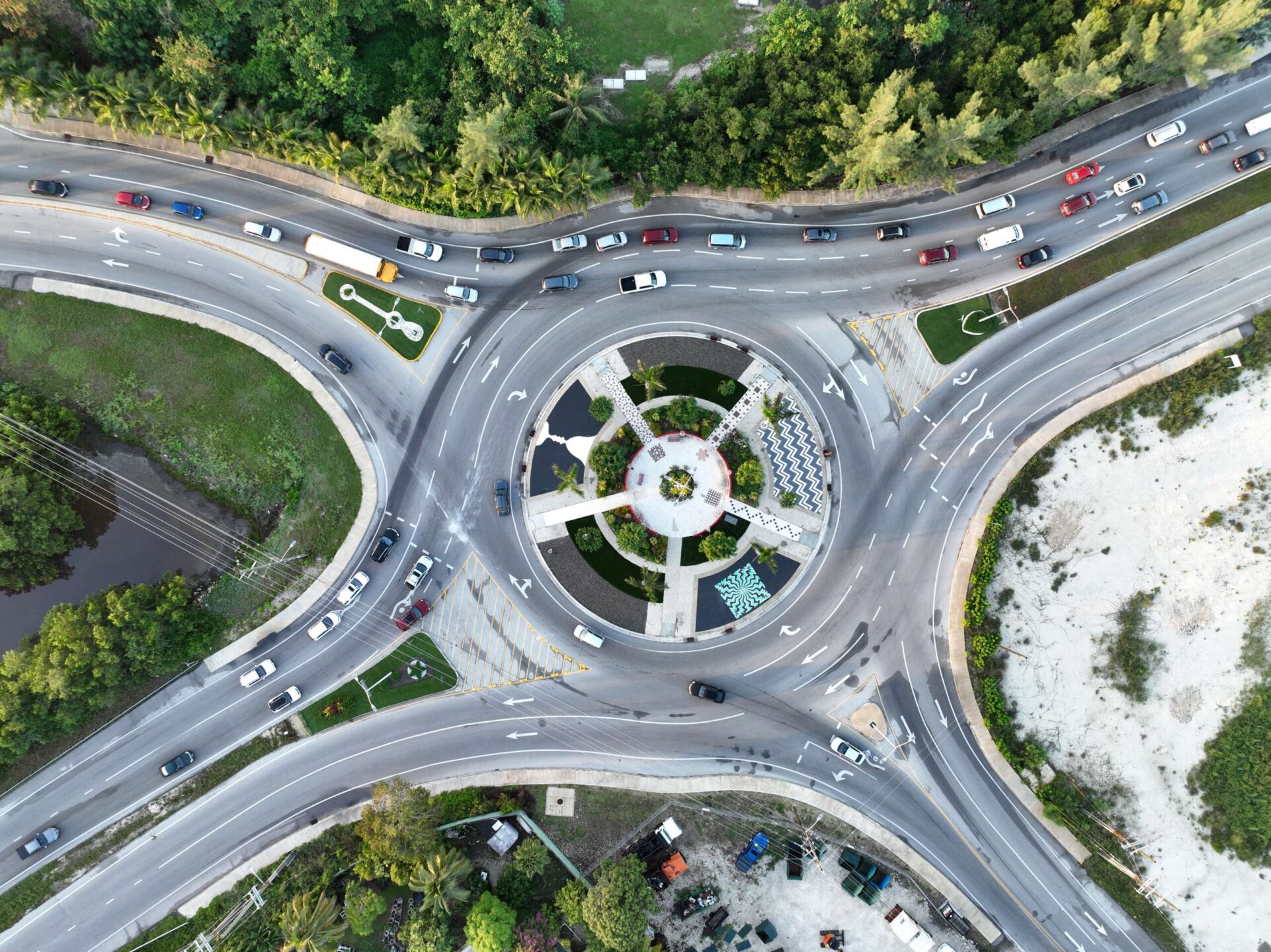
- How to navigate a roundabout. This is clearly something not everyone understands. Get in the wrong lane on the test, fail to indicate correctly or cut across an exit lane should equal a fail and a required retry – and additional payment.
- Driving on a dual-lane highway. Hog the right-hand lane, don’t indicate lane changes, overtake in the left-hand lane or fail to use the slip lane appropriately should all equal a fail and a required retry – and additional payment.
- Using the centre turning lane on West Bay Road. It’s not an overtaking lane! Know when to enter and exit it, and how to use your indicator. Getting any of that wrong should equal a fail and a required retry – and additional payment.
- Navigating roads with cyclists. Know how to use a roundabout with a cyclist and giving sufficient room when passing. Getting any of that wrong should equal a fail and a required retry – and additional payment.
- Minimum distances when driving behind another motor vehicle. Tailgating is epidemic in Cayman, and not knowing how far behind you’re supposed to be should equal a fail and a required retry – and additional payment.
As a whimsical aside, one could even programme in the Hurley’s roundabout – although perhaps even the most advanced AI might struggle to comprehend the monster that has been created there.
Using simulators would ensure efficient use of everyone’s time and the ability to test multiple people simultaneously. It would also allow the test to be adjusted to evolving road conditions. This wouldn’t be a test on how to drive, but a test to ensure people are following proper behaviours that contribute to making the roads safer for everyone and the practical implications of the driving code.
It might well be embarrassing to our pride if we all fail such a test, but quickly we would learn, as the costs of the retakes would add up. Make everyone retake the test every five years to ensure continued familiarity, since it appears in Cayman that our memories for good driving are somewhat limited.
We already teach the theory and the basics, but we don’t seem to teach proper behaviour on the road. Given Cayman’s multicultural population, this is a glaring omission. We have basically imported, in many instances, the worst behaviours from 50 countries, simultaneously. That needs to be addressed.
Simulators offer a safe, efficient and adaptable solution to this problem; a solution that could also save hundreds of thousands of dollars in car repair bills and help reduce insurance costs to the benefit for all.
Innovative approaches needed
The reason I wanted to write this article was not to pick on policymakers, officials or the police, but rather to illustrate that whatever it is we are currently doing isn’t delivering the meaningful change that surely everyone would want. People are still dying on the roads, accidents are commonplace and driving standards are, if we are honest, pretty terrible.
There’s a second part to this article (Editor’s note: We will publish part two next week) in which I want to explore changes I think could lead to positive improvements. Perhaps readers will have their own; I would love to hear them in the comments section.
All we seem to do in Cayman is regurgitate the same old approaches, which aren’t working, when there exist innovative potential solutions. It’s high time that we searched for those innovations since the status quo is killing us.
Simon Cawdery, CFA, is an investment manager and governance professional who lives and works in the Cayman Islands.
Related Videos











Brilliant. Couldn’t agree more. Now if RCIPS Cayman could effectively enforce the traffic laws there would be immediate results. But that makes too much sense. We will continue to turn a blind eye…the stats will continue to rise…
Banning drivers for 5 years or longer with a mandatory jail sentence if caught breaking the ban will have a meaningful change.
My question is – how on earth do you drive a 2 ton piece of machinery looking at your phone and not expect, that at some point, you’re going to have an accident or, worst case scenario, kill someone?? What type of mentality thinks it’s ok. Don’t get me started on wrong lanes, no indicators…
Such a thought provoking article. I do hope your ideas will be treated seriously and implemented. Look forward to your next article with advice.
“Deaths per 1,000 in Cayman from road accidents were 0.158 people. In the UK, 0.024 people. ”
This is not a fair comparison due to the substantial use of public transport in the UK.
In Florida, in 2023, there were 0.17 deaths per 100,000 people.
Slightly higher than here.
I think the answer is better public transport available till, say 2am on a Friday night and 1am other nights.
We regularly use the bus when in London. Aside from the usual bus service there’s a Night Bus route, less frequent but reliable.
All London buses have GPS positioning so you can see the expected arrival time of the next bus on a cellphone app.
Hear, Hear! And of course all these issues will be greatly improved once it costs upwards of $600 to obtain a driving licence, during a cost of living crisis. Quite sure there will be far more licensed and qualified drivers on the road as a result(!)
What is the point of inventing a bicycle?
Scandinavian countries consistently have among the lowest traffic fatalities in the world! Norway continues to be the safest country in Europe for road users, and is a model of “vision and action.”
Just do what they do.
They also have excellent public transport systems that are inexpensive and reliable. That’s the key.
I just don’t get it.
• Waste management – CIG doesn’t know what to do and keeps wasting millions on “discovering the perfect solution”. Meantime a civilized world has figured out how to manage waste a long time ago.
• Traffic – CIG doesn’t know what to do and keeps wasting millions on “discovering the perfect solution”. A civilized world figured out a long time ago how to manage traffic and reduce accidents.
• Public transportation – CIG doesn’t know what to do and keeps wasting millions on “discovering the perfect solution”.
Meantime:
– The first motorized bus service in Bermuda was introduced in 1946
– 1955: The Barbados Transport Board was established to take over bus services from private companies, officially launching the modern bus system.
– Public transportation has existed in Curaçao since at least 1943
– The Jamaica Omnibus Service (JOS) began a municipal bus service in 1953. The government took over JOS in 1974, and it was replaced by a mix of private minibuses and a new government-run company
How much money did Kenneth Bryan waste traveling around and “LEARNING” how to establish and run a modern public transportation system? What about promises he EXPLICITLY made?
Great article, well done Simon!
Another way to use new technology would be to allow the police to issue a ticket based on video footage from dash-cams. Create a scheme that trains people how to use them safely and approves certain dashcam units for the purpose.
This would instantly provide all of the benefits of speed cameras without any of the cost. Set up a new department at the RCIPS to process the footage and fine the registered owner (who, as with UK automatic speeding fines, would be presumed to be the driver at the time unless they attest otherwise). Pay authorised contributors a percentage of the fines they generate.
Imagine how safe our roads would be if 20% of our drivers were effectively deputised traffic cops?
Opponents will use a couple of arguments against this.
They’ll say you can’t be sure they are correctly calibrated to capture the speed of both vehicles. This is not a serious objection for a couple of reasons. Most dashcams use GPS to establish the speed of the vehicle hosting the camera. That makes it virtually impossible to fake. Only prosecute those shown to be doing more than 10 mph over the limit to allow for some calibration difference. Besides, there is plenty of objectionable behaviour other than just speeding.
Second, people will say that users will fake dashcam footage using AI to get other people in trouble. This is theoretically possible and also utterly implausible in reality. AI-created video is quite easy to spot and won’t have any of the meta tags of original dashcam recording. Few people are sophisticated or motivated enough to fake dashcam footage.
Nonetheless, drivers receiving fines would of course have the opportunity to challenge the fine and if they have evidence the footage has been faked, let them present it and let the court decide.
These tiny risks would be worth dealing with to get the upside of safer roads at minimal cost to the state.
We’re all familiar with at least one case of corruption involving the Department of Vehicle Licensing (our DMV), which involved selling vehicle inspections under the table. From the look of driving habits it could also appear the same is happening with driver licenses.
We’re all familiar with at least one recent case of corruption at the Department of Vehicles Licensing (our DMV), which involved selling inspections under the table. From the look of driving habits it could also seem that driver’s licences were being “handed out”, rather than being legitimately earned. It’s not a stretch of the imagination.
Yes, the officer involved suffered consequences but is the management of DMV now confident that they’ve rooted out all of that graft culture? After all, it went on for years on their watch. It wasn’t a big secret “on the street”, hence why it was pervasive. The general public but especially those who follow the rules of the road, are plagued with the results of poor oversight at DMV. Therefore, the public should be told what the DMV has done or intends to do to prevent repeats of those incidents and further, how it feels about the standard of driving tests it presently conducts.
Lowering the illegal BAC limit for drivers from 0.07 g/dL to 0.05 g/dL (or below) in Cayman will save lives and prevent alcohol-related accidents.