

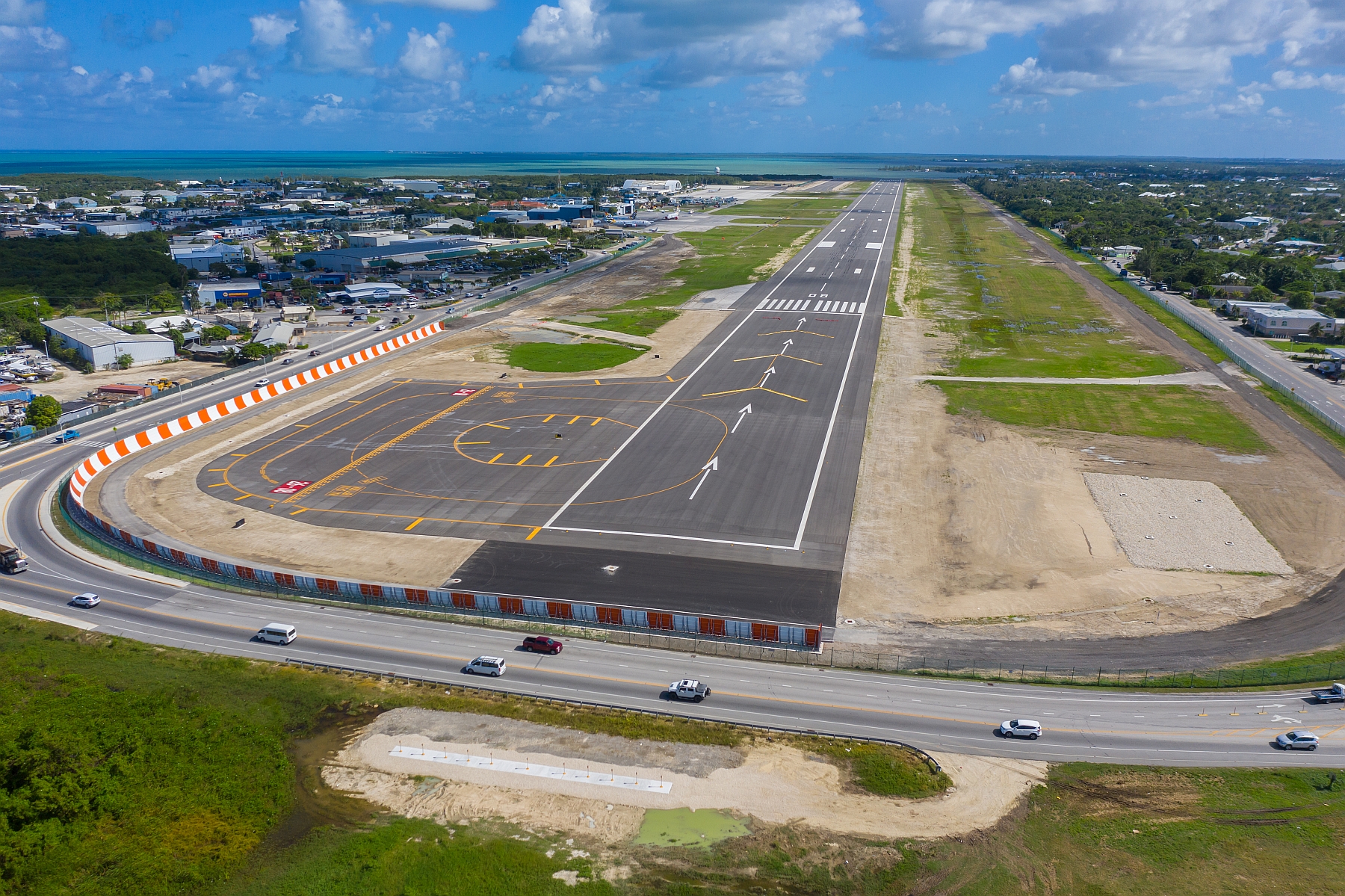
I again question the logic of extending the runway into the North Sound when the fiscal and environmental costs cannot be justified. If government is hell-bent on extending the runway for a European market which doesn’t exist and which Government has not yet begun to establish, then extension to the west should be the option.
Extending to the west will NOT lower the approach path, as the threshold of the runway will be displaced for landings. Extra runway length to the west will serve for longer take-off runs, which is what would be needed for larger, long-haul aircraft.
Despite Mr. Albert Anderson accepting some airlines’ word, as he’s previously stated, aircraft do not need longer distances for landings, but do for take-offs. Landings would be no less safe, nor would takeoffs from the other direction.
Extending to the west would be less costly, and less environmentally risky, eliminating the very costly dredging and filling aspect of an extension into the North Sound. The section of Crewe Road around the runway would have to be closed, as has been an option in the airport development plans for decades – ence the creation of Thomas Russel Way.
General Aviation Terminal on the North Sound
While a new General Aviation Terminal could be said to be justified, there is no reason to create a new facility near the North Sound as proposed, as the infrastructure needs in that location far exceed a new terminal.
Major excavation and fill work to create an apron in the swamp, plus roads infrastructure for access (never once mentioned in public discussion) would be extremely costly even before a General Aviation Terminal is built.
Meanwhile, the National Weather Service, which shares the current building serving as General Aviation Terminal, is currently building its own headquarters and will be moving this year. When the National Weather Service leaves, all of their antennae, hydrology equipment, hydrogen generator, etc., will be moved from the site.
That leaves almost an acre of raw, solid land in the present location which could accommodate a new General Aviation Terminal, located farther back from the apron than the current building and provide for more apron space on the current footprint if/when the present building is thereafter knocked down.
Ultimately this is a less costly approach for a facility, which is used by people who don’t wish or need to spend much time within. High-net-worth people who travel on private jets want to be processed as quickly as possible and be on their way. They don’t want or need to “lounge around” in a private aircraft terminal for any length of time.
Jet bridges
Does the honourable minister and members of Cabinet know who pays for the use of jet bridges? I would suggest that they don’t. Jet bridges have long been a public demand and have just as long been on the Cayman Islands Airport Authority’s ‘consideration list’. But as revealed the high cost of purchase and installation have made them prohibitive, as acknowledged by former Minister Bryan.
However, purchase, shipping and installation are just the initial costs. The real continuous cots are in the operation thereof. We see HSBC and other advertising on jet bridges around the world. Advertising revenues on jet bridges assists with the costs, but airports charge airlines for the use of jet bridges, who in turn charge passengers – that’s the main source of operating costs of jet bridges.
In Cayman, we have a national airline which constantly accrues massive operational debt with the airport operator – the Cayman Islands Airport Authority – for land, parking and passenger fees. “Paying it off” amounts to a “Peter to Paul”, paper exercise within Government coffers, which doesn’t truly represent paying its debt.
In the past, that situation has caused the airport authority to run afoul of International Civil Aviation Organization (ICAO) and International Air Transportation Association (IATA) regulations prohibiting airports from favouring any particular airline. Cayman Airways has essentially been favoured by the Cayman Islands Airport Authority by being allowed to accumulate large debt, while other airlines did/could not. This resulted in a number of foreign carriers complaining to ICAO and IATA and thus CIAA had to scramble to collect the debt from Cayman Airways.
When I left the Cayman Islands Airport Authority as acting CEO in 2014, Cayman Airways owed the Cayman Islands Airport Authority $10 million in accrued debt and measures were in place to have it paid off in full (thanks to Mr. Ronnie Dunn). I do not know if that actually came to fruition. But in any case, if that $10m was collected by Cayman Islands Airport Authority then, by now Cayman Airways likely owes a similar amount.
Does the CIAA expect Cayman Airways to be more reliable in paying operating costs for jet bridges it will use? Again, the Cayman Islands Airport Authority is not allowed to favour CAL over say, American Airlines or Delta, for example. So, what will happen when those airlines threaten to not pay for their jet-bridge usage because Cayman Airways doesn’t? More complaints to ICAO/IATA.
Let’s be real, Cayman Airways will never be on top of its operational debt to the Cayman Islands Airport Authority, so other airlines will always have a gripe. But worse, jet bridges will only cause Cayman Airways’ debt to Cayman Islands Airport Authority to grow and give further reason for foreign airlines to complain to international regulators.
If government is ready to accommodate the cost of increasing fiscal supplements to Cayman Airways to assist in its debts to Cayman Islands Airport Authority, or if Cayman Islands Airport Authority is willing itself to absorb operational costs of jet bridges (against international airport norms), then jet bridges are a great convenience. Otherwise, they will be a continuous fiscal burden to the airport operator, as even reasonable passenger fee increases will not be able to cover the ultimate costs of daily jet bridge operations.
One is left to wonder and question if these grand plans, so far without solid justification and based on the ‘Field of Dreams’ principle, are in the best interest of the public or in the interest of people seeking to leave their personal legacy in vanity infrastructure? Unused public basketball and pickle ball courts in North Side, without shade or spectator stands are a suggestion as to the answer.
Kerith McCoy
Related Videos









I would like to reiterate my earlier comments on the runway extension, that the CIAA firstly consult with all the major airlines serving Cayman to see if they consider there would be sufficient traffic for larger jets.
A salaried airline employee probably doesn’t have the vision to know what the World will look like in 20 years and isn’t Caymanian, so won’t be living here to deal with the consequences of his answer.
With respect to Mr. Mcoy’s service in the field of Aviation here in Cayman, (which he left 12 years ago), we are not going to expand the airport into town because it’s too disruptive and would have heavy 777’s skimming the rooftops of the hospital, disrupting quality of life in Georgetown. That is why we will eventually be building into the sound. It will get built. I’ve read Mr. Mcoy wringing his hands over any mention of an extended runway for years now. If you read his remarks, he’s constantly writing that no runway extension should happen .. it’ an unproductive pattern. I’m starting to think he just wants to hear himself be right.
In a best case the excuses betray a myopic and penny-pinching mindset, completely devoid of vision for his great grandchildren. Either that or a hidden agenda to cloak some kind of trivial self interest.
We have Cuba opening up. There is going to be a race condition to improving long distance airlift infrastructure there. It may take them a generation but that place will eventually compete against us in some form. There will be tax free zones there close enough to threaten our financial services industry.
We need Caymanians with vision to build the infrastructure that will ensure our prosperity into the future. Airlift is like the air we breathe and we can’t say no to it, because a retired airport administrator wished he could stop it, for reasons of little worth or credibility to even an uninitiated observer