

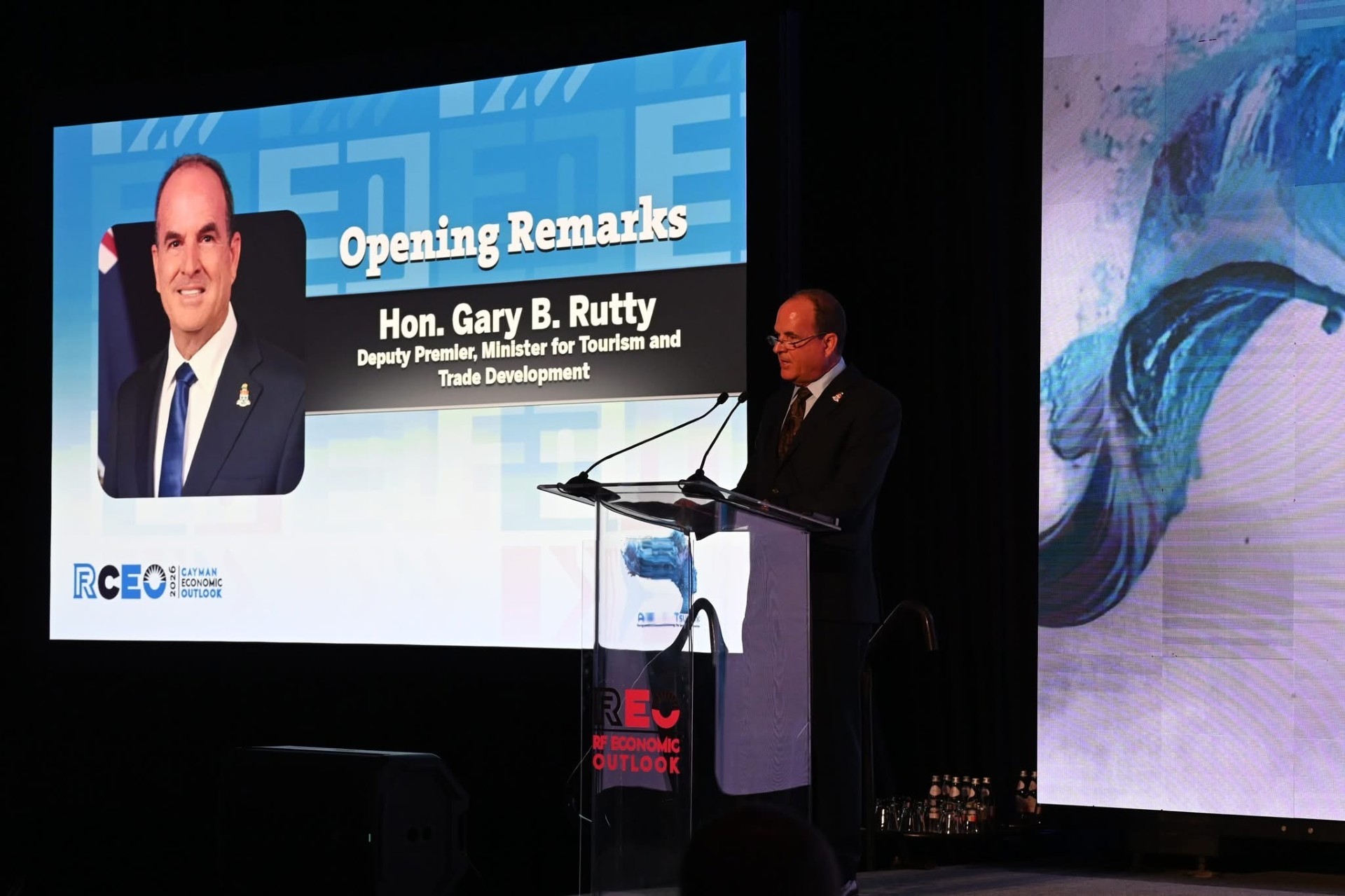
Deputy Premier and Minister of Tourism and Trade Development Gary Rutty has rejected suggestions that artificial intelligence threatens Cayman’s tourism industry, arguing instead that AI offers a meaningful opportunity to modernise and strengthen the sector.
“AI should not be viewed as replacing human talent but rather augmenting it,” he said at the RF Economic Outlook conference that took place on 11 Feb. “This is particularly relevant in the context of tourism because tourism is essentially a people-centric business.”
The conference, held at Kimpton Seafire Resort + Spa, brought together more than 400 business leaders and policymakers under the theme ‘AI Tsunami: Navigating the Surge of Intelligent Innovation’, examining how rapidly advancing technology is reshaping the economy.
Within that context, Rutty said AI can equip tourism operators with deeper insights into visitor behaviour, allowing them to craft more precise and effective marketing campaigns “that reach the right traveler in the right market at the right time”.
He pointed to AI’s ability to process vast amounts of data quickly and accurately, allowing organisations to improve forecasting, risk management and customer engagement. Virtual assistants operating around the clock, he noted, are increasingly meeting travellers’ expectations for 24/7 service.
At the same time, he emphasised that while “travelers themselves are also increasingly using AI to explore destinations, preview attractions and enjoy virtual experiences, all without stepping onto a plane”, technology cannot replace the core of Cayman’s tourism product.
“AI does not replace the actual experience of travel, at least not yet,” he said. “No algorithm can recreate the feeling of soft white sand between your toes on Seven Mile Beach or the exhilaration of standing in crystal-clear waters as a stingray glides past.”
Visitors, he added, come to Cayman for authentic interactions with its people, culture and environment – elements he said remain beyond the reach of automation.
“While AI may influence how people deliver our islands or what they do once they arrive, it does not replace the reasons why they come,” he said. “You see, tourism and travel is a deeply sensory experience. It is grounded in human connection. And visitors come here want to enjoy an authentic Caymanian experience.”
The need for effective governance
Rutty stressed the need for clear policies, ethical guidelines and governance frameworks as AI adoption accelerates. Organisations, he said, should invest in training and bring employees into the conversation early so that “AI is not seen as a threat but as a tool for enhancing individual output and potential.”
A key part of Rutty’s message also centred on education and workforce development. While encouraging Caymanians to pursue careers in tourism, Rutty said the country must also expand technical training pathways in areas such as data analytics, AI systems management, software engineering, content creation and customer experience design.
“Years ago, parents wanted their kids to study law and accounting. Now we need them to also look at the tech subjects,” he said. “Those types of roles are becoming increasingly vital in a world where automation and digital tools are reshaping innovation, economic growth and the way societies function.”
With the right skills and digital infrastructure, Caymanians can participate in the global digital economy without leaving Cayman, he added.
For Rutty, the greater risk lies not in embracing artificial intelligence, but in failing to prepare for it. As adoption accelerates globally, he argued, Cayman’s competitiveness will depend on its ability to blend innovation with its established strengths in hospitality and service.
“The organisations best positioned to succeed will be those that invest not only in technology, but in their people,” he said.
What the data says
Shifts across the global travel industry suggest that 2026 may mark a tipping point for AI- and algorithm-driven travel.
Research from Amadeus indicates that a growing share of travellers are already turning to generative AI to help plan and book trips. As major platforms such as Expedia and Booking.com integrate tools like ChatGPT into their systems, automated trip planning is moving into the mainstream.
Beyond booking, AI is increasingly embedded in the travel experience itself, from real-time language translation to mobile-based digital check-ins that streamline airport and hotel processes.
Industry surveys point in the same direction. Hilton reports that 61% of travellers see value in using AI for trip planning, while Skyscanner found that 54% feel confident using the technology, and digital tourism think tank, Think Digital, says that more than 35% of Millennials and Gen Z now use AI as their primary trip planning tool.
Related Videos













Hon. Rutty, AI could replace some of the WOS Civil Service C-Suite, though.
I bet AI wouldn’t have screwed-up the e-bike issue like the NRSC did! That’s just one example!
But will anyone be held accountable? No, probably all get Franzies!