At a glance
- Jamaica and Honduras have ended their medical cooperation agreements with Cuba.
- The United States has intensified criticism of Cuba’s overseas medical brigades, describing the programme as “basically human trafficking” and warning countries about participating.
- Several Caribbean governments, including the Bahamas and Dominica, are reviewing or restructuring agreements.
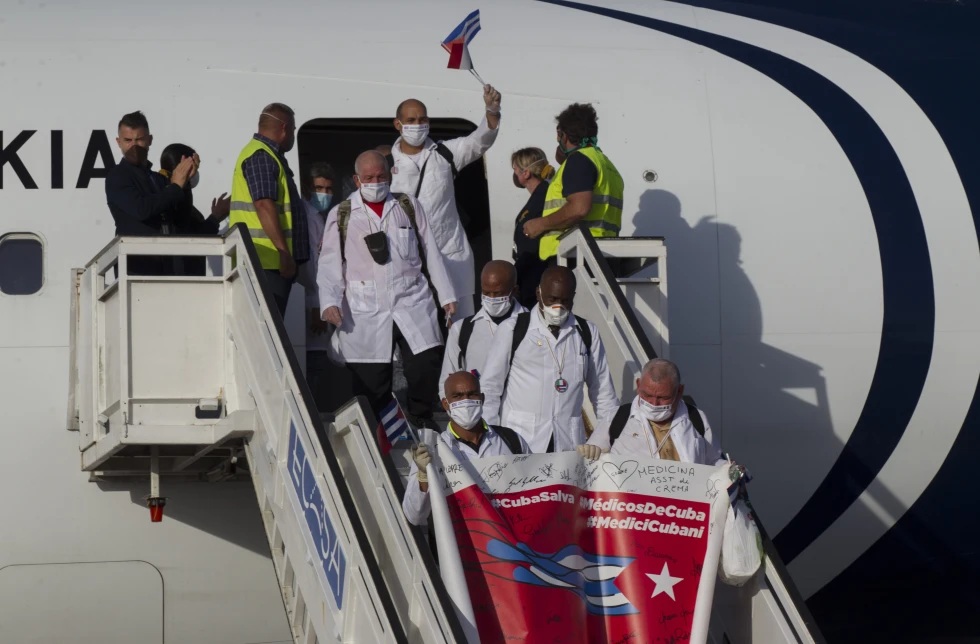
Governments across the Caribbean and parts of Central America are coming under increasing US pressure over Cuba’s overseas medical missions, prompting some to reconsider long-standing arrangements with Havana. Jamaica and Honduras have recently moved to end their medical agreements with Cuba, signalling a broader shift across the region.
The developments come as the administration of US President Donald Trump intensifies criticism of Cuba’s medical brigades, describing the programme as forced labour and warning governments against participating in it.
Speaking to reporters at the Fiftieth Regular Meeting of the Conference of CARICOM Heads of Government on 25 Feb., US Secretary of State, Marco Rubio described the programme as “basically human trafficking,” alleging that Cuban doctors receive only a fraction of the payments made by host governments while facing restrictions on movement and wages.
Rubio went on to say that “we’re not going to cut diplomatic relations with countries in the Caribbean because they don’t agree with us on it, but we make a forceful point about it”.
A 6 Feb. post on the Facebook page of the US Embassy in Bridgetown struck a sharper tone, warning that governments participating in Cuba’s medical missions risk complicity in what Washington calls forced labour. An accompanying graphic read “The United States will hold nations accountable.”
Prior to that, in August 2025, the US State Department imposed visa restrictions on officials in Grenada, alleged to be involved in Cuba’s overseas medical missions.
Jamaica ends decades-long programme
Jamaica announced on 5 March that it would discontinue its medical cooperation programme with Cuba after the two governments failed to agree on the terms of a new arrangement.
The programme, which began in 1976, has for decades supplied doctors, nurses and other specialists to Jamaica’s public health system. At the time of the decision, around 300 Cuban medical professionals were working in the country.
In a statement, Jamaica’s foreign ministry said the workers would be allowed to complete their existing assignments but that the long-standing programme would not continue under the current framework.
Foreign Affairs Minister Kamina Johnson Smith told Parliament that the decision was not driven by pressure from Washington but by unresolved issues in renegotiating the agreement after the previous arrangement expired in 2023.
“You would have heard us defending the programme in various contexts, because when the [Cuban medical professionals] come here, we do our very best to be respectful and ensure that our treatment of them accords with the laws of Jamaica and best international labour law practice,” she said.
“Where the programme came into conflict with those things, unfortunately, we were not able to reach agreement on correcting them and that is why the programme has ended.”
Honduras terminates agreement
On 4 March, 168 Cuban doctors and healthcare professionals departed Honduras after authorities said the programme no longer met internal regulatory requirements.
The move came two months after the inauguration of President Nasry Asfura, whose election had been backed by Trump. The Cuban medical brigade had been operating in Honduras since 2024.
“This is a sovereign decision by the Honduran government; our doctors came because (Honduran authorities) said they were needed, but if they are no longer necessary, the government has every right to dispense with their services,” said Cuban Ambassador to Honduras, Juan Loforte in an interview with AP.
Both the Honduran and Jamaican governments have denied that their decisions were made under pressure from the United States.
Washington pressure across the region
Beyond Jamaica and Honduras, several Caribbean governments are reviewing or restructuring their arrangements with Cuban medical teams as US pressure intensifies.
In the Bahamas, officials said last year they were preparing to cancel labour agreements with Cuban healthcare workers following discussions with Washington. Health Minister Dr. Michael Darville said in March the government is still negotiating with US officials while preparing a framework that would allow Cuban doctors to be hired directly.
“We are in negotiations with the United States government,” Darville said at a 5 March press conference, referring to a proposed new arrangement that would involve a Canadian recruitment firm.
Dominica is pursuing a similar approach, moving to replace its government-to-government agreement with direct contracts for Cuban doctors and nurses.
Foreign Minister Vince Henderson said 65 Cuban medical professionals are currently working in the country and remain vital to the health system.
“We will always be grateful to Cuba,” Henderson said, noting Havana’s role in training Dominican health workers and supporting medical infrastructure.
In Saint Lucia, the issue has raised concern about the future of long-standing medical cooperation with Cuba. For decades, Havana has provided scholarships for Caribbean students to study medicine at the Latin American School of Medicine, established in 1999 to train doctors from underserved communities.
Prime Minister Philip J. Pierre acknowledged the growing pressure at a 2 Feb. press conference. “The fact is the American government has problems with Cuban doctors working in these islands. That is a fact. This means that the entire medical situation exchange of doctors, students is under threat.”
The Cayman Islands does not currently participate in Cuba’s state-run medical brigade programme. The government considered recruiting between 50 and 100 Cuban medical professionals in 2020 to support the Health Services Authority during the COVID-19 pandemic, but the need was ultimately not deemed urgent.
Outside the Caribbean, Guatemala has also moved to phase out the programme. On 10 Feb., the country’s Ministry of Public Health and Social Assistance confirmed that it will not renew its cooperation agreement for Cuban doctors as existing licences expire beginning in January 2026. The agreement, most recently signed in 2024 and formally valid until 2027, will be wound down as missions conclude. No reason was given for the decision.
Washington has framed its opposition around human rights concerns. The US State Department argues that Cuba’s overseas medical missions amount to a state-run labor export programme that can expose workers to forced labour and human trafficking.
It says Cuban doctors often face coercive conditions, including withheld wages, restricted movement and threats of punishment if they defect, while most of the payments made by host governments go to the Cuban state rather than directly to the workers.
Related Videos