

At a glance:
- Tourism businesses say staffing levels are 10-25% below what peak season requires.
- Work permit delays have slowed hiring during peak season
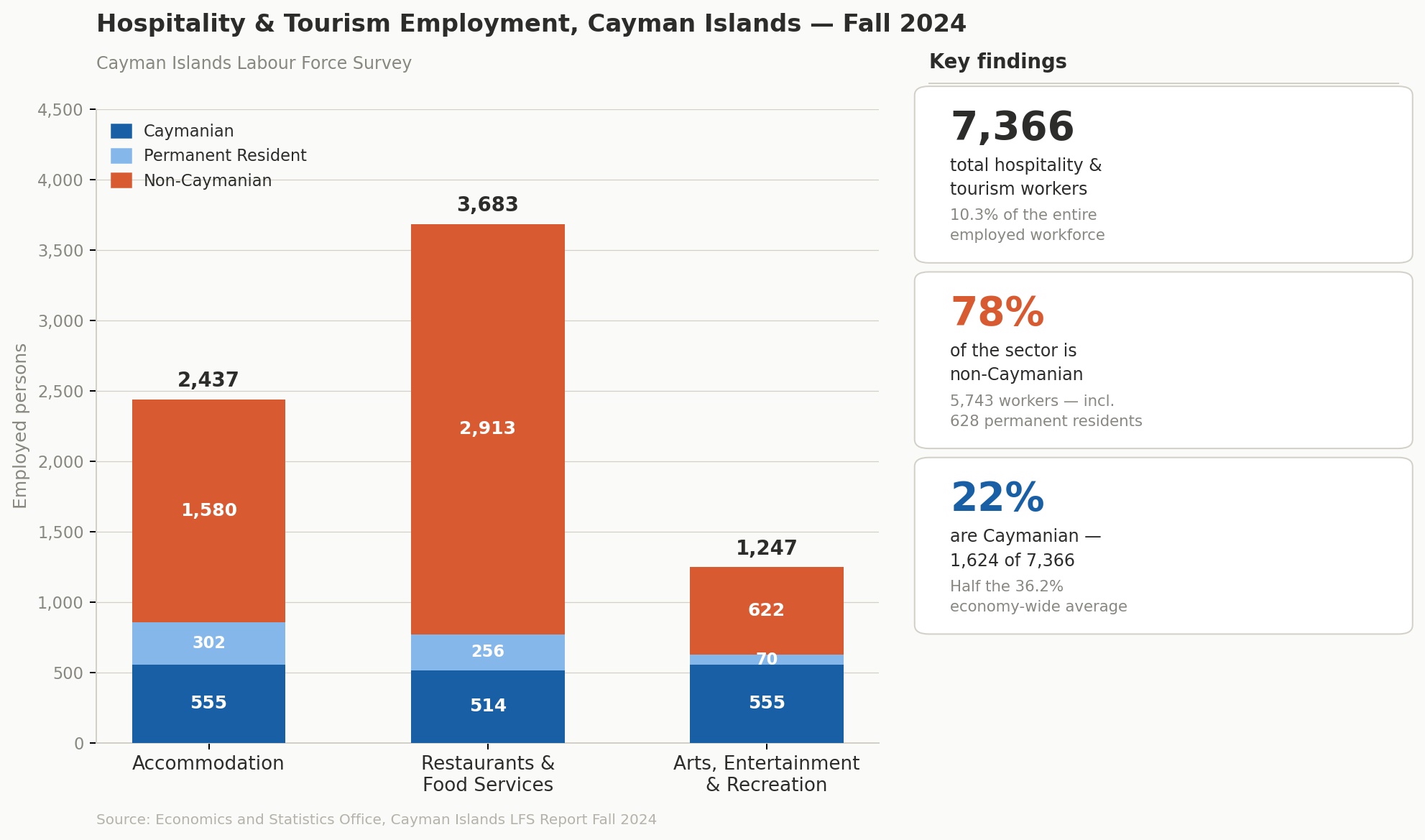
- Nearly four in five tourism workers are non-Caymanian
- New hotels and restaurants are expanding faster than the islands’ hospitality workforce
- Government hires extra staff to clear backlog
In the midst of a record-high season, the tourism industry is at full throttle. Hotels are full, room rates are high, and visitors are paying premium prices for Grand Cayman’s luxury tourism product.
But behind the scenes, restaurant and hotel workers are stretched to the limit as businesses struggle to fill shifts amid a backlog of work-permit applications.
Multiple hotels, recruiters, business owners and tourism leaders – most of whom spoke on the condition of anonymity – told the Compass that staff shortages are making it challenging to maintain the high level of service guests expect.
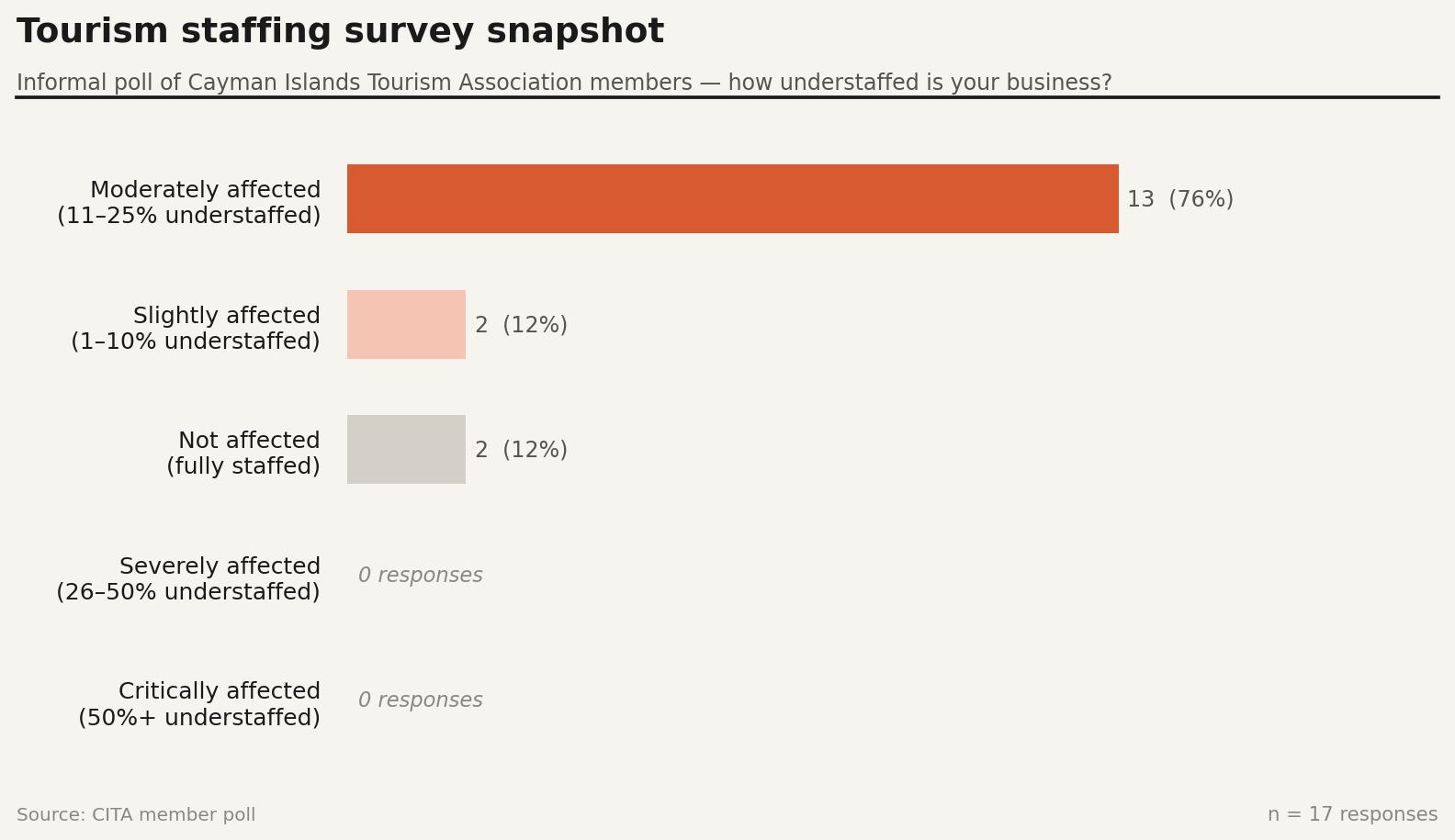
In a recent survey by the Cayman Islands Tourism Association, the majority of businesses polled said they were operating between 10% and 25% below their required staffing level.
Industry leaders fear long-term repercussions for the destination’s reputation if something does not change.
Government is pushing for greater Caymanian representation in the islands’ most visitor-facing sector. Officials acknowledged that imported labour remains essential and are working to clear a backlog of permits, processing more than 1,400 applications in the past three weeks.
But hotels have been full since December, and business leaders say there are very few Caymanians not already employed who can fill vacant positions.
The impasse highlights broader concerns about the future of the tourism industry and who staffs it. Hoteliers and human resources professionals believe a sea change in approach is required in education, training and outlook if the Cayman Islands is to create a pipeline of local tourism workers for the industry.
Labour data from 2024 shows more than 7,300 people worked in accommodation, restaurants and tourism-related recreation jobs in Cayman, with roughly 78% of those workers being non-Caymanian. The same survey showed a total of 1,048 Caymanians unemployed.

Reliance on imported labour has long been part of Cayman’s tourism model. And even if the education system was producing a stream of local workers ready to staff hotels and restaurants, the sheer volume of jobs in the sector means that dynamic is likely to remain in place.
Operators warn the issue is not simply about recruitment logistics; it is about protecting the service standards that underpin Cayman’s reputation as a high-end destination.
“If someone’s paying $2,000 a night at a brand they know, they’re not going to come back if they’re not getting the service they expect,” one hotel executive said.
The tourism sector has expanded rapidly
Cayman’s tourism industry has continued to grow steadily over the past several years, bringing new investment in hotels, restaurants and tourism-related businesses.
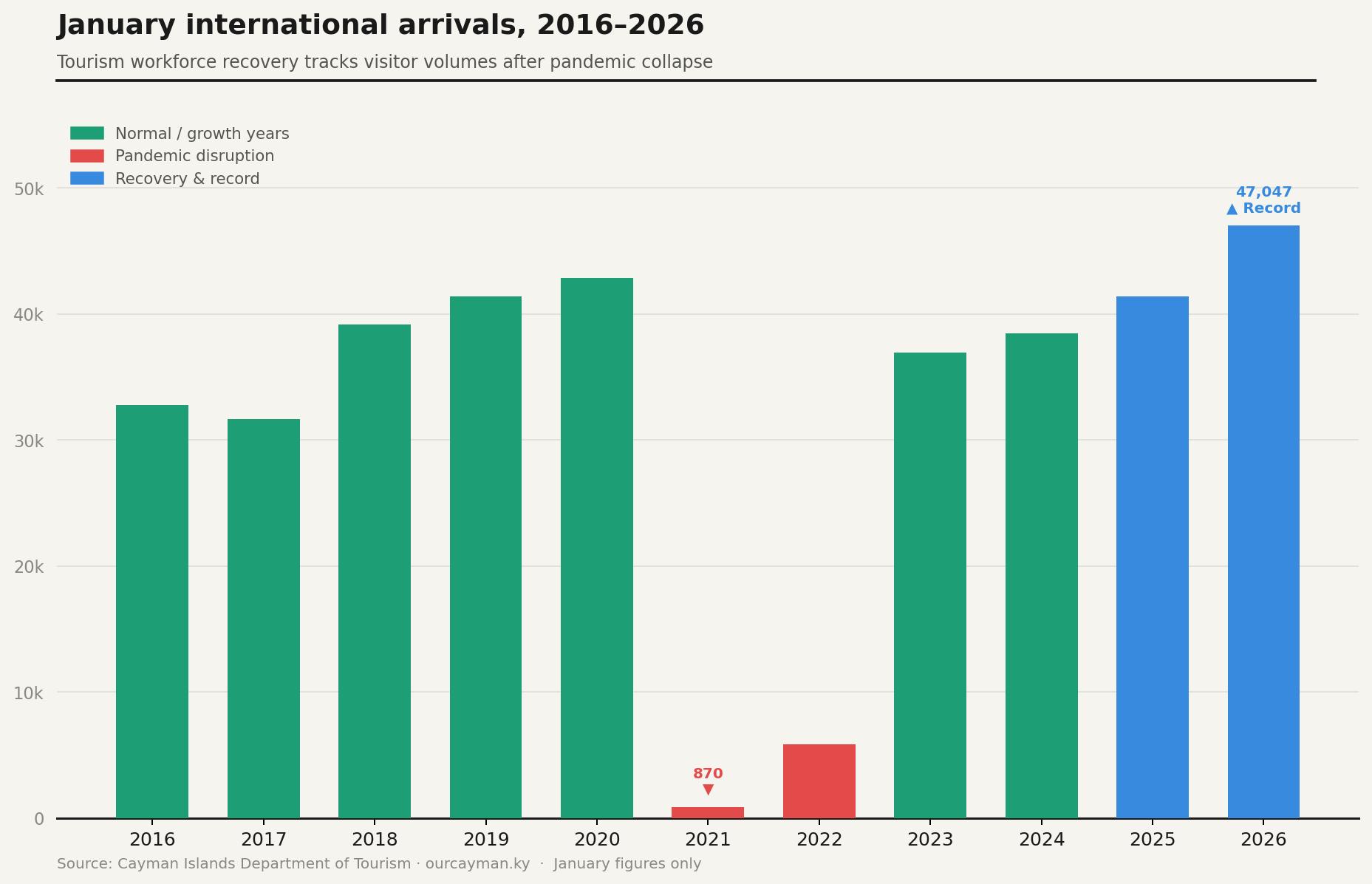
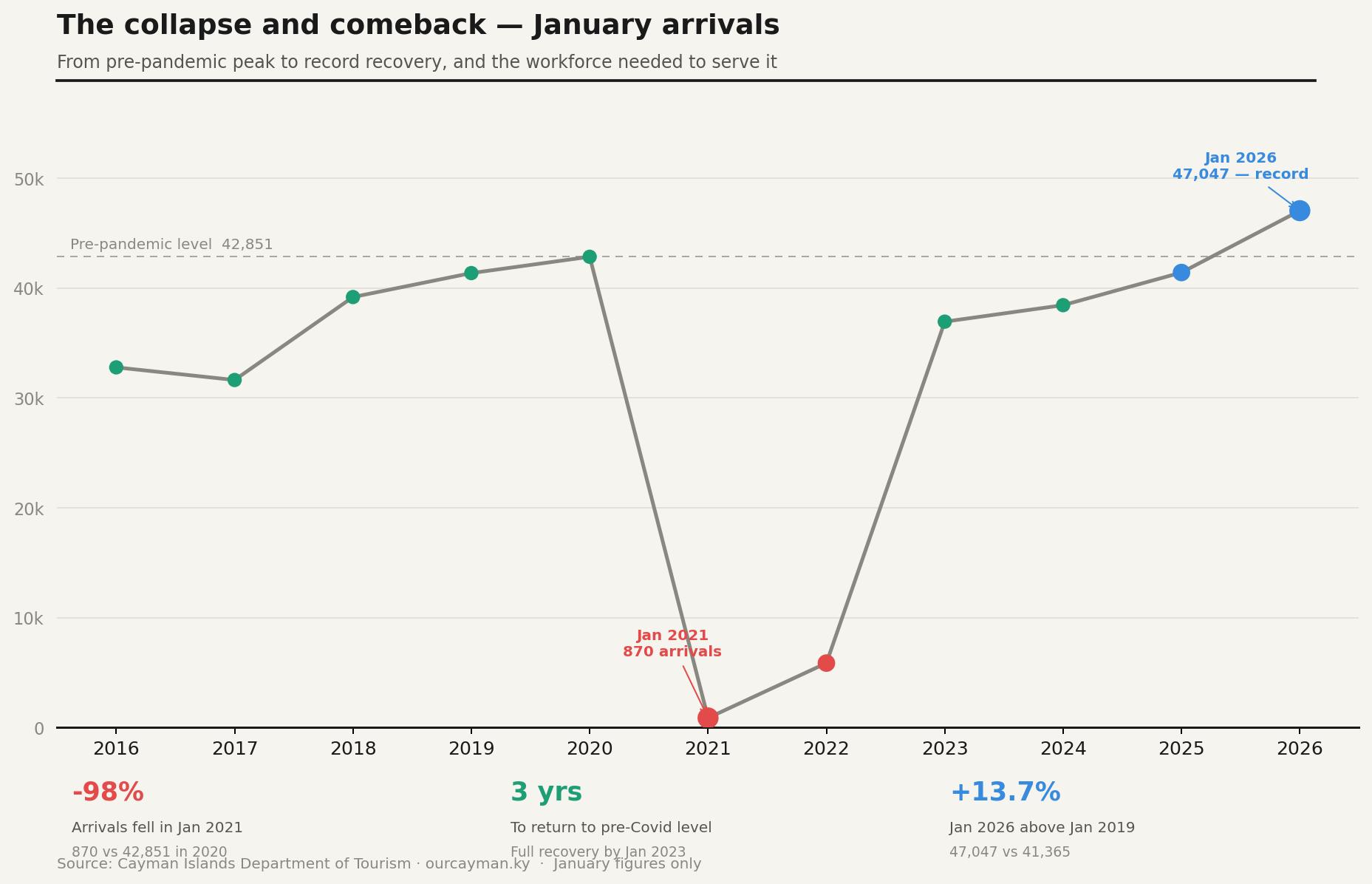
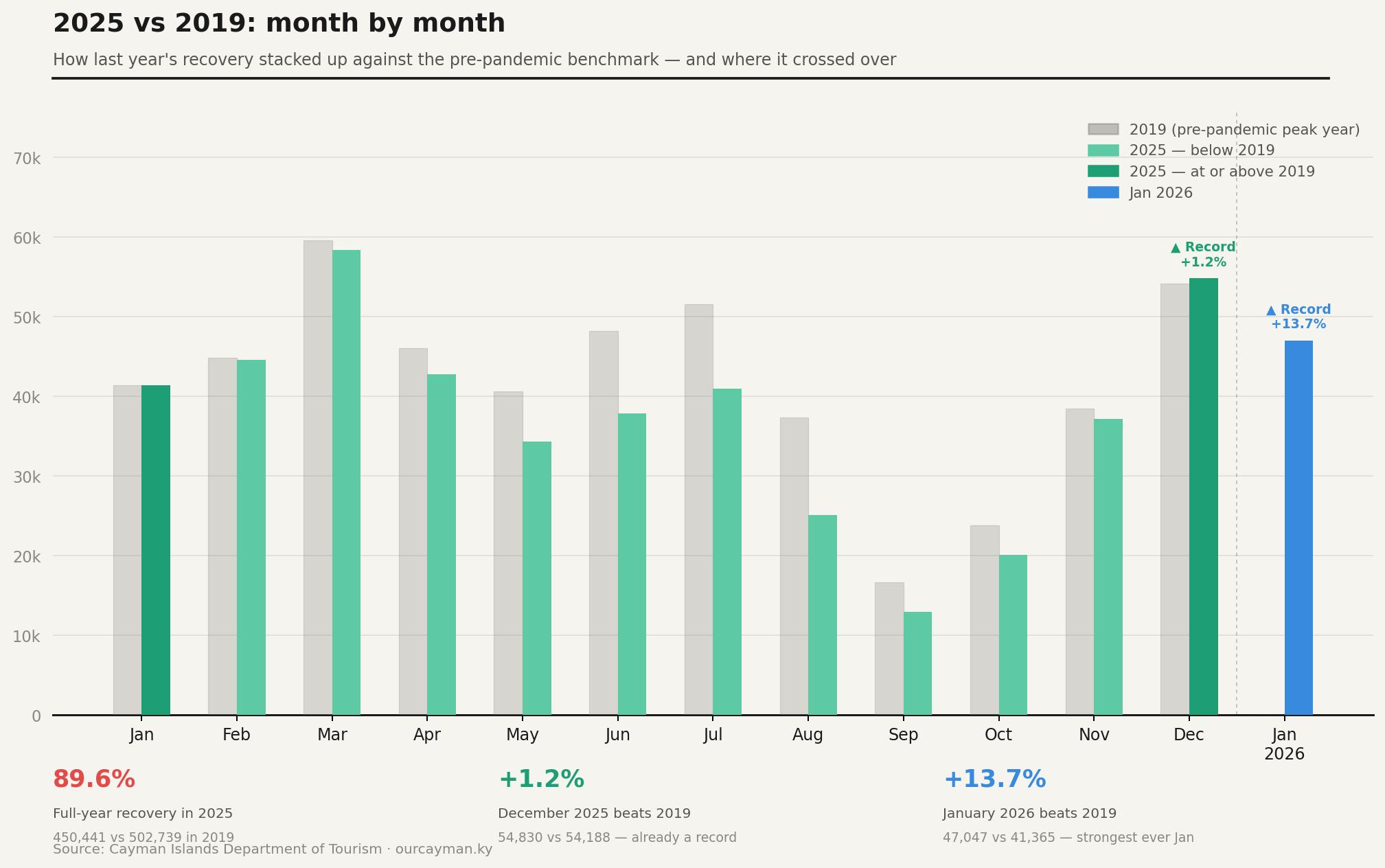
Arrivals reached a record high for January this year, and Cayman is on a pace to break pre-pandemic records in 2026.
The arrival of Indigo Hotel in 2025 and the opening of the Grand Hyatt and One|GT this are expected to add another 1,000 staff to the workforce, on top of the 2024 numbers. Add to that the opening of Jack’s on the Beach at the site of the old Royal Palms property and a string of new restaurants and bars, and the number of jobs created grows even further.
But that expansion is now colliding with the realities of labour supply.
Even if Caymanian participation in tourism had grown significantly, which many operators say it has not, the sector would still require additional workers simply to staff new hospitality businesses.
“It’s becoming a bit of a talent war between hospitality groups,” one recruiter said.
When new hotels open, employees often move from one property to another rather than expanding the overall workforce.
“Someone offers a dollar more an hour and suddenly you’re rebuilding your team again,” the recruiter said.
Business owners agree.
“Every time a new hotel opens, a percentage of employees leave to go there. That’s just the nature of the business,” said one restaurateur.
Some say the issue reflects a broader gap in economic planning.

“We plan the hotels and developments, but the human capital side of tourism doesn’t always seem to be part of that planning,” the recruiter said.
The result is a workforce market in which employers frequently compete for the same pool of available workers, while attempting to maintain consistent service standards.
Immigration delays adding to the strain
Compounding the staffing challenge are delays within the work-permit system, which businesses say have made recruitment more complicated and unpredictable.
Employers report that some permit approvals or internal promotion amendments can take months, and, in some cases, close to a year, to process.
Those delays can result in lost candidates, with workers accepting jobs in other jurisdictions rather than waiting for approvals. Hold-ups in processing title changes for promotions or shifting job titles can also create a domino effect, leaving key roles vacant when senior managers leave. In some instances, Caymanian staff in line for promotion have been unable to move up because the bureaucratic process of adjusting other permits in the chain slows the transition.
Government officials acknowledge the backlog and say steps are under way to improve processing times.
1,433 applications processed in 3 weeks
In response to questions from the Compass, the Ministry of Caymanian Employment and Immigration and the Workforce Opportunities and Residency Cayman department reported that 1,433 immigration applications had been processed within three weeks, including older cases dating back to last May.
Officials claim waiting times in some sectors have already dropped from roughly nine months to about two months, as additional staff have been brought in to address the backlog.
Immigration Minister Michael Myles said improving the system and strengthening the Caymanian workforce should not be seen as mutually exclusive.
“A well-functioning immigration system and a thriving Caymanian workforce are not competing goals. They are two sides of the same coin,” he said.
One immigration expert said policies aimed at increasing Caymanian hiring were “politically bulletproof”, but warned there could be long-term consequences if businesses could not access the labour they need.
Industry leaders broadly support the government’s goals, but stress that efficient permit processing remains essential for tourism businesses that experience high turnover and shifting seasonal demands. A particular point of frustration for employers is when they are asked to re-advertise positions after an initial job search did not attract Caymanian applicants.
Service expectations in a luxury market
For Cayman’s tourism industry, staffing challenges are not simply operational.
The Cayman Islands has positioned itself as a premium travel destination, where visitors expect exceptional service and personalised hospitality.
That reputation depends on having a well-trained workforce capable of delivering consistent service across hotels, restaurants and visitor experiences.
When businesses operate short staffed, operators say employees are placed under increased pressure, and the guest experience can suffer.
Over time, that can affect repeat visitation and the wider reputation of the destination.
“Hospitality is built on service, and delivering the level of experience our visitors expect requires the right people in the right roles,” said Cayman Islands Tourism Association President Sharlene Brenkus.
Brenkus said the industry remains committed to maintaining the standards that define Cayman’s tourism product while expanding opportunities for Caymanians within the sector.
But she also emphasised that businesses must be adequately staffed to operate effectively.
The Caymanian workforce pipeline
Beyond the work-permit backlog, industry leaders say a deeper issue remains unresolved when it comes to the pipeline of Caymanians entering tourism careers.
Despite job fairs, recruitment drives and workforce initiatives, many operators say the number of Caymanians choosing hospitality careers has not increased significantly in recent years.
Part of the challenge lies in long-standing perceptions of tourism work.
Some still view hospitality roles as “servitude” rather than a professional service industry offering long-term career opportunities.
Industry leaders say changing that perception will require sustained effort, particularly through education and training pathways.
There are already examples of programmes designed to connect Caymanians with tourism jobs, including the University College of the Cayman Islands’ hospitality programme and government initiatives linking jobseekers with employers.
But businesses say broader cultural change is needed, starting earlier in the education system.
“There are plenty of entry-level roles in hospitality,” one operator said. “The challenge is getting people to start in the industry and build a career.”
Tourism careers: Perception versus reality
For many in the industry, tourism’s image problem does not reflect the economic reality of the sector.
With high room rates and strong occupancy levels, employees in hospitality roles can earn significant income through gratuities and service charges.
In many cases, operators say the overall compensation package in hospitality can rival professional roles in the white-collar world.
But the nature of tourism work, including evening shifts, weekend schedules and seasonal fluctuations, often makes it less attractive compared with government or financial-services jobs offering more predictable hours.
One hotelier said they had trained several Caymanian staff, only to lose them to higher-paying roles for lower hours and better benefits with government.
That dynamic has contributed to a situation in which trained Caymanian hospitality workers are highly sought after.
Industry sources say experienced Caymanians with strong service records can often move easily between roles.
“The skilled Caymanian workers in the industry are always hired and can pretty much have any job they want if they have a strong track record,” one operator said.
The challenge, businesses say, is encouraging more young Caymanians to start in the industry and build careers over time.
A balancing act for the future
For now, tourism operators say they are managing the labour shortage through temporary permits, overtime and internal restructuring while hoping the backlog eases before the Easter rush.
But the long-term question of staffing Cayman’s tourism sector and ensuring local representation at the forefront of the industry remains a work in progress.
Tourism is one of Cayman’s most important economic pillars, supporting thousands of jobs and generating significant government revenue through visitor spending and industry taxes.
Ensuring the sector has the workforce it needs – both Caymanian and international – will require a careful balance between immigration policy, workforce development and economic planning.
Myles said, “I am committed to ensuring an effective and efficient immigration system that supports the labour needs of Cayman’s businesses.
“This is second only to my unwavering passion for ensuring every employable Caymanian has access to dignified and meaningful work.”
Mindset shift
Industry leaders say imported labour will likely remain an essential part of Cayman’s tourism economy simply because of the scale of the sector.
At the same time, many believe the long-term sustainability of the industry depends on building a stronger pipeline of Caymanians entering hospitality careers.
That effort, they argue, will require collaboration between government, educators and industry and must focus on shifting the image of hospitality work alongside building skill sets.
“We are fighting decades of ingrained perception that the tourism sector is all about servitude rather than service and hospitality,” said one hotelier. “You don’t change that mindset overnight.”
Related Videos












There is a very interesting quote in this article: One hotelier said they had trained several Caymanian staff, only to lose them to higher-paying roles for lower hours and better benefits with government. It’s true, very few Caymanians want to deal with the low pay and long hours that are required to work in tourism. So why do we keep trying to push them to work in this kind of environment. Why don’t we encourage them to work in sectors that pay well and have big opportunities like financial services, which provide a huge amount of money and support to our GDP? It’s always been like this and we continue to think that tourism is going to save Cayman. But it’s not… it does support approx 20% of our GDP, but it’s not what is going to sustain Cayman for years to come, not if 78% of the workforce is non-Caymanian.
Sadly financial services is dying due to this government in place. Billions of dollars have left over the last year and roles have been cut. It’s a lot to discuss.
What proportion of the cases dating back to last May were processed in 3 weeks from the end of May?
Why can’t Myles get his unemployed people and take them to the hotel for jobs????
I have applied to so many vacancies at; airport, cruise port, hotels for security, prisons and road department all of which I have so much experience, more than any Caymanian and I get an answer EVERY time that reads that they are only hiring Caymanian’s for said jobs. Then you look at each place and they show photos of the NEW hires of whom are NOT Caymanian. Cayman discriminates against age even though NO age limit is on the employment posting of said job b opening. Not sure if age is it or not but the prison had an opening that I applied for and never received a response as in the past that they received my application so I called and ignorant woman in Human Resources told me ,” you sound a little MATURE for the Entry Level Guard position”. I responded that there is no age limit posted and you are discriminating on age and in the US I could slap you with a lawsuit. I am qualified for that position as for the airport and cruise port as well. I never call out, never late, don’t drink and past baby bearing years and more physically fit than most your youngsters you hired and I wouldn’t be smuggling in ganja to the inmates like your islander whom you made a Supervisor! I wanted a work permit to work and retire there that’s all. But dependable and dedicated workers isn’t what KY wants.
Caymanians have very misguided ideas about employment. To have a strong government and country, the citizens must work, especially the areas that draw the most money. The hospitality industry is vital to all islands and countries. Without it there would not be a Cayman. Cayman depends on these local folks to step up and contribute to the tourist industry.