


At-a-glance:
- 37,000+ work permit holders now work in Cayman.
- Nepal is the fastest-growing nationality, with around 1,800 workers (5% of permits)
- Jamaica remains the largest source, with more than 13,000 workers
- Migration from Asia is rising, led by the Philippines, India and Nepal
- The share of workers from the UK, US and Canada is declining
Prayer flags flutter in the breeze outside the Steam & Spice food truck in George Town, where a small group of Nepali kitchen workers share a late lunch of chicken chatpatey and momo dumplings.
Between orders, Astha Khadka reminisces about the cool mountain air of her home in Kathmandu and the spectacular festival holidays that stretch on for days.
“What do I miss about home? Everything,” she says.
She came to Cayman to see a different part of the world and the transition to island life has been made easier by the welcome she has received.
“I feel all the Caymanian people are very nice,” says Khadka, who moved to the island three years ago. “Back home is a big city and we don’t say hi to strangers. We cross paths and we don’t say a word. Here, it’s important to greet people and say good morning.”
A handful of wooden tables sit on a raised platform around the truck and a guitar leans in the corner for customers to play. For workers spending long hours in restaurant kitchens and on construction sites, the food truck provides a taste of home and a social hub.
Along with Nepali Mart in Pasadora Place, the Real Deal bar on McField Square, an active social media group, the Everest FC football club and a newly formed community association, it is part of a small but visible network beginning to take root on the island.
Nepal barely appeared in Cayman’s labour statistics a decade ago. Today, it is the fastest-growing nationality group, with around 1,800 Nepalese citizens accounting for more than 5% of the islands’ 37,000 work permit holders.
Data analysis: Cayman’s labour force is evolving
The trend reflects a wider demographic shift over the past two decades. The emergence of a significant private healthcare industry, the development of large new hotels and restaurants, and the rapid growth of private security firms have contributed to demand for foreign labour.
Rising living costs and a more competitive global labour market have pushed employers to look further afield for both lower-wage service workers and highly skilled professionals, with recruitment from Asia and Africa increasing significantly.
An analysis of work-permit data by law firm HSM shows how dramatic that shift has been. Nepalese workers now outnumber those from Canada and the United States. The number of work-permit holders from the Philippines and India have more than doubled over the past decade to become the second and third highest represented nationalities, respectively, in the workforce.
In an update to clients, HSM wrote: “One of the most significant demographic shifts in the Cayman Islands’ expatriate workforce over the past decade has been the growing presence of workers from Asia, particularly from the Philippines, India and Nepal.”
It added: “The growth of the Nepalese workforce has been especially striking, expanding from a negligible presence a decade ago to one of the top nationalities by 2026.”
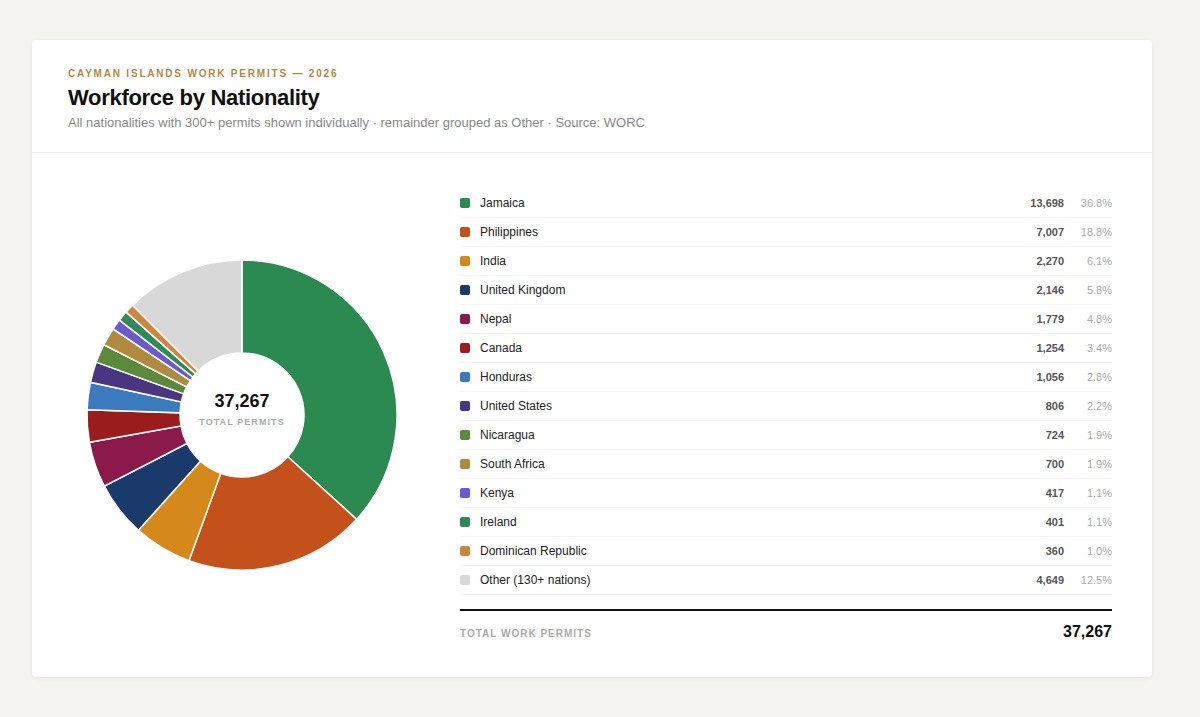
The report also highlighted the rapid increase in Indian migration to Cayman and the continued expansion of the Filipino community as part of broader global labour trends.
“The result is a workforce that is becoming more geographically diverse, which could lead to a change in the social and cultural landscape of the Cayman Islands.”
For decades, a handful of countries with regional or historic ties to the islands dominated Cayman’s workforce. Neighbouring Jamaica was, and remains, the single largest source of labour across multiple sectors of the economy.
Workers from the United Kingdom, Canada and the United States also featured consistently among the largest expatriate groups for much of the past half century. Some of the decline in numbers from those countries can be attributed to long-term work-permit holders becoming permanent residents. But the bigger picture shows fewer new immigrants from those countries coming to Cayman and an increasing trend of recruitment from Asia.
“The Filipino workforce globally has evolved significantly over the past generation,” said immigration attorney Alastair David, of HSM.

“Where, historically, many Filipino migrants worked in domestic or hospitality roles, today, they are just as likely to be nurses, accountants, managers or professionals in the financial sector,” he said.
“Nepal may now be filling some of the roles that Filipinos did 20 years ago – hospitality, domestic work and hotels.”
Economics driving recruitment from Asia and Africa
The reason for the shift is largely economic, according to recruiter Alan Brady.
“Employers are widening recruitment because traditional pipelines are tighter, more expensive and less mobile than they once were,” he said.
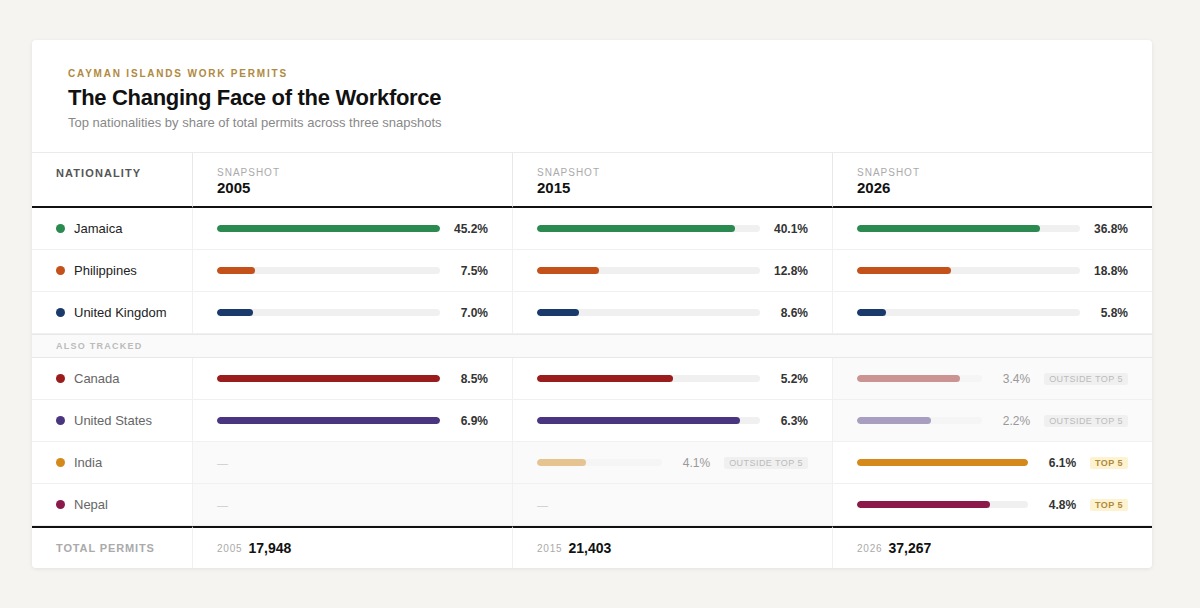
Rising living costs have made Cayman a less attractive proposition for many workers from the UK and United States, even with the islands’ tax advantages factored in.
“At the same time, Nepal, India, the Philippines, Kenya and South Africa offer reliable, scalable talent pools, from essential hospitality roles to highly qualified finance professionals,” added Brady, co-founder of Invenio Global.
Same trends impact white-collar world
The same forces reshaping kitchen and construction work are now visible in white-collar professions. In financial services, Cayman may increasingly be losing a talent competition for American and British professionals, who typically demand higher salaries.
Will Koutney, Finance Director and Head of Executive Search at CML Offshore recruitment, said “We’ve seen a shift away from the traditional recruitment markets like the UK, Ireland and Canada.
“More and more accountants and financial services professionals are now coming from sub-Saharan Africa, India and the Philippines.”
The United States’ economy remains strong, reducing the number of Americans looking overseas for work, and many British, New Zealand and Australian professionals are increasingly choosing places like Dubai.
Meanwhile, fewer young people in western countries are choosing accounting as a career. The same issues affect the Caymanian talent pool. While the islands produce a proportionately high number of accountants compared with similar-sized communities, the recruiter estimates there are only 10-15 qualified local candidates for every 100 jobs that come up.
Training programs in places like Kenya, Nigeria and Zimbabwe have improved and South Africa remains strong, creating a pipeline of well-trained accountants, eager to work in Cayman. There are 700 South Africans and 417 Kenyans in Cayman on permits in the 2026 data.
“[For] a guy in Kenya or the Philippines, if he could land a job here, it’s a game changer for his family, potentially for generations,” the Koutney said.
Firms still often prefer western hires for client-facing roles, he added, particularly when dealing with clients in major financial centres, such as New York or London.
But attracting those candidates has become more difficult.
To some extent, the trends are also shaped by Cayman’s immigration system.
The territory’s permanent residency points system awards points for diversity of nationality, encouraging a broad mix of workers rather than allowing any single group to dominate the workforce. Similarly, business staffing plans guard against firms over-recruiting from one nationality.
With Caymanians now in the minority in an increasingly international community, the intent of that framework was to preserve Cayman’s traditions from being overwhelmed by any particular culture.
Cultural shifts are taking place
Food, sports and faith are often the first markers of cultural change.
Americans brought Little League baseball. Jamaicans and Bajans brought cricket. Filipino migrants expanded the already vibrant basketball scene. Two teams largely made up of Nepali workers recently contested a volleyball final in Cayman.

Last weekend, the Holi festival brought a splash of vibrant Hindu culture to George Town.
For many Nepali workers, the biggest adjustment to life in Cayman is distance from family, friends and festivals.
“Dashain [festival] at home lasts for days,” Khadka said. “Here, everyone is working, so it is harder to celebrate.”
The next major event for the community will be celebrations for Nepali New Year, where organisers hope to showcase traditional music and folk dancing.
Solidarity in tragedy
Deepak Rokaha, a restaurant manager at the Guy Harvey’s Boathouse Grill on the George Town waterfront and secretary of the newly formed Nepali Community of Cayman Islands, said sharing Nepali culture with Caymanians is an important part of building a community.
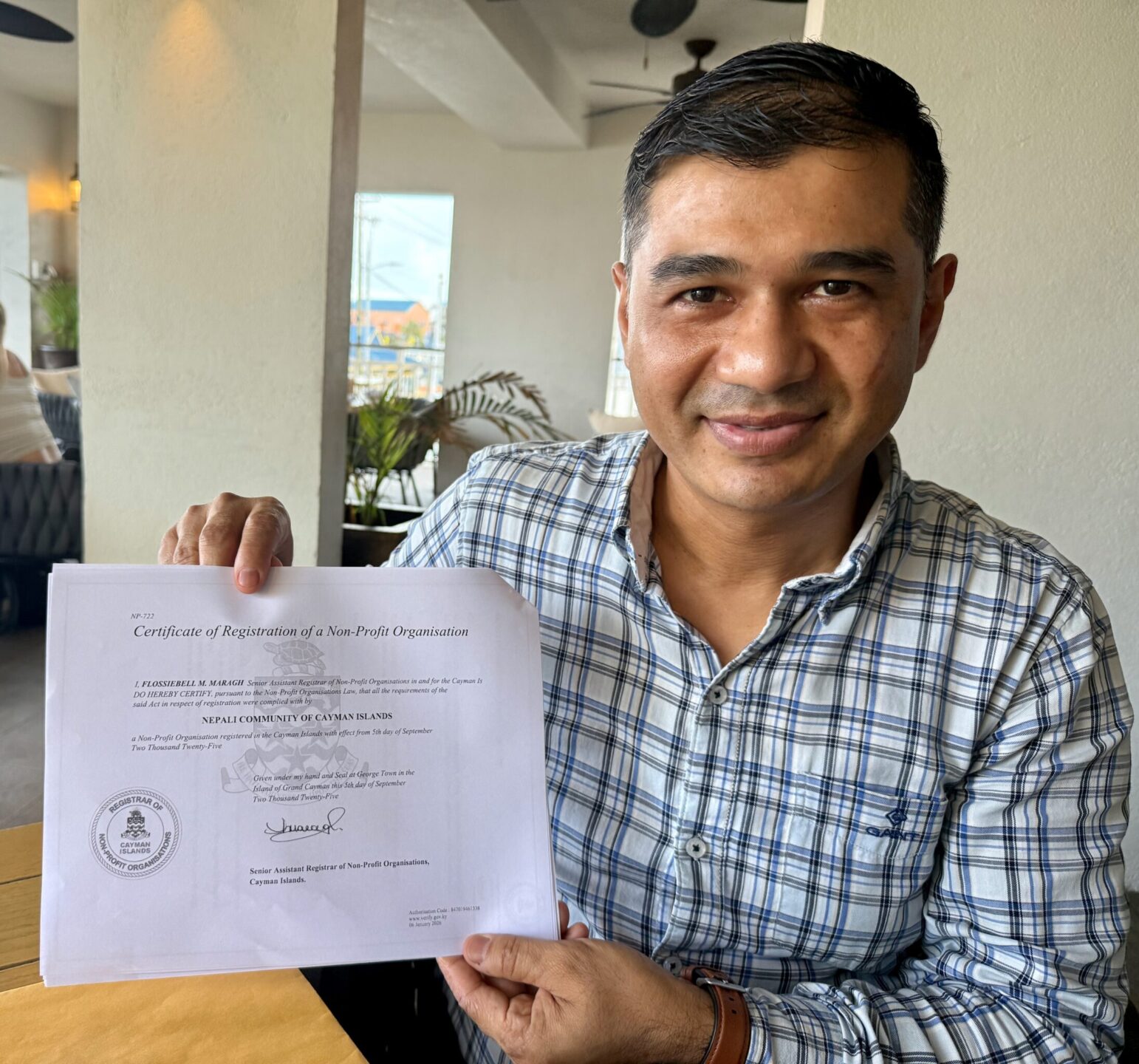
He proudly displayed the certificate of incorporation for the organisation, which grew out of informal WhatsApp groups where Nepali workers swapped advice on apartments, vehicles and jobs.
The association’s origins came out of tragedy. In December 2024, a 22-year-old janitorial worker, Tara Bahadur Shrestha, was killed in a road accident while cycling home from work.
The news spread quickly through the small Nepali community on the island. Many of the workers were recent arrivals, and Shrestha’s family back home had little financial support.
Within days, friends and acquaintances began organising collections and charity events to help.
“We collected a good amount of money – almost $35,000,” Rokaha said.
The funds were used to help return Shrestha’s body to Nepal and support his family with funeral costs. Since then, the informal network has grown into a more organised group, offering guidance to newcomers navigating life on the islands and a support network in times of need.
Cayman’s future and the global workforce
An undercurrent of tension remains around local employment and whether imported labour may suppress wages. When contemplating a minimum wage job, currently $8.75 an hour in Cayman, the economic calculation can be very different depending on where someone comes from.
For many migrant workers, saving even a few hundred dollars a month can transform the prospects of families thousands of miles away.
Rokaha knows that first-hand.
“When I first came here, I was able to send money home and eventually build my dream house for my family. It is a small home, but it is something we will always have,” he said.
Saving even small amounts on minimum wage salary in Cayman may seem improbable and Rokaha explained that many Nepalese live in close quarters with relatives or friends in small apartment to reduce rent and take overtime shifts at weekends to make it possible.
Employment tensions
In many lower-wage sectors, migrant labour fills roles that employers find difficult to staff locally, said Mushfiq Mobarak, an economist and professor at Yale University with family ties to Cayman.
But the presence of large numbers of low-income workers in a small expensive country can still create pressures.
“There’s some of that tension happening … if you’re bringing in people to fill low-wage jobs, Cayman is a very expensive place, and it becomes very difficult for them to live,” Mobarak said.
He believes some of the most significant economic tensions for Caymanians lie at the other end of the economy, where he sees a perception that access to higher-income jobs and professional opportunities is limited for local people.
Caribbean economist Marla Dukharan said the impact of immigration on Cayman’s economy is complex and often misunderstood, with the high GDP and relatively low levels of extreme poverty masking issues of economic inequality.
She said migrant workers are disproportionately represented in lower-paying jobs and often face higher levels of poverty and vulnerability. Meanwhile, an influx of higher-income expatriates and overseas investors can also push up the cost of housing and essentials for ordinary Caymanians.
With Cayman’s birth rate below replacement level and the economy continuing to grow, immigration is likely to remain central to the islands’ development. The challenge for policymakers, Dukharan said, is ensuring that economic growth benefits the local population while maintaining social cohesion in an increasingly diverse society.
Cayman’s population continues to evolve
Considering the tensions that exist over immigration and the speed of change in Cayman, which has grown from a fishing and seafaring community of fewer than 10,000 people in 1960 to a financial centre approaching 100,000 residents today, the islands remain relatively harmonious.
MP Chris Saunders made that point in Parliament earlier this month as legislators debated more changes to immigration legislation.
“Cayman’s success was never immigration; it was integration,” he said.
“People can come here, regardless of where they were born, and still contribute to this country, still add value and still become a part of our community. That is the Caymanian secret.
“Just about every single family in this island at some point now is integrated with people from all over the world. I dare you to find any place of 103 square miles with more than 140 nationalities living in peace and harmony.”
For Rokaha, that is the goal of the new community association – helping Nepali workers support each other and share their culture while contributing to the fabric of the community.
“I love Cayman,” he said. “That is the reason I’m here.”
After decades of change in Cayman and amid a raft of new immigration legislation, it is not clear how the islands will develop over the next 50 years. For the Nepalese, that future is already happening. The association’s first major event will be celebrations for Nepali New Year in April, the year 2083 in the Nepali calendar.
Related Videos













I just don’t understand why the Caymanians aren’t chomping at the bit for low wage jobs….
Ah yes, we are “entitled Caymanians” like our bumper stickers read.
Meanwhile, CIG depends so much on work permit revenues to fuel its continuous waste, it will never do anything to reduce the need for work permits.
Provide suitable education and vocational foundations for young Caymanians to take jobs across our economic spectrum? No! Diversify the economy? No! Discourage employers from importing workers as a first option? No!