

The Caribe Wave 2026 tsunami exercise on 19 March envisioned a familiar but sobering scenario: A powerful magnitude 7.6 earthquake occurs along the Swan Islands fault line, 130 miles to the south-southwest of Grand Cayman, a near repeat of the real 8 February 2025 event that triggered a regional tsunami alert.
In the simulation, waves between one to three feet reached Cayman’s shores in just 15 minutes.
That compressed timeline is the concern.
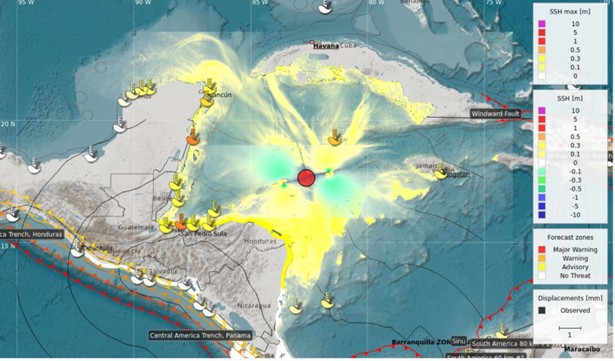
Hazard Management Cayman Islands activated the National Emergency Notification System, sending alerts to roughly 11,000 registered users, while also testing response procedures within the tourism sector, including evacuation readiness at the Hotel Indigo Grand Cayman and Kimpton Seafire Resort + Spa hotels.
But as in previous exercises, the drill exposed a persistent challenge: How does Hazard Management warn an entire country in minutes?
Despite an expanding toolkit, including social media, WhatsApp messaging, mass SMS text alerts, radio interrupt systems and the National Emergency Notification System, gaps remain. Numerous subscribers of the latter reported not receiving the audible alert on their mobile devices, with issues linked to required updates for the BlackBerry AtHoc app, which underpins the system.
The tsunami exercises are designed to identify exactly these weaknesses. Yet the scenario also underscored a deeper structural issue – one that technology alone may not solve.
Cayman’s population is now estimated at around 90,000, with an additional 20,000 visitors potentially on island at any given time through air arrivals and cruise tourism. Reaching that many people within a 15-minute window is not simply difficult, it may be unrealistic.
Hazard Management has acknowledged this limitation and is exploring what it describes as “Phase 3” of its alerting capability: cell broadcast technology, which would allow emergency messages to be pushed to all mobile devices within range of local towers, regardless of subscriptions or installed apps.
The system, already used in several countries, would represent a significant leap forward in coverage and reliability. HMCI Deputy Director Mark Codling said, “cell broadcast alerting is something we would like to implement and currently we are in the feasibility study stage”.
But even that may not fully close the gap.
Tsunamis generated close to the Cayman Islands, particularly along regional fault systems like the Swan Islands transform plate boundary line, offer very little lead time. In such cases, the earthquake itself may be the only warning people receive before wave arrival.
That reality shifts the focus from technology to behaviour.
The NOAA tsunami inundation modelling of the Cayman Islands showed that the risk from tsunamis in the Cayman Islands remains low, in part due to the underwater topography and small coastal shelf area, but it also showed that a very strong earthquake occurring directly south of the Cayman Islands on the transform plate boundary could result a tsunami wave impacting some coastal areas.

The probability of an event of that large of a magnitude, occurring directly south of the Cayman Islands is a low probability event, but it is still possible. However, unlike the scenario in the Caribe Wave exercise, an earthquake of this magnitude and proximity would certainly be felt by local residents and visitors.
Feeling an earthquake sends a direct message, and through public outreach and presentations, Hazard Management has emphasised a simple principle: “If you feel a strong or long earthquake near the coast, move immediately to higher ground or to the upper floors of strong buildings.”
The Caribe Wave exercise suggests that this principle may need to be more deeply embedded in Cayman’s public awareness strategy.
While the expectation of timely government alerts is important, there is a growing recognition that public safety cannot rely solely on receiving a message.
Hazard Management continues to strengthen partnerships across government and the private sector, with clearly defined plans and protocols. The inclusion of major hotels in this year’s exercise reflects a broader push to ensure that frontline tourism operators are part of the response network because visitors may outnumber residents in certain districts on any given day.
The exercise also highlighted a subtle shift in emphasis that may be required going forward. Rather than asking whether it is possible to notify everyone in time, the more practical question may be: How many people can act correctly without being told?
Because in a 15-minute scenario, there may not be time for anything else.
Editor’s note: Simon Boxall previously led communications for Hazard Management Cayman Islands and helped write the national tsunami response plan. He was listed as the designated tsunami scientific advisor for the Cayman Islands by a UNESCO commission.
Related Videos







Well i have suggested that its nice
To have the push notice on phones
But we need another system that will get to everyone and that is the mega speaker system install on the light poles
Its simple to install wont cost alot money
But very effective at a push of a button
Every one will hear that sound go off and know what it means this would be very effective in the 7mile beach area where theres lots tourist at any given time