

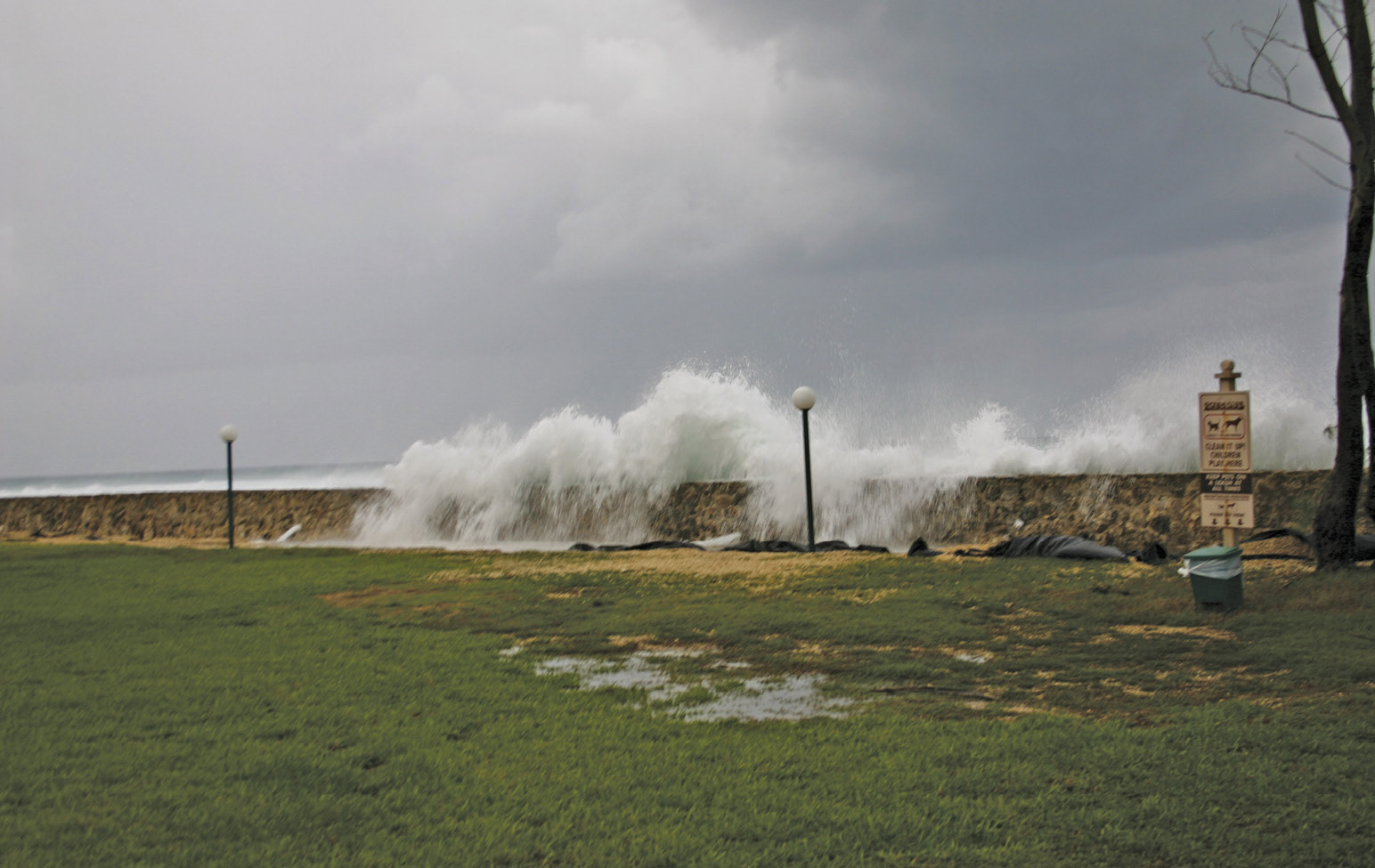
Following Saturday’s 7.6 magnitude earthquake and subsequent tsunami alert, one of the public statements repeated by regional and local experts has been that residents should better understand the risk posed by tsunamis.
For Cayman, mitigating the tsunami danger will involve mapping efforts, public education and getting the islands’ tsunami sensor back in operation.
On Radio Cayman’s ‘For the Record’ on Monday morning, Hazard Management Cayman Islands Director Dani Coleman called for residents to “understand and be aware of their tsunami risk, especially in the context of where they live or work and if they have children, where their children go to school”.
The HMCI director elaborated on the topic to the Cayman Compass and explained, “The department is working to make the information from the tsunami inundation model available to residents, so they can make informed decisions about where to go and how to react in the event of a tsunami threat.”
She said, fortunately, the lack of a wide continental shelf area offshore means the Cayman Islands is naturally well protected from tsunamis.
“However, out of the scenarios that were modelled, we now know from the scientific data that a tsunami is possible for a very large earthquake event occurring in close proximity to the Cayman Islands,” she said.
“While the probability of this type of event happening in our lifetime is very low, a tsunami wave could affect our coastal areas.”
Even in the worst case scenario, she said the impacts would be less detrimental than, for example, the Boxing Day tsunami that devastated coastal communities in the Indian Ocean in 2004. In the event of a major earthquake near Cayman, waves would only be expected to travel a short distance inland.
To help better inform the community on the risk, HMCI is engaged in the regional ‘Tsunami Ready‘ communities programme, expected to be released later this year as part of mitigation efforts.
“Tsunami hazard maps are being developed to assess risk exposure, guide emergency response planning and enhance community preparedness in vulnerable coastal areas,” Coleman said.
Diego Arcas from the NOAA Center for Tsunami Research, who produced the Cayman Islands tsunami model in 2023, stated on government’s CIG News, “The study that we have conducted is part of a bigger programme to make communities ‘Tsunami Ready’.”
He added, “We are conducting this investigation so that evacuation maps, showing the risks of tsunamis, can be designed and shared with the community.”
Tsunami sensor not functional
Following the earthquake on Saturday night, the Cayman Islands was unable to confirm if a tsunami had been experienced locally because the sea-level monitoring station located in George Town Harbour was not working.
This tsunami sensor in George Town is part of a wider, regional alerting mechanism that provides an early warning system to regional countries if a tsunami wave is detected in the Cayman area.
Once a tsunami wave is picked up on the local station, other countries use the data to make decisions and take appropriate public safety actions based on the threat recorded on the sensor. The Cayman Islands similarly benefits from other sensors in the regional network.
On the subject of the non-functional UNESCO-funded tsunami sensor, John Tibbetts, director general of the Cayman Islands National Weather Service, could not say for certain when it would be functioning again.
He said, “Work is already underway to address the topic of sensors more broadly, and it is possible that responsibility for upkeep and maintenance would move to the National Weather Service”, as indicated in legislation.
He did not specify who currently had responsibility for the sensor.
The National Weather Service is currently “the recognized authority for all seismic matters in the Islands”, under the National Weather Service Act, and their functions include “establishing and maintaining a national network of seismic stations”.
Under their list of functions, the Cayman Islands National Weather Service is also tasked with issuing tsunami warnings.
“That is actually a duplication under the law,” Tibbetts said.
“The responsibility also falls to Hazard Management Cayman Islands under their legislation, the Disaster Preparedness and Hazard Management Act, and so we are looking at this issue to determine who is best suited to provide the tsunami alert messaging.”
He added, “It is possible that responsibility will come across to the National Weather Service when the department goes 24/7 later in the year, but that is yet to be determined.
“Staffing is presently an issue. … We recently hired one forecaster and another is due to be hired. We are also hoping to add a few observers and that will provide more capacity to deliver on additional responsibilities.”
Related Videos








Clearly nobody is taking responsibility for the tsunami sensor. As a result nobody has a clue as to how long it has been inoperative. The latest undersea earthquake highlights the need for this equipment. Instead of tossing a coin, the public deserve a prompt decision on responsibility, along with immediate repairs to the sensor.