
Following a request from Cabinet, the Law Reform Commission is reviewing Cayman’s legislation on spent convictions, to help address rehabilitation and employability of offenders.
The Law Reform Commission, in a discussion paper, said the review of the Criminal Records (Spent Convictions) Act was prompted by “difficulties in administering the Act, anomalies within the legislation, and the need to develop a fair, efficient and clear framework that balances rehabilitation of offenders with public protection”.
Unlike an ‘expunged’ conviction, which effectively gives the offender a clean slate, a spent conviction remains on the record, but is sealed for most purposes, so that after the sentence and crime-free period are completed, the person is not required to disclose it, unless for the purposes of public safety or due to the nature of the person’s role or profession.
The Law Reform Commission, in its review, noted that the existing regime is “cumbersome, internally inconsistent and burdened by anomalies”, and “does not operate in the best interests of offenders, administrators or the community”.
It says that, rather than attempting to fix the scheme by way of numerous amendments to the act, it favours repealing the law and replacing it with a “streamlined scheme”. It has outlined a series of recommendations and is inviting the public to provide feedback on these.
In its discussion paper, the commission states that checks on criminal records can “indirectly extend the punishment imposed on an offender by limiting their ability to gain employment, hold licences, be admitted to professions or appointed to certain offices, long after they have completed their sentence”.
It added, “This can significantly impact an offender’s prospects of rehabilitation and increase the likelihood of re-offending, which carries significant social and economic costs.”
Employment a key factor in rehabilitation
Addressing the issue of young offenders, the commission pointed out they are less likely to re-offend as they age “if they are provided with the right conditions for rehabilitation, such as the ability to be employed”.
It also noted, “While employment is a key factor in rehabilitation, a criminal record significantly hampers prospects for employment.”
The commission recommended a simplified scale of crime-free period based on the sentences imposed, as outlined in this table below:
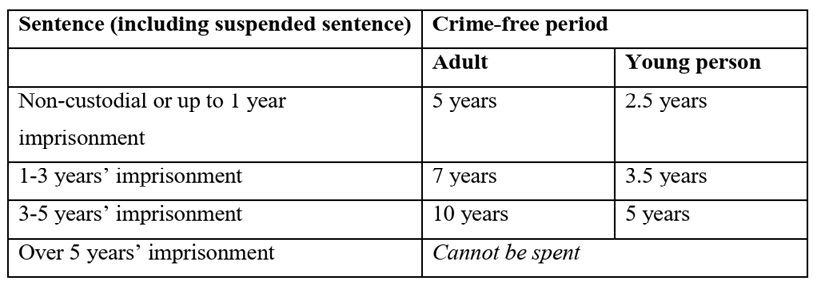
The Law Reform Commission recommends that an automatic scheme be adopted, where a conviction is automatically spent on completion of a specified crime-free period and in which it is assumed that the offender is rehabilitated without undertaking an assessment.
“An automatic scheme is easier to administer and less resource-intensive than one that requires an application process. It also provides an objective standard that an offender must meet,” the commission said.
It noted that a hybrid approach would provide for most convictions to be automatically spent, but reserve an application process for more serious offences, an approach already taken under the existing legislation. With some exceptions, such as minor marijuana offences, convictions carrying a term of imprisonment not exceeding five years are eligible for automatic expungement.
The commission recommends that several offences be excluded, include murder, manslaughter, rape and attempted rape, indecent assault, gross indecency, sexual assault of a mentally impaired person, wounding or causing grievous bodily harm, firearm offences, child pornography and child sex offences, and importing, exporting or producing controlled drugs.
In its discussion paper, the Commission outlined five questions to be considered. They are:
- Should the spent convictions scheme be generally self-executing, so that eligible convictions become spent automatically on completion of the relevant crime-free period?
- Should complete expungement of some convictions be permitted, so there is no requirement for disclosure of such offences?
- Do you agree with the crime-free periods proposed by the Commission? (See table above)
- Do you agree with the sentence limit of five years’ imprisonment proposed by the Commission?
- Do you agree with the proposed list of excluded offences that are not eligible to be spent?
Those wishing to submit feedback on the discussion paper should forward submissions by 27 June 2026 to the Director of the Law Reform Commission, 5th Floor Government Administration Building, Portfolio of Legal Affairs, 133 Elgin Avenue, George Town, Grand Cayman, P.O. Box 136, Grand Cayman KY1-9000 in writing, by post or hand delivered, or via email to [email protected].
Click here to view the discussion paper.
Related Videos